
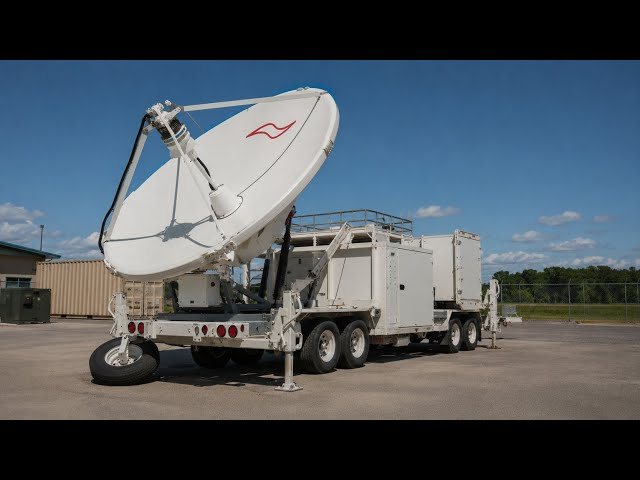
The U.S. Space Force has introduced a new electromagnetic warfare system called Meadowlands, a mobile platform designed to disrupt communications between enemy satellites and ground forces without physically damaging the spacecraft. The capability marks another step in the growing militarization of space, where countries increasingly view satellites as strategic military assets rather than just tools for communications and navigation.
While the system has sparked headlines about a possible “space war,” defense experts note that Meadowlands is designed as a non-kinetic weapon—one that disables or interferes with signals instead of destroying satellites. As military operations become more dependent on space-based infrastructure, electronic warfare is emerging as a critical component of modern conflict.
What is Meadowlands?
Meadowlands is an electromagnetic warfare system developed by defense contractor L3Harris for the U.S. Space Force.
Rather than attacking satellites with missiles or lasers, the system targets the radio-frequency links that allow satellites to communicate with operators and military forces on Earth.
Its primary mission is to:
- Jam satellite communications
- Disrupt data transmission
- Deny adversaries access to satellite networks
- Support military operations through electronic warfare
The U.S. Space Force has described Meadowlands as part of a “robust toolkit for spectrum dominance.”
How does Meadowlands work?
Meadowlands is a mobile ground-based system built around a large directional antenna mounted on a transportable trailer.
The platform can be:
- Transported by road
- Airlifted using military cargo aircraft
- Rapidly deployed near operational areas
Once activated, it transmits powerful electromagnetic signals designed to interfere with communications between satellites and ground stations.
Instead of damaging the satellite itself, Meadowlands interrupts the flow of information, making it difficult for adversaries to exchange commands, intelligence, or surveillance data.
What does “non-kinetic” mean?
Military analysts distinguish between kinetic and non-kinetic weapons.
Kinetic weapons
These physically destroy or damage targets using force, such as:
- Missiles
- Projectiles
- Explosive interceptors
Non-kinetic weapons
These disable systems without physical destruction by using:
- Electronic jamming
- Cyber operations
- Directed energy
- Electromagnetic interference
Meadowlands falls into the second category.
Because it does not create orbital debris by destroying satellites, electronic warfare is generally viewed as a less destructive—but still strategically significant—form of space conflict.
Why are satellites becoming military targets?
Modern armed forces rely heavily on satellites for:
- Communications
- GPS navigation
- Intelligence gathering
- Missile warning
- Weather forecasting
- Battlefield coordination
Disrupting these services can significantly reduce an opponent’s operational effectiveness without launching a traditional military strike.
As a result, many countries are investing in technologies that can temporarily disable satellite capabilities during conflict.
How does Meadowlands fit into U.S. military strategy?
The system reflects the U.S. government’s growing emphasis on treating space as an operational military domain.
President Donald Trump has repeatedly emphasized the importance of achieving “space superiority,” and the Space Force has expanded investments in capabilities designed to protect U.S. space assets while countering those of potential adversaries.
According to the Space Force, electromagnetic warfare has become an increasingly important element of modern military operations.
Has the U.S. used similar capabilities before?
According to the Space Force, electromagnetic warfare capabilities were employed during Operation Midnight Hammer in June 2025.
The agency stated that electronic warfare units helped establish a communications “silence zone” that protected U.S. bomber operations by disrupting adversary communications and improving situational awareness.
Officials also said similar non-kinetic capabilities were used during the opening stages of Operation Epic Fury, where they reportedly disrupted Iranian air defense sensors and military communications networks.
These statements reflect the U.S. military’s description of the operations.
Why is electromagnetic warfare becoming more important?
Future conflicts are expected to involve heavy competition across the electromagnetic spectrum.
Rather than relying solely on traditional weapons, militaries increasingly seek to:
- Deny enemy communications
- Protect friendly networks
- Disrupt surveillance systems
- Reduce dependence on physical attacks
Electronic warfare offers several potential advantages:
- Immediate effects
- Reduced physical destruction
- Lower risk of creating orbital debris
- Greater operational flexibility
Does this mean space warfare has already begun?
Not necessarily.
Military analysts generally distinguish between:
- Militarization of space, where satellites support military operations.
- Weaponization of space, where systems directly attack or interfere with space assets.
Electronic warfare systems like Meadowlands blur that distinction because they target space-based communications without physically attacking satellites.
Many nations—including the United States, China, and Russia—have invested in counter-space capabilities ranging from cyber operations to electronic jamming and anti-satellite technologies.
What challenges could electronic warfare create?
While non-kinetic systems avoid physical destruction, they may still pose significant operational risks.
Potential consequences include:
- Loss of communications
- GPS disruptions
- Reduced intelligence capabilities
- Interference with military coordination
Because many civilian services also depend on satellites, prolonged disruptions could indirectly affect transportation, emergency response, financial systems, and telecommunications.
Why this matters
Space has become an essential component of modern military operations.
As governments invest more heavily in protecting and contesting access to satellite networks, electronic warfare systems such as Meadowlands are likely to play an increasingly important role.
Rather than signaling an immediate “space war,” the system illustrates how future conflicts may focus less on destroying satellites and more on disrupting the information they provide.
TL;DR
- The U.S. Space Force has introduced Meadowlands, a mobile electromagnetic warfare system developed by L3Harris.
- The system jams satellite communications instead of physically destroying satellites.
- Meadowlands is designed to support military operations by disrupting enemy communications and data links.
- Electronic warfare is becoming a key component of modern military strategy because it can disable capabilities without creating orbital debris.
- The growing reliance on satellites means protecting—and disrupting—space-based communications is becoming increasingly important.