


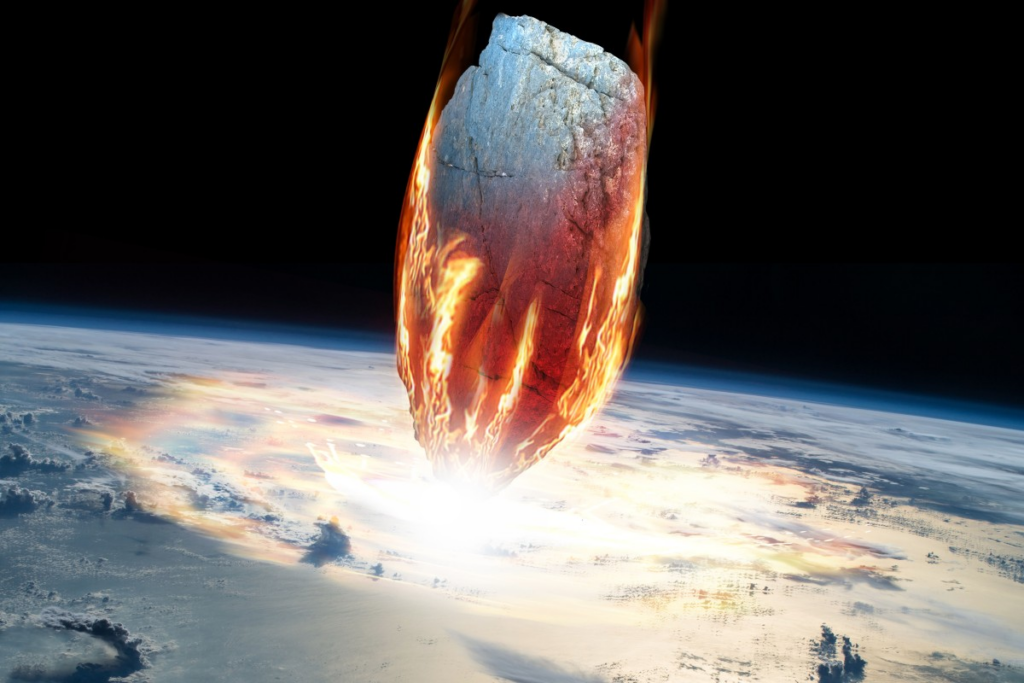
For decades, scientists have debated the best way to stop a large asteroid from colliding with Earth. The most common idea has been to strike it with a nuclear explosion near or on its surface. Now, a new study by Chinese researchers suggests there may be a far more effective approach: dig first, detonate later.
The team, led by Xiaowei Wang from the China Academy of Launch Vehicle Technology, proposed a method, known as pre-excavation detonation, that calls for creating a deep crater in an asteroid before placing a nuclear device inside it. According to the researchers, this strategy could dramatically increase the amount of energy transferred into the asteroid, making it more effective at destroying or deflecting dangerous space rocks.
What is the pre-excavation detonation strategy?
Instead of detonating a nuclear device on an asteroid’s surface, the researchers propose a two-step mission.
Step 1: Create a deep crater
A spacecraft would first impact or excavate the asteroid to form a deep cavity.
Step 2: Place a nuclear device inside
A nuclear payload would then be positioned within that crater before detonation.
The idea is similar to underground explosions on Earth, where surrounding material contains and directs more of the blast energy instead of allowing it to disperse into open space.
The researchers argue that this approach could significantly improve the effectiveness of asteroid defense missions, particularly when response time is limited.
Why isn’t exploding a nuclear bomb on the surface enough?
Traditional concepts assume that detonating a nuclear device close to an asteroid would either:
- Push it off course
- Break it apart
- Vaporize portions of its surface
However, much of the explosive energy escapes into space.
The problem with surface detonations
In the vacuum of space:
- Blast waves do not behave like they do in Earth’s atmosphere.
- A large portion of the energy radiates away.
- Only part of the explosion is transferred into the asteroid itself.
By placing the device inside a crater, more energy is absorbed by the asteroid, potentially producing a much stronger deflection or fragmentation effect.
What did the researchers find?
The study compared two different approaches.
Surface detonation
This method creates a relatively shallow crater before or during the explosion.
Advantages:
- Simpler mission design
- Faster deployment
Limitations:
- Lower energy transfer
- Reduced effectiveness against larger asteroids
Deep detonation
The proposed pre-excavation strategy:
- Creates a deeper cavity first
- Places the nuclear device below the surface
- Maximizes the force directed into the asteroid
According to the simulations, the deep-detonation method consistently outperformed surface explosions when dealing with larger asteroids.
What size asteroid is this designed for?
The researchers focused on asteroids roughly 330 feet (about 100 meters) in diameter.
Objects of this size:
- Are capable of causing regional devastation
- Can release energy many times greater than nuclear weapons if they strike Earth
- Are too large for many traditional deflection techniques if discovered late
For smaller asteroids, the study suggests the same technique could simply push them onto a safer trajectory rather than completely destroying them.
How was the strategy tested?
The proposal was evaluated through computer simulations rather than physical experiments.
Researchers examined variables including:
- Launch vehicle energy
- Spacecraft impact speed
- Asteroid velocity changes
- Different warning times ranging from one to twenty years
The simulations used a virtual database of potential threat asteroids to estimate mission performance under different scenarios.
Would this work on every asteroid?
Probably not.
One of the biggest uncertainties is asteroid composition.
Different asteroids behave differently
Some asteroids are:
- Dense metallic bodies
- Solid rocky objects
- “Rubble piles” made of loosely bound debris
A rubble-pile asteroid may absorb explosive energy very differently from a solid rock.
Mission planners would first need to determine:
- Density
- Internal structure
- Surface composition
- Rotation speed
before selecting an appropriate deflection strategy.
What about the debris?
This remains one of the biggest unanswered questions.
Destroying an asteroid could create hundreds—or thousands—of fragments.
Potential risks
If those fragments remain on a collision course with Earth:
- Multiple impacts could occur.
- Some debris could survive atmospheric entry.
- The overall threat might be reduced—or potentially redistributed.
The study reportedly does not fully address how fragmentation debris would behave after detonation.
This is one reason many planetary defense experts often prefer deflecting an asteroid rather than completely destroying it whenever sufficient warning time exists.
How does this compare with NASA’s DART mission?
The proposed strategy differs significantly from Double Asteroid Redirection Test.
DART
- Used a kinetic impactor
- Relied on momentum transfer
- Successfully altered an asteroid’s orbit without explosives
Chinese proposal
- Uses nuclear technology
- Designed for larger or more urgent threats
- Intended for situations where kinetic impact alone may not be sufficient
The two approaches could complement one another depending on:
- Asteroid size
- Warning time
- Composition
Could this ever be used in a real emergency?
Possibly—but only under extraordinary circumstances.
Any nuclear mission in space would require:
- International cooperation
- Extensive safety reviews
- Technical validation
- Political approval
Existing international treaties also place restrictions on nuclear weapons in outer space, although emergency planetary defense scenarios present unique legal and policy questions.
Why this research matters
The study reflects a broader shift in planetary defense planning.
Rather than assuming one solution fits every asteroid, scientists are increasingly exploring:
- Kinetic impactors
- Gravity tractors
- Laser deflection
- Nuclear options
- Hybrid approaches like pre-excavation detonation
As asteroid detection systems improve, having multiple response strategies could become increasingly important.
TL;DR
- Chinese researchers propose burying a nuclear device inside an asteroid rather than detonating it on the surface.
- Their “pre-excavation detonation” method aims to transfer more explosive energy into the asteroid.
- Computer simulations suggest the approach is more effective against asteroids around 330 feet in diameter.
- The strategy still faces major questions, including how different asteroid compositions would respond and whether dangerous debris could be created.
- The proposal adds another potential option to the growing field of planetary defense research.