
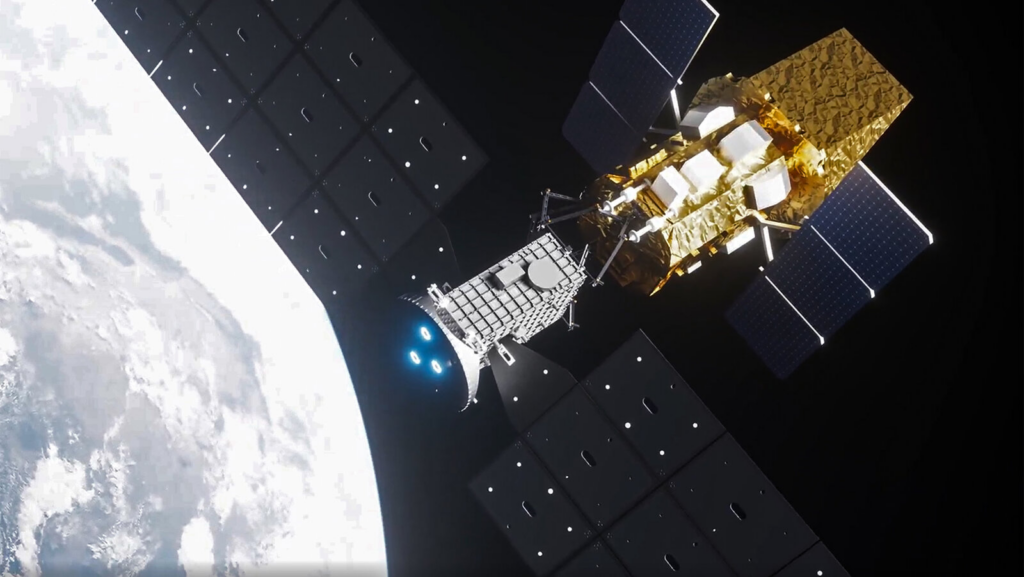
NASA has launched an unprecedented space rescue mission aimed at extending the life of one of its most productive observatories. The agency’s new LINK spacecraft is designed to rendezvous with the 22-year-old Neil Gehrels Swift Observatory, capture it using robotic arms, and lift it into a higher orbit before atmospheric drag forces it to re-enter Earth’s atmosphere.
If successful, the mission would mark the first time a space agency has used a robotic spacecraft to physically capture and reboost an aging scientific observatory already in orbit, potentially opening a new era in satellite servicing and space sustainability.
Why is NASA trying to rescue the Swift Observatory?
Most satellites nearing the end of their operational lives are allowed to re-enter Earth’s atmosphere, where they burn up safely.
Swift is different.
For more than two decades, the Neil Gehrels Swift Observatory has played a crucial role in detecting some of the universe’s most energetic and short-lived events, including gamma-ray bursts, exploding stars, and collisions involving neutron stars.
Because these events occur unexpectedly and often last only seconds or minutes, Swift has become one of astronomy’s fastest-response observatories.
Rather than replacing the spacecraft immediately, NASA decided preserving its scientific capabilities would provide greater value.
Why is Swift falling toward Earth?
Swift launched in 2004 into an orbit approximately 600 kilometers (373 miles) above Earth.
Since then, atmospheric drag has gradually reduced its altitude to around 360 kilometers (224 miles).
Although space is often described as a vacuum, Earth’s atmosphere extends much farther than many people realize.
Even at several hundred kilometers above the surface, tiny atmospheric particles create drag that slowly reduces a spacecraft’s speed and lowers its orbit.
The process has accelerated during the current solar maximum.
How does solar activity affect satellites?
During periods of intense solar activity:
- The Sun heats Earth’s upper atmosphere.
- The atmosphere expands to higher altitudes.
- Satellites experience increased atmospheric drag.
- Orbit decay accelerates.
Scientists say much of Swift’s recent orbital decline has occurred over the past two years as solar activity intensified.
What is the LINK spacecraft?
LINK is a robotic servicing spacecraft developed specifically to perform an orbital rescue mission.
Its primary objective is to rendezvous with Swift, inspect it, securely capture it, and gradually raise it into a safer orbit where atmospheric drag is significantly weaker.
According to NASA, the spacecraft includes:
- Three robotic capture arms.
- Precision cameras.
- Autonomous guidance and navigation systems.
- Small maneuvering thrusters for delicate orbital adjustments.
The mission represents one of the most ambitious demonstrations of robotic satellite servicing attempted by a civilian space agency.
How will LINK rescue Swift?
The operation will unfold in several stages.
Phase 1: Spacecraft checkout
Following launch, LINK will spend several weeks activating and testing its onboard systems to ensure every component is functioning properly.
Phase 2: Rendezvous
Although the launch vehicle placed LINK into an orbit close to Swift, the spacecraft must slowly adjust its trajectory over several weeks until it reaches the observatory.
Phase 3: Inspection
Before attempting capture, LINK will circle Swift and photograph it from multiple angles.
These images will help engineers verify the spacecraft’s condition and plan the safest capture approach.
Phase 4: Capture
Using its three robotic arms, LINK will gently secure the observatory.
Unlike docking with spacecraft designed for servicing, Swift was never built to be captured in orbit, making this one of the mission’s greatest engineering challenges.
Phase 5: Orbit raising
Once attached, LINK will gradually fire its thrusters over several months to move Swift into a higher, more stable orbit.
The entire operation is expected to take between three and four months.
Why is Swift so important?
The Neil Gehrels Swift Observatory carries three scientific instruments that work together to study some of the universe’s most energetic events.
Its primary mission is detecting gamma-ray bursts, which are among the brightest explosions known.
Swift can rapidly locate these bursts and immediately point its telescopes toward them, allowing astronomers around the world to conduct follow-up observations.
The observatory also studies:
- Supernova explosions.
- Neutron star mergers.
- Black holes.
- Active galaxies.
- Other high-energy cosmic phenomena.
Its ability to react within minutes has made it one of NASA’s most valuable astronomical observatories.
Who built the LINK mission?
NASA awarded the rescue mission to Katalyst Space Technologies, which faced an unusually compressed development schedule.
According to company CEO Ghonhee Lee, engineers had less than a year to design, build, test, and integrate the spacecraft before Swift’s orbit declined to a point where recovery would become increasingly difficult.
The company reportedly completed the spacecraft in just eight months, highlighting rapid advances in commercial satellite servicing technologies.
Why does this mission matter beyond Swift?
If successful, LINK could demonstrate that aging satellites no longer need to become space debris or be abandoned when their fuel runs low.
Future robotic servicing missions could:
- Extend satellite lifespans.
- Reduce space debris.
- Save billions of dollars by avoiding replacement missions.
- Upgrade spacecraft already in orbit.
- Improve sustainability in Earth’s increasingly crowded orbital environment.
Many experts believe satellite servicing will become a major part of future space operations as governments and private companies launch thousands of additional spacecraft.
The bigger picture
NASA’s LINK mission is about far more than saving a single observatory.
It is testing whether robotic spacecraft can safely capture and reposition satellites that were never designed for servicing, potentially transforming how future missions are managed.
If LINK successfully raises the Neil Gehrels Swift Observatory into a higher orbit, it will not only extend the life of a telescope that has revolutionized high-energy astronomy but also demonstrate a technology that could reshape satellite maintenance, reduce orbital waste, and make future space missions more sustainable.
TL;DR
- NASA has launched the LINK spacecraft to rescue the Neil Gehrels Swift Observatory.
- Swift’s orbit has decayed from about 600 km in 2004 to roughly 360 km due to atmospheric drag.
- LINK will use three robotic arms to capture the observatory and move it into a higher orbit.
- The rescue operation is expected to take several months.
- NASA hopes to extend Swift’s scientific mission, which studies gamma-ray bursts and other powerful cosmic explosions.