
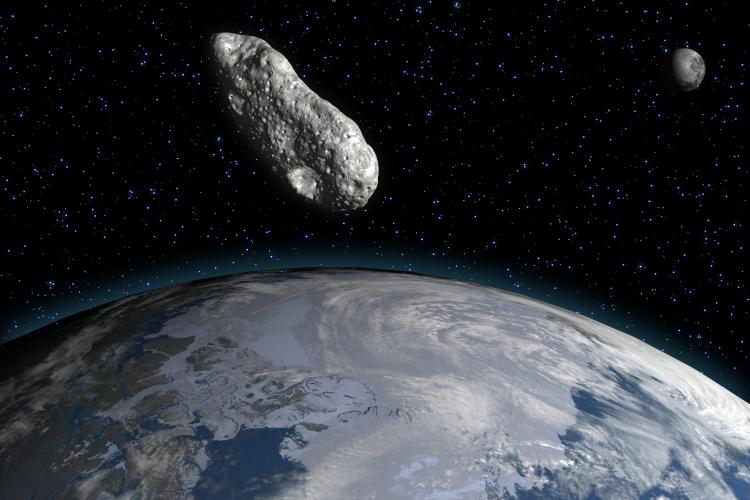
In March 1989, Earth narrowly avoided what scientists describe as one of the most alarming asteroid near-misses ever recorded. The object, known as asteroid 4581 Asclepius, crossed Earth’s orbital path at almost the same point where our planet had been just six hours earlier.
At the time, nobody knew it had happened.
Astronomers only discovered the asteroid nine days after the close encounter, highlighting a major blind spot in humanity’s ability to detect potentially dangerous space rocks. The incident later helped drive the creation of modern asteroid-tracking and planetary defense programs that continue to monitor threats today.
What happened during the 1989 asteroid near-miss?
On March 22, 1989, asteroid 4581 Asclepius passed Earth at a distance of roughly 684,000 kilometers (425,000 miles), nearly twice the average distance between Earth and the Moon.
While that may sound comfortably far away, the event gained attention because of a remarkable orbital coincidence.
The asteroid crossed through the exact region of space that Earth had occupied only six hours earlier. Had the timing been slightly different, the asteroid and Earth could have arrived at the same point simultaneously.
Astronomers Henry Holt and Norman Thomas detected the asteroid on March 31, nine days after the close approach, at California’s Palomar Observatory.
The delayed discovery exposed how limited asteroid detection capabilities were in the late 1980s.
Why was asteroid 4581 Asclepius is considered dangerous?
Asteroid 4581 Asclepius is estimated to be around 1,000 feet (300 meters) in diameter, making it significantly smaller than the asteroid linked to the extinction of the dinosaurs but still large enough to cause catastrophic regional damage.
Experts classify objects of this size as potential “city-killers.”
According to estimates cited by astronomers, an impact could have released hundreds of megatons to around one gigaton of explosive energy, far exceeding the power of the largest nuclear weapons ever tested.
Potential consequences of an impact
- Destruction of a major metropolitan area.
- Massive shock waves extending hundreds of miles.
- Intense heat and firestorms near the impact zone.
- Widespread infrastructure damage.
- Potential tsunamis if the asteroid struck an ocean.
Although it would not have caused a mass extinction event, the consequences for a populated region could have been devastating.
How does Asclepius compare to the dinosaur-killing asteroid?
The asteroid responsible for creating the Chicxulub crater in present-day Mexico is estimated to have been roughly 10 kilometers (6 miles) wide.
By comparison, Asclepius measured only about 300 meters (1,000 feet) across.
Size comparison
| Asteroid | Approximate Diameter | Potential Impact |
|---|---|---|
| 4581 Asclepius | 300 meters (1,000 feet) | Regional or city-scale devastation |
| Chicxulub Impactor | 10 kilometers (6 miles) | Global climate disruption and mass extinction |
While Asclepius would not have threatened life on Earth as a whole, it could have caused destruction on a scale rarely seen in human history.
Why was the discovery so important?
The 1989 near-miss served as a wake-up call for astronomers and policymakers.
At the time, asteroid monitoring was relatively limited and largely driven by academic research rather than coordinated planetary defense efforts.
The fact that a potentially dangerous asteroid passed so close to Earth without anyone noticing until afterward underscored the need for dedicated detection systems.
Lessons from the Asclepius encounter
- Potentially hazardous asteroids can go undetected.
- Early warning is essential for any future mitigation effort.
- Continuous sky surveys are necessary to identify threats.
- International cooperation is critical for planetary defense.
The incident became one of several events that encouraged governments and space agencies to invest in asteroid tracking programs.
How does NASA monitor asteroids today?
Today, asteroid surveillance is far more advanced than it was in 1989.
NASA’s asteroid monitoring efforts are coordinated through the Center for Near-Earth Object Studies (CNEOS) at the Jet Propulsion Laboratory.
The agency continuously tracks thousands of near-Earth objects and evaluates whether any pose a future impact risk.
Current planetary defense tools include
- Automated sky surveys.
- Advanced orbital calculations.
- International asteroid tracking networks.
- Space-based observation systems.
- Impact risk assessment models.
NASA and its partners regularly publish updates on newly discovered near-Earth objects and their projected trajectories.
Can humanity stop an asteroid impact?
In recent years, space agencies have moved beyond detection and begun testing deflection technologies.
One of the most significant milestones came through NASA’s Double Asteroid Redirection Test (DART), which successfully altered the orbit of a small asteroid moonlet after a deliberate spacecraft collision.
The mission demonstrated that humanity may have the ability to change the path of a threatening asteroid if enough warning time is available.
Future planetary defense strategies could include:
- Kinetic impactors.
- Gravity tractors.
- Nuclear deflection concepts.
- Advanced early-warning systems.
Why the 1989 near-miss still matters
Asteroid 4581 Asclepius never posed an immediate impact threat when it was discovered, but the event remains one of the most famous examples of how close Earth can come to potentially dangerous objects without advance notice.
The encounter transformed scientific thinking about asteroid detection and helped accelerate the development of modern planetary defense programs.
Today, thousands of near-Earth objects are tracked every year, giving scientists far greater visibility into potential threats. Yet the story of Asclepius remains a reminder that Earth’s place in the solar system is far from empty.
TL;DR
- Asteroid 4581 Asclepius crossed Earth’s orbital path in March 1989.
- Earth had passed through the same location in space just six hours earlier.
- Scientists did not discover the asteroid until nine days after the encounter.
- The asteroid measured roughly 1,000 feet (300 meters) across.
- An impact could have caused regional devastation and destroyed a major city.
- The incident became a turning point for asteroid detection and planetary defense efforts.