
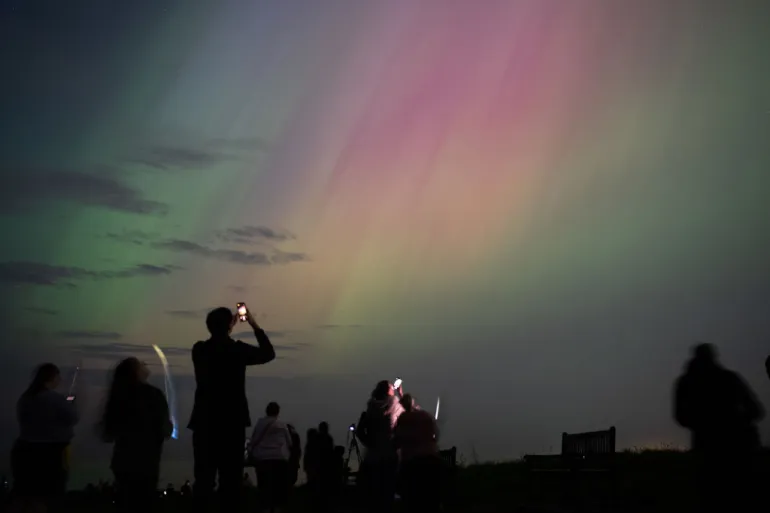
A powerful solar storm is expected to reach Earth on June 8 and 9 after a massive eruption from the Sun sent billions of tons of charged particles hurtling through space. While scientists say there is no cause for alarm, space weather agencies are closely monitoring the event because it could temporarily affect satellites, GPS systems, and power infrastructure in some parts of the world.
The incoming storm has prompted the US National Oceanic and Atmospheric Administration (NOAA) to issue a G3 geomagnetic storm watch for June 8, followed by a G2 watch for June 9.
Although the expected impacts are considered manageable, the event serves as a reminder that activity on the Sun can have real consequences for technology on Earth.
What is the solar storm heading toward Earth?
The storm was triggered by a Coronal Mass Ejection (CME), a massive burst of solar plasma and magnetic fields that erupted from the Sun on June 6.
A CME can contain billions of tons of charged particles traveling through space at extraordinary speeds. When these particles collide with Earth’s magnetic field, they can create a geomagnetic storm.
According to scientists monitoring the event, the CME initially traveled at approximately 1,500 kilometers per second near the Sun, making it an unusually fast solar eruption.
While the cloud of charged particles is expected to slow somewhat during its journey, researchers anticipate it will reach Earth by Monday evening.
What do G3 and G2 geomagnetic storm warnings mean?
NOAA classifies geomagnetic storms on a scale from G1 to G5.
G1: Minor
- Weak power grid fluctuations
- Minor satellite effects
- Limited aurora activity
G2: Moderate
- Possible voltage alarms in high-latitude power systems
- Minor impacts on satellite operations
- Expanded aurora visibility
G3: Strong
- Intermittent satellite navigation disruptions
- Increased drag on low-Earth orbit satellites
- Potential challenges for radio communications
- Additional stress on power systems in polar regions
The current forecast places June 8 at the G3 level before conditions are expected to weaken to G2 on June 9.
Why are scientists paying close attention?
Most geomagnetic storms pass with little public impact, but stronger events can affect critical technology.
Satellite operations
Low-Earth orbit satellites are among the most vulnerable systems during geomagnetic storms.
Charged particles can:
- Disrupt onboard electronics
- Affect navigation systems
- Increase atmospheric drag
- Alter satellite orbits
Space agencies often place sensitive spacecraft into protective operating modes when stronger storms are expected.
GPS and navigation systems
Geomagnetic activity can interfere with signals traveling through Earth’s upper atmosphere.
This can lead to:
- Temporary GPS inaccuracies
- Navigation errors
- Reduced positioning precision
For most consumers, any disruption is expected to be minor and short-lived.
Power grids
Electrical systems in higher-latitude regions are more susceptible to geomagnetic disturbances.
In rare cases, induced electrical currents can stress transformers and grid infrastructure.
However, experts emphasize that the current storm is not expected to produce major widespread power outages.
Will the solar storm affect people in India?
According to Indian space weather experts, the effects are likely to be minimal across most of India.
The strongest impacts from geomagnetic storms are generally concentrated near Earth’s polar regions, where the planet’s magnetic field channels charged particles toward the atmosphere.
As a result:
- Most people in India are unlikely to notice any direct effects
- Communication systems should remain largely unaffected
- Major power disruptions are not anticipated
Scientists will continue monitoring the storm from observatories across the country, including facilities in the Himalayan region.
Could the storm produce northern lights?
One of the most visible effects of geomagnetic storms is the appearance of auroras.
When charged solar particles collide with gases in Earth’s upper atmosphere, they create colorful displays known as:
- Aurora Borealis (Northern Lights)
- Aurora Australis (Southern Lights)
The stronger the geomagnetic storm, the farther from the poles these displays can sometimes be seen.
While residents in northern Europe, Canada, Alaska, and parts of the northern United States may have opportunities to observe enhanced auroras, visibility in India is highly unlikely.
How common are solar storms?
Solar storms are a natural part of the Sun’s activity cycle.
The Sun follows an approximately 11-year cycle during which solar activity rises and falls.
Scientists say the Sun is currently near a period of heightened activity known as solar maximum.
During this phase, there is an increased likelihood of:
- Solar flares
- Coronal Mass Ejections
- Geomagnetic storms
- Enhanced auroral displays
As a result, space weather alerts have become more frequent over the past two years.
Could a solar storm damage Earth?
For most people, the answer is no.
Earth’s magnetic field and atmosphere provide strong protection against the majority of solar activity.
Modern infrastructure is also better prepared for moderate geomagnetic storms than in previous decades.
Experts tracking the current event expect:
- Minor GPS inaccuracies
- Possible satellite operational adjustments
- Increased atmospheric drag on spacecraft
- Enhanced aurora activity
No major societal disruptions are currently forecast.
Why space weather matters more than ever
Modern civilization relies heavily on technologies that can be influenced by solar activity.
These include:
- Satellite communications
- Internet infrastructure
- GPS navigation
- Aviation systems
- Power grids
- Financial timing networks
As humanity becomes increasingly dependent on space-based technologies, monitoring solar storms has become a critical component of global infrastructure protection.
The June 8-9 geomagnetic storm is unlikely to cause major problems, but it highlights why scientists constantly monitor the Sun and issue alerts when significant eruptions occur.
TL;DR
- A fast-moving Coronal Mass Ejection from the Sun is expected to reach Earth on June 8-9.
- NOAA has issued a G3 geomagnetic storm watch for June 8 and a G2 watch for June 9.
- Minor disruptions to satellites, GPS systems, and high-latitude power infrastructure are possible.
- Space agencies are monitoring the event and may place satellites into protective modes.
- Enhanced aurora displays could be visible in higher-latitude regions.
- Experts do not expect major societal impacts or widespread outages.
- India is unlikely to experience noticeable effects from the storm.