
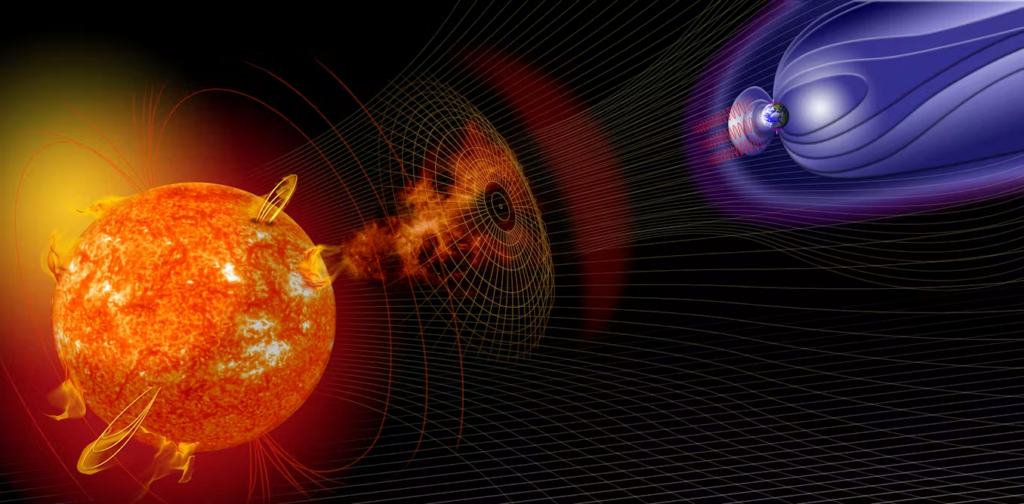
For generations, humanity has treated solar storms as unavoidable forces of nature. Scientists could predict them, governments could prepare for them, and operators could temporarily shut down vulnerable systems. But stopping a solar storm before it causes damage? That has largely belonged to the realm of science fiction. A new proposal from researchers at Boston University aims to change that. The concept, known as StormWall, would create an artificial protective barrier around Earth by releasing clouds of ionized particles into space. The goal is simple but ambitious: weaken the impact of dangerous solar storms before they reach critical infrastructure on Earth. If successful, the idea could help protect satellites, communication networks, GPS systems, and power grids from one of the biggest natural threats facing modern technology.
What is StormWall?
StormWall is a proposed planetary defense system designed to strengthen Earth’s natural magnetic shield, known as the magnetosphere.
The magnetosphere acts as an invisible protective bubble around the planet. It deflects most of the charged particles continuously emitted by the Sun, known as the solar wind.
During major solar events, however, that shield can become overwhelmed.
Researchers led by Brian Walsh at Boston University believe StormWall could provide an additional layer of protection by temporarily reinforcing the magnetosphere during extreme space weather events.
Unlike existing approaches that focus on forecasting solar storms and preparing for disruptions, StormWall seeks to actively reduce the intensity of the storm itself.
Why are solar storms a growing concern?
Solar storms occur when the Sun releases massive bursts of energy and charged particles into space.
Most of the time, Earth remains well protected. But particularly powerful events can trigger geomagnetic storms capable of disrupting technology on a global scale.
Potential consequences include:
- Satellite malfunctions
- GPS navigation errors
- Communication outages
- Power grid failures
- Increased radiation exposure for astronauts
- Disruptions to aviation systems, especially on polar routes
The modern world depends heavily on interconnected technologies that did not exist during many of history’s largest solar storms. As a result, scientists and governments have become increasingly concerned about the economic and security risks posed by severe space weather.
Lessons from past solar storms
The most famous example remains the Carrington Event of 1859, the strongest geomagnetic storm ever recorded.
Telegraph systems failed across multiple countries, operators received electric shocks, and auroras appeared in regions where they are rarely seen.
More recently, the powerful geomagnetic storm that struck Earth in May 2024 demonstrated how solar activity can still affect modern infrastructure, even when damage remains limited.
Researchers used that 2024 event as a test case when evaluating the StormWall concept.
How would StormWall work?
The proposal involves deploying six spacecraft into geosynchronous orbit around Earth.
These satellites would remain on standby until scientists detect an incoming solar storm severe enough to threaten infrastructure.
Once activated, the spacecraft would release carefully selected materials into space, including:
- Barium
- Lithium
- Sodium
- Calcium
Exposure to sunlight would ionize these materials, transforming them into a cloud of plasma.
Creating an artificial plasma shield
The plasma cloud would gradually drift toward the sun-facing side of Earth’s magnetosphere.
Researchers believe this additional plasma could strengthen a critical boundary where Earth’s magnetic field interacts with incoming solar particles.
The objective is to disrupt a process called magnetic reconnection, one of the primary mechanisms that allows solar energy to penetrate Earth’s protective magnetic shield.
By reducing the efficiency of magnetic reconnection, StormWall could decrease the amount of solar energy entering near-Earth space.
Think of it as adding extra padding to a protective barrier before a storm arrives.
What is magnetic reconnection?
Magnetic reconnection occurs when magnetic fields from the solar wind temporarily connect with Earth’s magnetic field.
This connection creates pathways through which large amounts of energy and charged particles can enter the magnetosphere.
When reconnection becomes intense, geomagnetic storms can rapidly strengthen, increasing the risk of disruptions on Earth and in orbit.
StormWall’s entire strategy revolves around weakening this process.
Rather than blocking the solar storm directly, the system aims to make Earth’s magnetic defenses more resistant to incoming solar energy.
Has StormWall been tested?
Not in space.
At this stage, StormWall remains a theoretical concept supported by computer simulations.
Researchers modeled the system using data from the severe Mother’s Day geomagnetic storm that occurred in May 2024.
According to their simulations, StormWall could reduce the strength of a major solar storm by more than 50%.
That reduction would not eliminate the threat entirely, but it could significantly lessen the risk of damage to critical infrastructure.
The findings suggest that even partial mitigation could provide valuable time for governments, utilities, and satellite operators to implement emergency protective measures.
What challenges stand in the way?
While the concept is intriguing, several major obstacles remain before StormWall could become reality.
Massive engineering requirements
The six spacecraft would need to carry enormous quantities of material.
Researchers estimate the system would require payloads equivalent to roughly a dozen oil tanker trucks.
Launching and maintaining such a fleet would involve substantial costs.
One-time use limitations
Each deployment would consume the released material.
After activation, spacecraft would need to be replenished or replaced before they could respond to another major solar storm.
That raises questions about long-term operational costs and sustainability.
Real-world testing risks
Computer simulations offer valuable insights, but space is a far more complex environment.
Scientists would need to conduct carefully controlled experiments before deploying a system capable of altering conditions within Earth’s magnetosphere.
International coordination
A project of this scale would likely require cooperation among multiple countries and space agencies.
The effects of severe solar storms do not respect national borders, making StormWall a truly global undertaking.
As Walsh noted, the system would benefit everyone on Earth rather than any single nation.
Why this idea matters
The significance of StormWall extends beyond solar storms.
It reflects a broader shift in how scientists think about planetary protection.
Historically, humanity has focused on predicting natural hazards and minimizing their consequences. Increasingly, researchers are exploring whether advanced technology can actively reduce the hazards themselves.
That trend can be seen in proposals ranging from asteroid deflection missions to climate intervention concepts and now space-weather mitigation systems.
StormWall may never leave the drawing board. But even as a theoretical proposal, it expands the conversation about what future generations might be capable of achieving in space.
Could humanity someday control space weather?
That remains an open question.
StormWall is far from becoming an operational system, and significant scientific, technical, and financial hurdles remain.
Yet the proposal highlights how rapidly space science is evolving. Ideas that once sounded like science fiction are increasingly being evaluated through rigorous modeling and engineering studies.
Whether StormWall ultimately succeeds or not, it represents a fascinating possibility: a future in which humanity does more than endure the Sun’s most powerful storms and instead learns how to soften their impact before they arrive.
TL;DR
- Scientists at Boston University have proposed a space-weather defense system called StormWall.
- The concept would use six spacecraft to release materials that form an artificial plasma cloud around Earth.
- The plasma would help strengthen Earth’s magnetosphere during major solar storms.
- Computer simulations suggest the system could reduce the intensity of severe geomagnetic storms by more than 50%.
- StormWall remains theoretical and faces significant engineering, financial, and scientific challenges before it could become reality.