
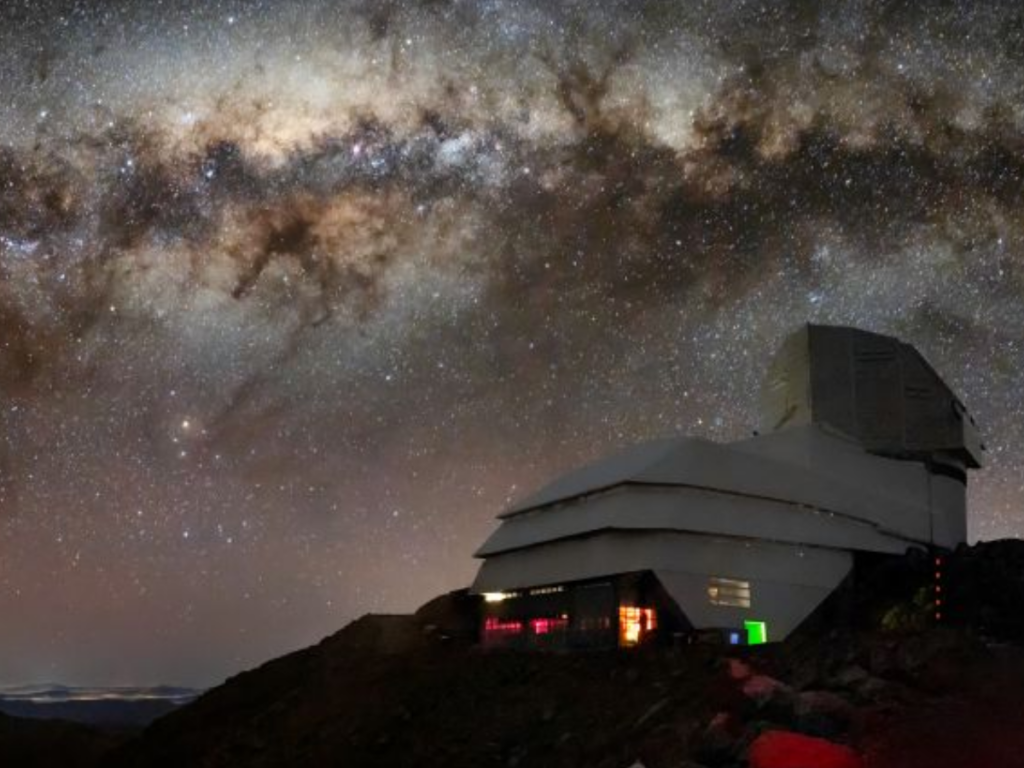
The NSF–DOE Vera C. Rubin Observatory has officially launched one of the most ambitious astronomy projects ever attempted: the Legacy Survey of Space and Time (LSST). Over the next decade, the observatory will repeatedly scan the southern sky, creating the most detailed and dynamic map of the universe ever assembled.
While the Rubin Observatory is based in Chile, the project is truly global—and India is playing a significant scientific role. From studying gravitational lensing and dark matter to analysing billions of galaxies and tracking cosmic explosions, Indian researchers are helping shape one of the world’s largest astronomical surveys.
Here’s how India is contributing to a mission that could transform our understanding of the cosmos.
TL;DR
- The Vera C. Rubin Observatory has begun the 10-year Legacy Survey of Space and Time (LSST).
- The project will repeatedly image the southern sky to create a high-resolution time-lapse of the universe.
- India is contributing through institutions including IUCAA, NCRA-TIFR, IIA, IIT Bombay, and IIT Indore.
- Indian scientists are leading research on:
- Gravitational lensing
- Dark matter and dark energy
- Galaxy evolution
- Cosmic transients such as supernovae and kilonovae
- Indian ground-based telescopes, including the Giant Metrewave Radio Telescope (GMRT), will complement Rubin’s discoveries.
What is the Vera C. Rubin Observatory’s Legacy Survey of Space and Time?
The Legacy Survey of Space and Time (LSST) is a decade-long astronomical survey designed to create the most comprehensive visual record of the universe ever produced.
Unlike traditional sky surveys that capture a single snapshot, the Rubin Observatory will revisit the same regions of the southern sky every few nights over 10 years. This repeated imaging will allow astronomers to detect changes over time, from exploding stars to moving asteroids and distant galaxies evolving across billions of years.
By the end of the survey, Rubin is expected to generate an unprecedented cosmic dataset containing observations of roughly 20 billion galaxies, along with millions of other celestial objects.
Why is the LSST considered revolutionary?
The Rubin Observatory combines three major strengths:
- An ultra-wide field of view
- One of the world’s most powerful digital cameras
- Continuous long-term observations
Instead of producing isolated astronomical images, LSST will generate a high-definition “time-lapse movie” of the universe.
This approach enables scientists to observe phenomena that change over time, including:
- Supernova explosions
- Variable stars
- Asteroid movements
- Galaxy evolution
- Black hole activity
- Rare cosmic collisions
The survey will also issue millions of real-time alerts every night, notifying astronomers whenever something in the sky suddenly changes, moves, brightens, or disappears.
How is India contributing to the Rubin Observatory mission?
India is an important international partner in the scientific analysis of LSST data.
Several leading research institutions are contributing expertise across multiple areas of astronomy and cosmology, including:
- Inter-University Centre for Astronomy and Astrophysics (IUCAA), Pune
- National Centre for Radio Astrophysics (NCRA-TIFR)
- Indian Institute of Astrophysics (IIA)
- Tata Institute of Fundamental Research (TIFR)
- IIT Bombay
- IIT Indore
Rather than building the telescope itself, Indian scientists are helping answer some of astronomy’s biggest unanswered questions using the enormous volume of data Rubin will produce.
Indian scientists are leading gravitational lensing research
One of India’s most prominent contributions is through the LSST Strong Lensing Science Collaboration.
What is gravitational lensing?
Gravitational lensing occurs when an extremely massive object—such as a galaxy or galaxy cluster—lies between Earth and a much more distant object.
According to Einstein’s theory of general relativity, the foreground object’s gravity bends the path of light, acting like a natural cosmic magnifying glass.
This effect allows astronomers to observe galaxies that would otherwise be too faint or distant to detect.
India’s leadership role
The international collaboration is co-chaired by Dr. Anupreeta More of IUCAA, with participation from researchers across multiple Indian institutions.
Their goal is to identify more than 10,000 gravitational lenses, dramatically expanding the current catalogue.
These observations will help scientists:
- Measure how quickly the universe is expanding.
- Improve estimates of the universe’s age.
- Detect rare astronomical events hidden behind gravitational lenses.
- Study the distribution of invisible matter in the universe.
Managing data from 20 billion galaxies
Astronomy is increasingly becoming a data-intensive science.
By the end of its mission, Rubin Observatory is expected to observe approximately 20 billion galaxies, producing petabytes of scientific data.
Indian researchers are contributing significantly to processing and analyzing this information.
Understanding galaxy evolution
Prof. Yogesh Wadadekar of NCRA-TIFR is a key member of the LSST Galaxies Science Collaboration.
Using Rubin’s exceptionally deep images, researchers will investigate:
- How galaxies formed.
- How their shapes changed over billions of years.
- How stars formed inside them.
- How galaxies interacted and merged over cosmic history.
These studies could provide valuable insights into how our own Milky Way evolved.
Mapping dark matter and dark energy
One of the Rubin Observatory’s most important scientific objectives is understanding the invisible components that dominate the universe.
Although stars and planets are what we see, they account for only a small fraction of the universe.
Scientists estimate that most of the cosmos consists of:
- Dark matter, which exerts gravity but does not emit light.
- Dark energy is a mysterious force driving the accelerating expansion of the universe.
India’s role in cosmological mapping
Prof. Surhud More, who serves as the Rubin IUCAA Program Manager, is among the researchers helping coordinate India’s participation in these cosmological studies.
Indian cosmologists are working to:
- Map dark matter across nearly half of the observable night sky.
- Measure the effects of dark energy on cosmic expansion.
- Test leading cosmological models using Rubin’s unprecedented observations.
The resulting maps could become some of the most detailed representations of the universe’s large-scale structure ever created.
Indian telescopes will help verify Rubin’s discoveries
Rubin Observatory will detect millions of changing astronomical events every night.
Many of these discoveries will require follow-up observations using other telescopes around the world.
India is preparing to play an important role here as well.
The Giant Metrewave Radio Telescope
The Giant Metrewave Radio Telescope (GMRT), operated by NCRA, will observe many of Rubin’s discoveries in radio wavelengths.
Other optical and infrared observatories in India will also contribute.
Together, these facilities will allow scientists to study the same event across multiple wavelengths, providing a much more complete picture.
For example, if Rubin detects the optical signature of a neutron star collision, Indian telescopes can observe the event in radio or infrared light, helping researchers better understand the physics behind gravitational-wave events and other short-lived cosmic phenomena.
What discoveries could LSST make?
The Rubin Observatory is expected to transform nearly every area of astronomy.
Potential discoveries include:
Millions of new Solar System objects
Scientists expect Rubin to identify millions of previously unknown:
- Asteroids
- Comets
- Dwarf planets
- Other small Solar System bodies
This will improve our understanding of the Solar System’s formation and could also strengthen planetary defense efforts by identifying potentially hazardous near-Earth objects.
A better view of the Milky Way
Rubin’s sensitive camera will peer through cosmic dust clouds to study regions where stars are actively forming.
This will help astronomers build a more complete picture of our galaxy’s structure and history.
Unlocking cosmic mysteries
The survey will also investigate:
- Supernovae
- Pulsating stars
- Black holes
- Dark matter
- Dark energy
- Galaxy clusters
- Rare transient events
Because Rubin repeatedly observes the same regions of the sky, it can capture phenomena that previous surveys often missed.
Why India’s participation matters
India’s involvement in the Vera C. Rubin Observatory extends beyond scientific collaboration—it reflects the country’s growing role in global astronomy and big-data science.
By contributing expertise in gravitational lensing, galaxy evolution, cosmology, and multi-wavelength observations, Indian scientists will help interpret one of the largest astronomical datasets ever collected.
The knowledge generated over the next decade is expected to influence research for years to come, offering fresh insights into how galaxies form, how the universe expands, and what dark matter and dark energy really are.
As Rubin Observatory begins producing its nightly stream of discoveries, India’s research institutions will remain at the forefront of turning those observations into scientific breakthroughs.