
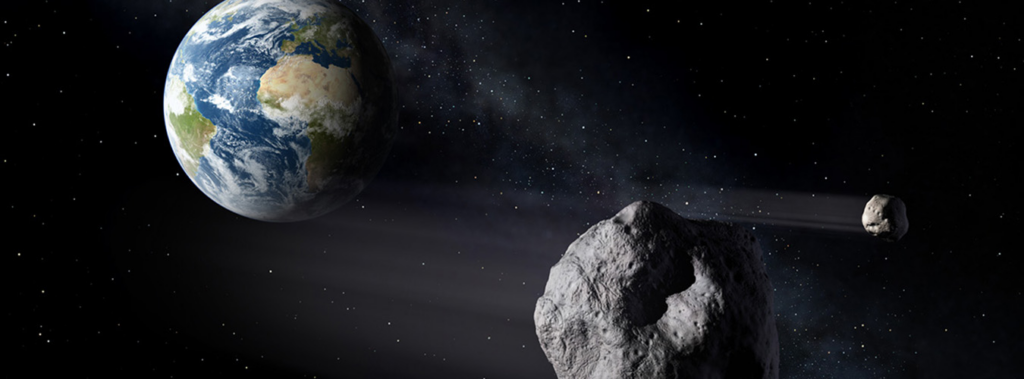
Every year on June 30, the world observes World Asteroid Day, commemorating the 1908 Tunguska event, the largest asteroid impact witnessed in recorded human history. The day also serves as a reminder that while most asteroids pass Earth harmlessly, collisions have repeatedly reshaped the planet over billions of years.
Some impacts carved out giant craters, others triggered mass extinctions, and one transformed vast deposits of graphite into trillions of diamonds almost instantly. Here’s a look at five of the most significant asteroid impacts in Earth’s history and why scientists still study them today.
Why is World Asteroid Day celebrated?
World Asteroid Day is observed every year on June 30, marking the anniversary of the Tunguska event, when an asteroid or comet exploded over Siberia in 1908.
Although the object never struck the ground, the mid-air explosion released energy estimated at 10 to 15 megatons of TNT, flattening around 80 million trees across more than 2,000 square kilometers.
The United Nations officially recognizes the day to raise awareness about asteroid hazards and the importance of detecting near-Earth objects before they pose a threat.
1. Vredefort Crater: Earth’s largest confirmed impact structure
When did it happen?
Approximately 2.02 billion years ago
Where?
South Africa
The Vredefort Impact Structure remains the largest confirmed asteroid impact site on Earth.
Scientists estimate that an asteroid measuring 20 to 25 kilometers (12 to 16 miles) across slammed into the planet at speeds between 54,000 and 90,000 km/h (33,500 to 56,000 mph).
The collision excavated a crater roughly 300 kilometers (186 miles) wide and about 40 kilometers (25 miles) deep.
The tremendous force deformed Earth’s crust, flipping ancient rock layers on their sides and exposing granites estimated to be 3.5 billion years old. Today, the site is recognized as a UNESCO World Heritage Site and offers scientists a rare window into Earth’s early geological history.
2. Sudbury Basin: The impact that created one of the world’s richest mining regions
When did it happen?
Approximately 1.85 billion years ago
Where?
Ontario, Canada
A massive asteroid roughly 15 kilometers (9 miles) wide struck what is now Ontario, creating one of the largest impact structures on Earth.
The impact melted enormous volumes of crust, forming a vast underground sea of molten rock.
Over billions of years, geological processes reshaped the original crater, leaving today’s Sudbury Basin, which measures about 60 kilometers (37 miles) long.
The ancient impact also concentrated valuable metals such as nickel, copper, and platinum-group elements, making Sudbury one of the world’s most important mining districts.
3. Chicxulub: The asteroid that ended the age of dinosaurs
When did it happen?
Approximately 66 million years ago
Where?
Yucatán Peninsula, Mexico
No asteroid impact has been studied more extensively than the Chicxulub event, which is widely accepted as the cause of the mass extinction that ended the reign of the non-avian dinosaurs.
Scientists estimate the asteroid measured 10 to 15 kilometers (6 to 9 miles) across.
Its impact produced a crater between 150 and 300 kilometers (93 to 186 miles) wide and unleashed catastrophic consequences worldwide.
The collision triggered:
- Massive earthquakes
- Towering tsunamis
- Global wildfires
- Atmospheric dust clouds that blocked sunlight
- Years of global cooling
- Acid rain
The disaster wiped out roughly 75% of all plant and animal species, permanently altering the course of evolution and allowing mammals to eventually dominate Earth.
4. Popigai Crater: The impact that created trillions of diamonds
When did it happen?
Approximately 35.7 million years ago
Where?
Northern Siberia, Russia
The Popigai impact is remarkable not only because of its size but also because it created what is believed to be the world’s largest known deposit of impact diamonds.
Scientists estimate the incoming asteroid measured around 8 kilometers (5 miles) across.
The collision generated pressures of up to 60 gigapascals and temperatures reaching several thousand degrees.
The region already contained large deposits of graphite. Under the extraordinary heat and pressure generated by the impact, the graphite’s crystal structure rapidly transformed into diamonds within seconds.
Researchers believe the site contains trillions of carats of impact diamonds.
The Popigai impact is also linked to broader environmental changes during the Eocene-Oligocene extinction event, particularly when considered alongside another large impact near present-day Chesapeake Bay in the United States.
5. Tunguska Event: The largest impact witnessed by humans
When did it happen?
June 30, 1908
Where?
Siberia, Russia
Unlike the other entries on this list, the Tunguska event left no impact crater.
Instead, the asteroid or comet exploded approximately 5 to 20 kilometers (3 to 12 miles) above Earth’s surface in an airburst.
Despite never reaching the ground, the explosion released energy comparable to that of a large thermonuclear weapon.
The blast flattened more than 80 million trees across approximately 2,150 square kilometers (830 square miles) of Siberian forest.
Fortunately, the remote location meant casualties were minimal, but the event demonstrated how devastating even a relatively modest asteroid can be.
Why asteroid impacts still matter today
While catastrophic impacts are extremely rare, astronomers continue monitoring thousands of near-Earth objects (NEOs) that regularly pass close to our planet.
Space agencies, including NASA and the European Space Agency (ESA), operate planetary defense programs designed to detect potentially hazardous asteroids years before any possible collision.
The successful DART (Double Asteroid Redirection Test) mission in 2022 also demonstrated that humanity can alter an asteroid’s trajectory under controlled conditions, marking a major milestone in planetary defense.
TL;DR
From the gigantic Vredefort crater to the Chicxulub impact that ended the age of dinosaurs, asteroid collisions have repeatedly transformed Earth. One impact in Siberia even converted ancient graphite into trillions of diamonds within seconds. World Asteroid Day commemorates the 1908 Tunguska explosion while highlighting ongoing efforts to detect and defend against future asteroid threats.