
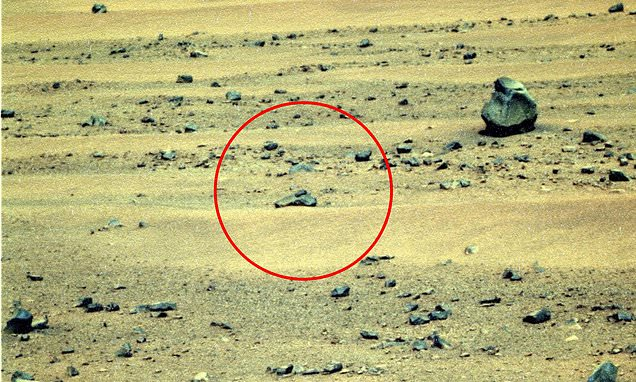
A decade-old image captured by NASA’s Opportunity rover is once again making waves online after social media users claimed it shows what appears to be a gun lying on the surface of Mars. The resurfaced photograph has fueled fresh speculation about extraterrestrial civilizations, despite experts pointing to a far simpler explanation: the human brain is wired to recognise familiar shapes—even when they aren’t actually there.
The image, originally taken in 2014, has been shared widely after UFO researcher Scott C. Waring claimed the object is an “alien gun” about one foot long. He also alleged that NASA removed additional photographs of the object, a claim for which there is no publicly available evidence.
TL;DR: A viral Mars image has reignited claims of an “alien gun” discovered by NASA’s Opportunity rover. While UFO researcher Scott C. Waring argues the object is evidence of extraterrestrial technology, scientists say it is almost certainly a naturally shaped rock, an example of a psychological phenomenon known as pareidolia.
What is the viral ‘alien gun’ image?
NASA’s Opportunity rover captured the photograph during its exploration of Mars and recently resurfaced on the social media platform X.
Scott C. Waring, who runs the website UFO Sightings Daily, described the object as an “incredible” discovery and claimed it resembles a firearm approximately one foot in length.
According to Waring, the object appears near SOL 3773, between Mt. Edgecumbe and Wdowiak Ridge on Mars. He further alleged that NASA once had multiple images of the object but later deleted them.
However, NASA has not acknowledged any such discovery, nor has it provided evidence supporting claims that photographs were removed.
Why do some people believe it is an alien artifact?
Supporters of the theory argue that the object’s apparent symmetry and shape make it appear manufactured rather than naturally formed.
This is not the first time unusual rock formations photographed on Mars have sparked speculation about ancient civilisations or alien technology.
Over the years, internet users have claimed that NASA images show:
- Human faces.
- Statues.
- Fossils.
- Buildings.
- Animal-like figures.
- Tools and machinery.
In nearly every case, scientists have concluded the formations are naturally occurring rocks shaped by erosion, wind, and lightning conditions.
What is pareidolia?
The most likely explanation is pareidolia, a well-documented psychological phenomenon in which the human brain interprets random patterns as recognizable objects.
People experience pareidolia every day when they:
- See faces in clouds.
- Recognize animals in rock formations.
- Spot shapes in tree bark.
- Notice human-like features on the Moon.
Our brains evolved to identify familiar patterns quickly, particularly faces and everyday objects. While this ability has survival benefits, it also makes us prone to seeing meaningful images where none actually exist.
The “alien gun” appears to fit this pattern.
What has NASA actually found on Mars?
Although NASA has never found evidence of present-day life on Mars, its missions have revealed compelling signs that the planet was once much different.
Scientists have discovered evidence of:
- Ancient rivers and lakes.
- Minerals formed in water.
- Organic molecules.
- Sedimentary rocks.
- Conditions that may once have supported microbial life.
These findings suggest that Mars was warmer and wetter billions of years ago.
However, NASA has repeatedly stated that no mission has confirmed the existence of either ancient or current extraterrestrial life.
The search continues through missions such as Perseverance, which is collecting rock samples that could eventually be returned to Earth for detailed analysis.
The Opportunity rover’s remarkable mission
The viral image comes from NASA’s Opportunity rover, one of the agency’s most successful planetary missions.
Originally designed to operate for just 90 Martian days, Opportunity exceeded all expectations.
Mission highlights
- Landed on Mars on January 25, 2004.
- Touched down inside Eagle Crater in Meridiani Planum.
- Operated for nearly 14 years.
- Traveled more than 45 kilometers (28 miles).
- Discovered strong evidence that liquid water once existed on Mars.
The mission ended in 2018 after a massive global dust storm blocked sunlight from reaching the rover’s solar panels, preventing it from recharging.
Opportunity’s discoveries fundamentally changed scientists’ understanding of Mars’ geological history.
Why are people skeptical of the ‘alien gun’ claim?
Many social media users quickly questioned the theory, arguing that the object’s resemblance to a human-designed firearm actually weakens the extraterrestrial explanation.
One widely shared reaction asked:
“Why would aliens have guns designed for human hands and fingers?”
Others noted that natural rock formations can easily appear artificial depending on lighting, shadows, and camera angles.
The skepticism reflects a broader pattern in which extraordinary claims are increasingly scrutinized by online audiences demanding stronger evidence.
This is not the first unusual claim from Scott C. Waring
Scott C. Waring has made similar claims about Mars images for years.
In previous analyses of NASA rover photographs, he has suggested he discovered:
- A shoe.
- Artificial structures.
- Alien artifacts.
- Various manufactured objects.
In one instance, Waring claimed a rock resembled a shoe belonging to an ancient Martian civilization, even constructing a narrative about its possible owner.
Scientists have consistently rejected such interpretations, explaining that the objects are almost certainly naturally shaped rocks viewed through the lens of pareidolia.
Why does NASA share raw Mars images
NASA routinely publishes thousands of photographs captured by its Mars missions.
These images are made available to researchers, educators, journalists, and the public, allowing anyone to examine the Martian surface.
Because the images are largely unprocessed, unusual lighting conditions, shadows, and rock formations sometimes produce optical illusions that fuel speculation online.
The agency encourages scientific analysis based on multiple images, geological context, and peer-reviewed evidence rather than visual resemblance alone.
The bigger picture
The resurfaced “alien gun” photograph is another reminder of how easily extraordinary claims can spread online, especially when familiar shapes appear in unfamiliar places. While the image has reignited discussions about extraterrestrial life, there is currently no scientific evidence that the object is anything other than a naturally formed Martian rock.
Mars remains one of the most promising places in the solar system to search for signs of ancient microbial life, and NASA’s ongoing missions continue to explore that possibility. But identifying life beyond Earth requires far more than a curious-looking photograph—it demands rigorous scientific evidence that can withstand scrutiny.