


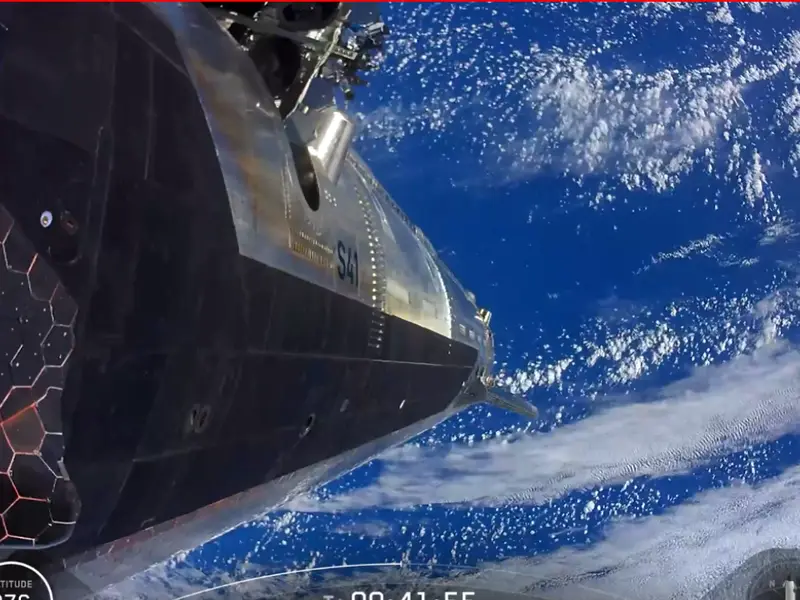
SpaceX’s historic Starship Flight 14 made headlines Monday after the giant spacecraft reached orbit for the first time and deployed 26 Starlink V3 satellites. But during the livestream, viewers noticed something else: a strange blue-white streak moving through the darkness behind the spacecraft.
The object appeared roughly eight minutes into the flight, at about 7 minutes and 55 seconds into the livestream. It looked like a narrow, slightly curved trail of pale blue light with a brighter white point at one end.
The unusual sight quickly spread across social media, where some viewers called it a UFO or even an “alien mothership”. Others offered more conventional explanations, including rocket exhaust associated with the Super Heavy booster.
There is currently no verified evidence that the object was an alien spacecraft. The footage shows an unidentified visual phenomenon, but its precise identity has not been established.
What was the mysterious object seen during Starship Flight 14?
The unusual streak appeared while Starship was completing the most ambitious portion of its mission yet: reaching Earth orbit and preparing to deploy its first operational payload from the vehicle.
Viewers watching the SpaceX livestream noticed the pale blue formation behind the spacecraft. Screenshots and clips quickly circulated online, with some users describing the object as unusually large or appearing to move independently of Starship.
One viewer wrote that it looked like a “mothership”, while another said they believed viewers had just watched a UFO on a live broadcast.
Other viewers were more cautious. Some suggested that the object could have been the International Space Station or another satellite, although the livestream provides no reliable way to determine the object’s distance or size.
That distinction is important. An object being unidentified does not establish that it is extraterrestrial. In this case, there is no confirmed evidence linking the streak to alien technology or life.
One explanation points to the Super Heavy booster
A more conventional theory circulating online is that the streak may have been associated with the Super Heavy booster.
According to one viewer’s analysis, the apparent object could have been gas or exhaust produced when the booster shut down after separation and later restarted engines for its return maneuver.
The changing position of the streak may also have been affected by the Earth’s horizon. A faint cloud or plume initially hidden against the bright edge of Earth could become more visible as the vehicles and camera perspective changed.
Another viewer pointed to footage from earlier in the flight, around 6 minutes and 35 seconds after launch, where a smaller fuzzy blue-white patch could reportedly be seen near Earth’s edge. That has been cited online as possible evidence supporting the exhaust explanation.
However, this remains an interpretation of the footage rather than a confirmed explanation from SpaceX.
Why did the Starship UFO sighting attract so much attention?
The timing of the sighting was significant.
Starship Flight 14 was already an important mission for SpaceX because it was the first time the company attempted to send the spacecraft into orbit rather than follow the suborbital trajectories used on earlier tests.
SpaceX said the mission was designed to demonstrate orbital insertion, deploy 26 Starlink V3 satellites, perform an in-space deorbit burn and attempt a controlled return to the Pacific Ocean.
The spacecraft successfully reached orbit and deployed all 26 satellites, marking a major milestone in Starship’s development. Reuters reported that the satellites were successfully deployed even though an engine problem later forced the mission to end earlier than planned.
That meant millions of viewers were already watching closely when the unusual streak appeared.
A visually ambiguous object appearing against the blackness of space was therefore almost guaranteed to attract attention, particularly during a livestream being watched by space enthusiasts around the world.
Starship reached orbit despite an engine problem
The mysterious object was not the only unexpected moment during Flight 14.
The Starship upper stage experienced an unexpected shutdown of one of its engines during the mission. Despite the problem, the spacecraft continued with its orbital mission and successfully deployed the 26 Starlink V3 satellites.
The mission was originally planned to last roughly 10 hours. Instead, the flight was shortened to about three hours following the engine issue. Reuters reported that Starship eventually splashed down in the Pacific Ocean after the shortened mission.
SpaceX had planned Flight 14 as a major step toward making Starship a fully reusable orbital transportation system. The company’s own mission description said the flight would be the first to send Starship into orbit and would test several technologies needed for future missions.
The 26 Starlink V3 satellites were particularly important. SpaceX said each satellite is designed to add about 1 terabit per second of capacity to the Starlink constellation, making the payload substantially more capable than a comparable launch of earlier V2 Mini satellites.
Is the object actually a UFO?
In the literal sense, the object can be described as unidentified because there is not yet a confirmed identification of what viewers saw.
But that is very different from establishing that it was an extraterrestrial spacecraft.
No credible evidence currently connects the Starship livestream object to alien technology. The available reporting instead documents several possible conventional explanations, including rocket exhaust or material associated with the vehicle’s flight and staging sequence.
The footage itself also makes it difficult to judge.
The viral UFO theories overshadowed a genuine SpaceX milestone
The speculation surrounding the blue streak may continue until clearer footage or technical analysis identifies what appeared in the background.
For now, however, the bigger story is what Starship itself accomplished.
Flight 14 successfully demonstrated orbital flight and deployed 26 Starlink V3 satellites, achieving objectives that SpaceX had specifically identified as central goals of the mission. The flight still encountered an engine problem and ended much earlier than originally planned, leaving additional technical questions for future tests.
The strange object adds an intriguing footnote to an already historic flight. But until there is stronger evidence about its origin, the “UFO” label describes what viewers could not immediately identify, not what the object has been proven to be.