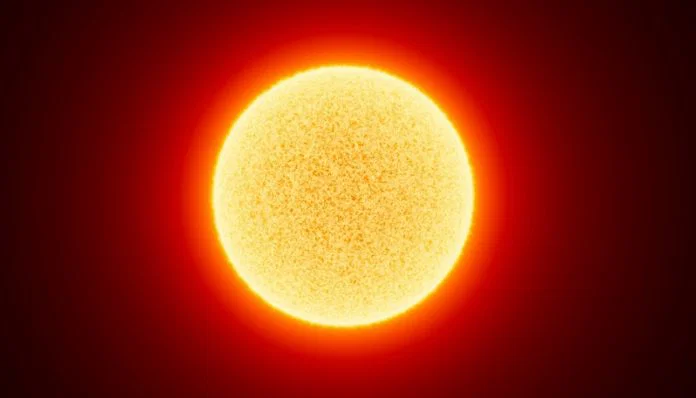
For decades, astronomers believed the Sun contained significantly less silver than expected—a puzzling finding because the Sun and the rest of the solar system formed from the same cloud of gas and dust about 4.6 billion years ago.
Now, researchers say the mystery has finally been solved. According to a new study, the silver was never actually missing. Instead, earlier estimates underestimated the amount because of limitations in how scientists modeled the Sun’s atmosphere.
Using a more sophisticated model, researchers found that the Sun contains about 55% more silver than previously calculated, bringing its composition much closer to that of ancient meteorites.
Why Was the Sun’s Silver a Mystery?
The Sun, planets, asteroids, and meteorites all formed from the same giant cloud of gas and dust roughly 4.6 billion years ago.
Because they share a common origin, scientists expect them to contain broadly similar proportions of chemical elements, allowing for known physical and chemical processes that occurred during the formation of the solar system.
Meteorites, especially primitive ones that have changed very little since the solar system formed, serve as valuable records of its original chemical composition.
However, when astronomers measured the Sun’s silver abundance using its spectrum, they consistently found much lower levels than those inferred from meteorites.
This discrepancy puzzled researchers for decades.
How Do Scientists Detect Elements in the Sun?
Scientists cannot collect samples directly from the Sun, so they rely on spectroscopy.
Every chemical element absorbs and emits light at specific wavelengths, creating unique patterns known as spectral lines.
When sunlight passes through the Sun’s outer atmosphere, atoms absorb particular wavelengths of light, leaving dark lines in the solar spectrum.
By analyzing these spectral fingerprints, astronomers can determine:
- Which elements are present.
- Their relative abundances.
- The physical conditions inside the Sun’s atmosphere.
This technique has been fundamental to astronomy for more than a century.
What Did the New Study Find?
The new research, led by Sema Caliskan of Uppsala University, concluded that previous measurements underestimated the Sun’s silver abundance because the atmospheric models used to interpret the spectral lines were too simplistic.
Instead of assuming relatively static conditions, the team developed a more realistic model that accounted for:
- Turbulent gas motions.
- Temperature variations.
- Dynamic behavior in the Sun’s outer layers.
- More detailed atomic interactions between silver and light.
Using this improved approach, the researchers found that the Sun contains approximately 55% more silver than earlier estimates indicated.
As a result, the Sun’s chemical composition is now much more consistent with that of primitive meteorites.
Why Did Earlier Models Get It Wrong?
The Sun’s atmosphere is highly dynamic.
Hot plasma constantly rises and falls through convection, while changing temperatures and densities influence how atoms absorb and emit light.
Earlier models simplified many of these complex processes, making them computationally practical but less accurate for certain elements.
The new study incorporated more realistic physics, allowing the observed spectral lines of silver to be interpreted more accurately.
In other words, the silver was always there—the measurements simply underestimated it.
Why Does This Matter?
Although silver makes up only a tiny fraction of the Sun’s mass, accurately measuring trace elements helps scientists answer much larger questions.
Improved measurements allow researchers to:
- Better understand how the solar system formed.
- Compare the Sun with other stars.
- Trace how heavy elements were created over cosmic history.
- Improve models of stellar evolution.
- Refine our understanding of the Milky Way’s chemical enrichment.
Small corrections in elemental abundances can have significant implications for astrophysics.
What Happens Next?
The research team plans to apply the same improved modeling techniques to other stars.
Doing so could reveal where heavy elements such as silver were produced and how they spread throughout the Milky Way over billions of years.
The approach may also help resolve discrepancies involving other trace elements whose abundances remain uncertain.
Why Meteorites Are So Important
Primitive meteorites are often described as cosmic time capsules because many have remained largely unchanged since the birth of the solar system.
By comparing their chemical makeup with that of the Sun, scientists can test theories about:
- Stellar nucleosynthesis.
- Planet formation.
- The early solar nebula.
- Galactic chemical evolution.
The closer agreement between the Sun and meteorites strengthens confidence in current models of the solar system’s origin.
The Bottom Line
Scientists have solved one of the Sun’s long-standing chemical mysteries by showing that its apparent lack of silver resulted from limitations in earlier measurement techniques rather than an actual deficiency. Using a more advanced model of the Sun’s atmosphere, researchers found that the Sun contains about 55% more silver than previously estimated, bringing its composition into much closer agreement with ancient meteorites.
The discovery not only improves our understanding of the Sun but also provides a more accurate foundation for studying the chemical evolution of stars and galaxies.
TL;DR
- Scientists have resolved the long-standing mystery of the Sun’s “missing” silver.
- A new study found the Sun contains about 55% more silver than earlier estimates suggested.
- The discrepancy was caused by limitations in previous atmospheric models, not by the Sun lacking silver.
- Researchers used improved simulations of the Sun’s turbulent outer atmosphere.
- The findings help scientists better understand the chemical evolution of the solar system and stars across the Milky Way.