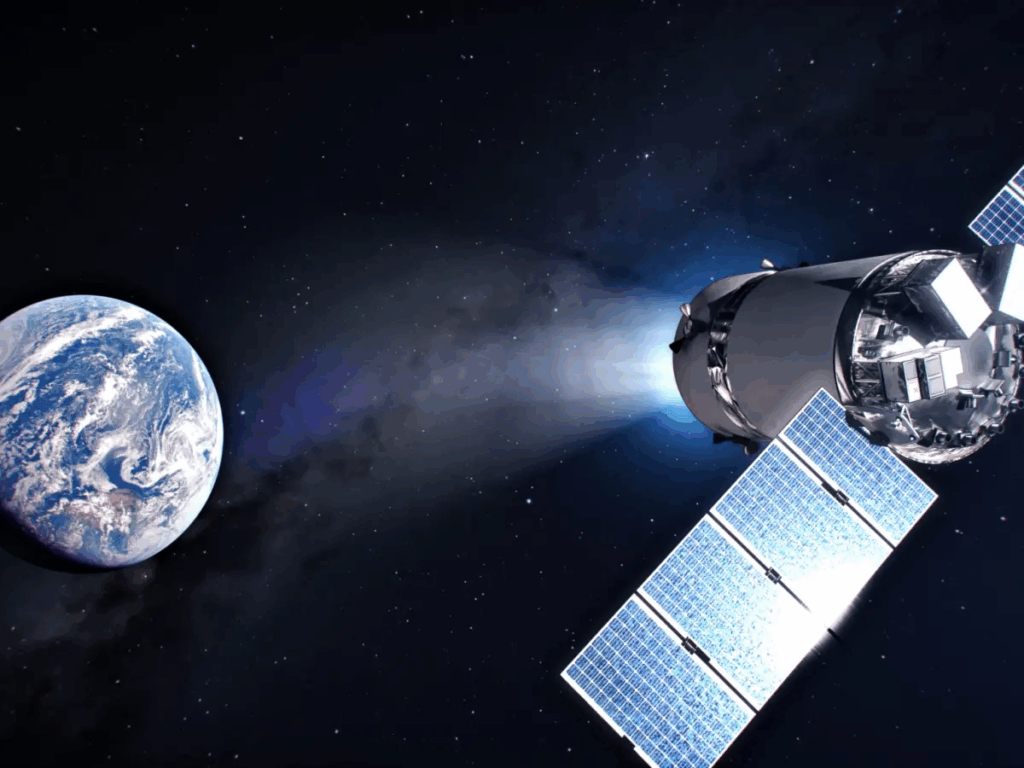
For more than a century, the dream of interstellar travel has been tethered to one unforgiving reality: fuel. Every spacecraft in history has relied on propellant to escape Earth’s gravity and navigate the cosmos. But the more fuel a craft carries, the heavier it becomes, demanding even more thrust to move. This paradox has defined the limits of space exploration since Russian scientist Konstantin Tsiolkovsky’s early rocket equation.
Now, a new generation of engineers and physicists is rethinking that equation entirely. A growing body of research, highlighted in a recent review on the arXiv preprint server, explores propulsion systems that could operate without any onboard fuel, instead harnessing natural cosmic forces like sunlight, planetary motion, and solar wind. If realized, these “propellantless” systems could make long-term interstellar travel not just possible but practical.
How fuel has held space travel back
Fuel is both the enabler and the anchor of every space mission. From the Saturn V rockets that carried Apollo astronauts to the Moon to today’s reusable Falcon 9 boosters, every launch is a careful tradeoff between mass, thrust, and payload.
The basic challenge is exponential: every kilogram of propellant added to a rocket requires additional propellant to lift it. This self-limiting cycle has meant that deep-space exploration, beyond our solar system, remains largely theoretical.
That’s why researchers are looking for propulsion systems that don’t rely on conventional fuel at all, instead leveraging existing energy in space.
Solar sails: Riding the power of light
Among these technologies, solar sails are the most advanced. The idea is elegantly simple: light itself can push. Photons from the Sun carry momentum, and when they strike a reflective surface, they impart a tiny but steady pressure.
By deploying an enormous, ultralight sail, sometimes spanning hundreds of meters, a spacecraft can gradually accelerate without consuming any fuel. Over time, even the faint push of sunlight can propel a probe to enormous velocities.
Real-world example: Japan’s IKAROS mission
In 2010, Japan’s IKAROS spacecraft became the first to demonstrate solar sail propulsion, using sunlight alone to travel to Venus.
The challenges
- Distance drop-off: Solar radiation weakens with distance from the Sun, reducing effectiveness in deep space.
- Engineering scale: Sails must be incredibly large, thin, and durable. Even micrometeoroid impacts or folding errors can compromise performance.
Still, solar sails remain one of the most promising paths toward sustainable, long-range space travel, particularly within the inner solar system.
Gravity assist: Borrowing speed from planets
Before propellantless propulsion became a buzzword, one such method was already in use, gravity assist. This time-tested maneuver allows spacecraft to gain speed by passing close to a planet and “stealing” a tiny fraction of its orbital momentum.
NASA’s Voyager 1 and Voyager 2 famously used a series of gravitational slingshots in the 1970s to tour the outer planets, a mission design that saved enormous amounts of fuel and made their record-breaking journey possible.
Advantages
- Requires no new materials or technology.
- Delivers powerful acceleration for free.
Limitations
- Depends on rare planetary alignments.
- Offers limited flexibility once a trajectory is set.
Even today, every major deep-space mission, from Cassini to New Horizons, uses gravity assists as part of its flight plan, proving how natural forces can substitute for fuel when used cleverly.
Magnetic and electric sails: Using the solar wind
Beyond sunlight, the Sun constantly emits a stream of charged particles known as the solar wind. Two emerging propulsion concepts aim to harness this phenomenon directly: magnetic sails and electric sails.
Magnetic sails (magsails)
These use giant superconducting loops to create magnetic fields that deflect solar wind particles. The resulting reaction force pushes the spacecraft forward.
- Pros: Continuous acceleration without propellant.
- Cons: Would require coils tens of kilometers across, maintained at cryogenic temperatures, a massive engineering challenge.
Electric sails (e-sails)
These use long, ultra-thin wires charged with electricity to repel protons from the solar wind, generating thrust.
- Pros: Lighter and simpler than magnetic sails.
- Cons: The tethers must be extremely thin, stable, and constantly powered, conditions difficult to maintain over interplanetary distances.
Both concepts could, in theory, outperform solar sails on missions that extend far from the Sun. If perfected, they might one day propel spacecraft toward nearby stars, an early form of interstellar travel.
Could this really make interstellar travel possible?
While these systems remain in various stages of research and testing, their potential is transformative. A future spacecraft might combine several of these technologies — using gravity assists for early boosts, solar sails for acceleration, and electric sails for long-term cruising.
Such a hybrid approach could eventually send probes beyond the solar system without a single drop of propellant. For missions lasting decades or centuries, this self-sustaining thrust could be the key to humanity’s first true interstellar journeys.
The road ahead
Though the idea of propellantless propulsion sounds futuristic, progress is tangible:
- NASA’s upcoming Solar Cruiser mission aims to test a next-generation solar sail.
- ESA and private startups are exploring e-sail prototypes.
- The arXiv review encourages further development of hybrid systems combining electromagnetic and photonic forces.
Each innovation brings us closer to solving one of space travel’s oldest problems and breaking the dependency on fuel that has defined space exploration for over a century.
TL;DR
- Spacecraft are limited by how much fuel they can carry.
- New “propellantless” propulsion systems, solar sails, magnetic sails, and gravity assists, could change that.
- Solar sails have already been demonstrated; others remain in development.
- Together, they could one day enable interstellar travel powered entirely by nature’s own forces.