
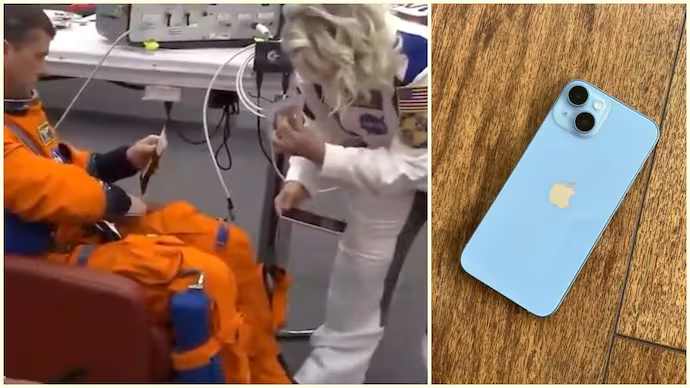
The idea of astronauts carrying iPhones to the Moon might sound like a tech gimmick, but it marks a subtle shift in how space exploration is experienced back on Earth. For NASA, the decision to allow smartphones aboard the Artemis II is less about convenience and more about connection.
As the first crewed lunar mission in over 50 years, Artemis II is already historic. Adding iPhones into the mix brings something new: A human lens on a mission traditionally defined by engineering precision and scientific milestones.
What is Artemis II, and why does it matter?
Artemis II is a 10-day crewed mission designed to orbit the Moon and return safely to Earth. Unlike the Apollo missions, this one won’t land on the lunar surface. Instead, it serves as a critical systems test for future missions that will.
A bridge between past and future
The mission connects two eras of spaceflight:
- The legacy of Apollo program, which last sent humans to the Moon in 1972
- The future ambitions of sustained lunar exploration and eventual Mars missions
The spacecraft, launched aboard the Space Launch System from Kennedy Space Center, is equipped with advanced life support, navigation, and communication systems.
But tucked into this high-tech ecosystem is something far more familiar: the iPhone.
Why are astronauts carrying iPhones?
The inclusion of iPhones isn’t about replacing mission-critical equipment. It’s about enhancing storytelling.
1. Capturing personal moments in space
For decades, space imagery has been captured through specialized cameras operated under strict protocols. iPhones introduce a more spontaneous, personal layer.
Astronauts can:
- Take candid photos and videos
- Record personal reflections
- Document moments that might not fit into official mission logs
This shift could make space missions feel less distant and more human.
2. Leveraging modern camera technology
Today’s smartphones rival professional cameras in many conditions. With advanced sensors, computational photography, and intuitive controls, iPhones offer:
- High-resolution imaging
- Low-light performance
- Stabilized video capture
In a microgravity environment, where bulky equipment can be cumbersome, a lightweight device becomes surprisingly practical.
3. Simplicity and usability in extreme environments
Space missions are complex enough. Tools that are easy to use reduce cognitive load on astronauts.
iPhones provide:
- Familiar interfaces
- Minimal training requirements
- Quick access for capturing fleeting moments
In short, they work like a digital notebook with a camera.
How NASA ensures safety and zero interference
Bringing consumer electronics into a spacecraft is not as simple as packing a carry-on.
Airplane mode is not optional
All iPhones will remain in airplane mode throughout the mission. This ensures:
- No signal transmission
- No interference with onboard systems
- Full compliance with spacecraft safety protocols
In this configuration, the devices function purely as offline tools.
Hardware integration and testing
Before approval, NASA teams:
- Tested devices for electromagnetic compatibility
- Evaluated performance in simulated space conditions
- Integrated them safely into astronaut gear
This is less about letting astronauts bring gadgets and more about certifying them as safe payloads.
Why this decision reflects a bigger shift in space storytelling
The use of iPhones signals a broader evolution in how space agencies communicate with the public.
From broadcast to personal narrative
Historically, space missions were documented through:
- Official footage
- Carefully curated images
- Technical briefings
Now, the focus is expanding to include:
- First-person perspectives
- Informal storytelling
- Behind-the-scenes glimpses
This mirrors how audiences consume content today, through platforms like Instagram and YouTube.
Making space exploration relatable
When astronauts share moments that feel personal, the mission becomes easier to connect with.
Instead of distant figures in bulky suits, they become:
- Individuals experiencing awe
- Professionals navigating challenges
- Storytellers sharing a rare journey
That relatability can inspire public interest, especially among younger audiences.
What this means for future missions
The Artemis II experiment with smartphones could set a precedent.
Potential future uses of consumer tech in space
If successful, future missions might expand the role of everyday devices:
- Real-time content creation tools
- Augmented reality interfaces for training or navigation
- Enhanced communication tools for crew interaction
While mission-critical systems will always rely on specialized hardware, consumer technology could play a growing supporting role.
Implications for Mars missions
As NASA looks toward Mars, long-duration missions will require:
- Psychological support for astronauts
- Tools for personal expression
- Ways to maintain a connection with Earth
Devices like smartphones could help bridge that emotional gap.
Where this fits in the broader Artemis program
Artemis II is just one step in a larger roadmap.
- Artemis III aims to land humans on the Moon again
- Future missions plan to establish a sustained lunar presence
- The long-term goal includes preparing for human missions to Mars
In this context, iPhones are a small detail with symbolic weight. They represent a shift from purely functional exploration to a more human-centered approach.
TL;DR
NASA astronauts carrying iPhones on Artemis II is not about convenience. It is about storytelling, accessibility, and bringing space exploration closer to everyday life. The devices will operate offline as personal cameras, offering a more human perspective on a historic mission.