
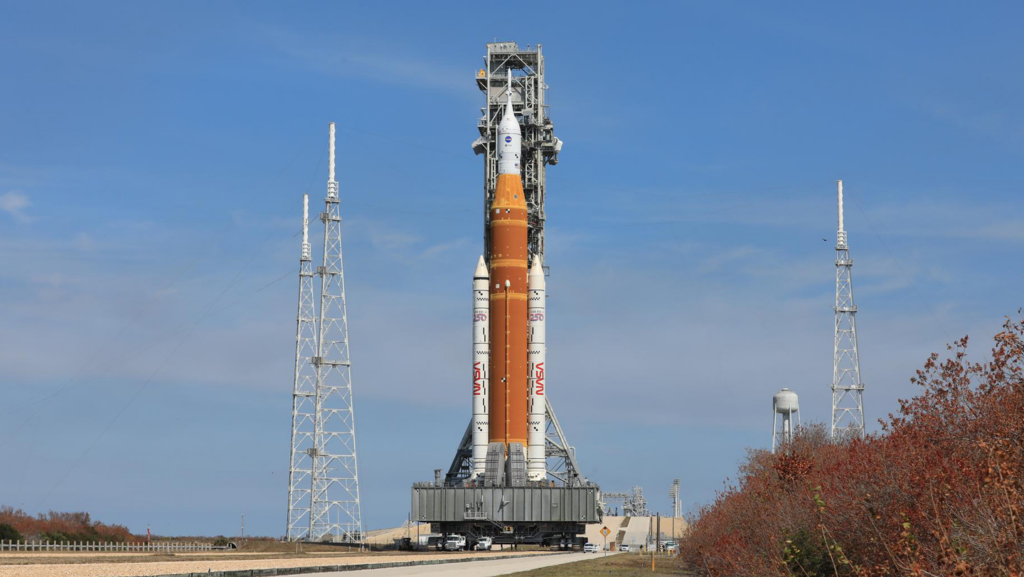
The next chapter of space exploration may not begin on Mars but on the Moon. According to U.S. policymakers and NASA planners, upcoming missions could transform the Moon into a refueling hub, a kind of “gas station” for missions deeper into space.
At the center of this vision is a mission designed not just to revisit lunar orbit but to lay the groundwork for a permanent human presence beyond Earth.
What does it mean to turn the Moon into a “gas station”?
The idea sounds futuristic, but it’s grounded in physics and logistics.
The core concept
Instead of launching everything from Earth, future missions could:
- Travel to the Moon first
- Refuel using lunar resources
- Then continue onward to Mars or beyond
This would dramatically reduce the cost and complexity of deep space missions.
Why the Moon?
The Moon offers two key advantages:
- Lower gravity: It takes far less energy to launch from the Moon than from Earth
- Available resources: Certain materials on the Moon could be converted into fuel
In short, the Moon could act as a stepping stone rather than a destination.
Why is leaving Earth so expensive?
One of the biggest challenges in space travel is escaping Earth’s gravity.
The problem
- Rockets need enormous amounts of fuel to reach orbit
- Most of a rocket’s mass is fuel—not payload
- Every additional kilogram increases the cost exponentially
Once a spacecraft is in space, however:
- Movement becomes far more energy-efficient
- Long-distance travel becomes easier
This is why refueling in space, or on the Moon, could be a game-changer.
What resources on the Moon make this possible?
The Moon isn’t just a barren rock, it may hold valuable materials for future missions.
Key resources
1. Water ice
- Found in permanently shadowed craters
- It can be split into hydrogen and oxygen
- These elements can be used as rocket fuel
2. Helium-3
- Rare on Earth but more abundant on the Moon
- Considered a potential fuel for nuclear fusion
- Still largely experimental, but highly valuable
3. Regolith (lunar soil)
- Can be used for construction
- Could support infrastructure like landing pads or habitats
These resources are central to the idea of a self-sustaining lunar base.
What is Artemis II, and why does it matter?
The mission is a critical step in NASA’s long-term plan.
Mission highlights
- Duration: Approximately 10 days
- Objective: Crewed flyby of the Moon
- First mission beyond low Earth orbit since 1972
What it will test
- Life support systems in the Orion spacecraft
- Deep-space navigation
- Human performance in extended space travel
This mission is less about landing and more about proving that humans can safely operate in deep space again.
When will humans return to the Moon?
NASA is targeting 2028 for a crewed lunar landing under the Artemis program.
Why the delay?
- Technical challenges
- Budget constraints
- Development timelines for spacecraft and landing systems
Despite delays, the long-term goal remains unchanged: a sustained human presence on the Moon.
What is the long-term vision of the Artemis program?
It’s not just about revisiting the Moon, it’s about staying there.
Future goals
- Build a permanent or semi-permanent lunar base
- Develop infrastructure for fuel production
- Use the Moon as a launchpad for Mars missions in the 2030s
Why a Moon base matters
- Enables continuous research
- Supports resource extraction
- Reduces dependence on Earth
Think of it as the difference between visiting Antarctica and building a research station there.
Why policymakers are backing this idea
U.S. lawmakers, including members of Congress, see the Moon as:
- A strategic asset in space exploration
- A way to reduce mission costs
- A platform for technological leadership
There’s also a geopolitical dimension, as other countries, including China, are advancing their own lunar ambitions.
What challenges remain?
Turning the Moon into a “gas station” is far from simple.
Major hurdles
- Extracting and processing lunar resources
- Building infrastructure in extreme conditions
- Protecting astronauts from radiation
- Ensuring long-term sustainability
Each of these challenges requires new technology and significant investment.
What does this mean for the future of space travel?
If successful, this approach could fundamentally change how humanity explores space.
Potential impact
- Cheaper missions to Mars and beyond
- Increased frequency of deep space travel
- Emergence of a space-based economy
In other words, the Moon could become the first logistics hub beyond Earth.
TL;DR
- NASA’s Artemis missions aim to use the Moon as a refueling hub
- Lunar resources like water ice could be converted into rocket fuel
- Artemis II will test human deep-space capabilities
- A crewed Moon landing is planned for 2028
- The long-term goal is a lunar base supporting missions to Mars