
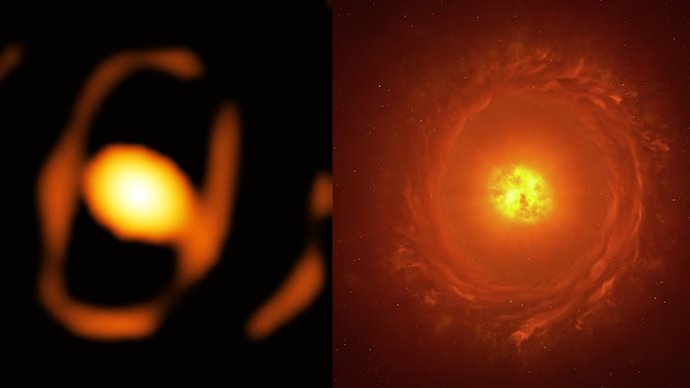
One of the largest known stars in the universe, WOH G64, has undergone a dramatic transformation over the past decade. Once classified as a red supergiant, the star is now considered a yellow hypergiant, a rare and unstable phase of stellar evolution.
Located in the Large Magellanic Cloud, WOH G64’s rapid change has drawn global attention. Astronomers say the star’s mass loss and instability suggest it may be approaching the final act of its life: a supernova explosion.
Here’s what we know, and why it matters.
What Is WOH G64?
WOH G64 is a massive star discovered in the 1970s and quickly recognized as one of the largest stars ever observed.
How Big Is It?
- More than 1,500 times the radius of our Sun
- Hundreds of thousands of times more luminous
- So large that, if placed at the center of our solar system, it would extend past Jupiter’s orbit
That scale is difficult to visualize. A simple comparison graphic showing the Sun, Betelgeuse, and WOH G64 side-by-side would make the difference clear.
Because it sits about 160,000 light-years away in the Large Magellanic Cloud, we are observing it from outside our own galaxy, which makes the level of detail astronomers have achieved even more impressive.
How Did Scientists Detect the Transformation?
In 2024, astronomers used the Very Large Telescope Interferometer (VLTI) in Chile to capture detailed images of WOH G64.
The images revealed:
- A thick, asymmetric, dusty cocoon
- Significant mass loss
- Evidence of instability in its outer layers
Dusty envelopes form when massive stars shed material into space. In WOH G64’s case, the scale of that mass loss appears extreme, even by red supergiant standards.
Why Was WOH G64 Reclassified as a Yellow Hypergiant?
In 2014, researchers reclassified WOH G64 as a yellow hypergiant, a rare and short-lived phase in the life of extremely massive stars.
What Is a Yellow Hypergiant?
Yellow hypergiants are:
- Exceptionally luminous
- Highly unstable
- Undergoing rapid internal restructuring
During this phase:
- The star’s core contracts
- Surface temperatures increase
- Outer layers are violently expelled
This transition marks a star that is no longer stable as a red supergiant but has not yet reached its final collapse.
What Triggered the Change?
Astronomers suspect several possible mechanisms:
- Violent surface eruptions
- Deep internal pulsations
- Binary interaction with a companion star
Spectral data indicate the presence of a companion star. Stellar interactions in binary systems can destabilize outer layers, accelerating evolution.
This kind of rapid change, over just a decade, is extraordinarily rare on cosmic timescales.
Why Is This Transformation So Unusual?
Massive stars do evolve through different phases, but typically over thousands to millions of years.
What makes WOH G64 remarkable is:
- The speed of its transition
- The scale of its mass loss
- The clarity of observational data
Astronomers are essentially watching stellar evolution unfold in near real-time, something that rarely happens.
Because the star lies outside the Milky Way, observing such detail is technically challenging. The VLTI combines multiple telescopes to simulate a much larger aperture, enabling unprecedented resolution.
A sidebar explaining how interferometry works would help readers understand how astronomers achieve this level of detail.
Is WOH G64 About to Go Supernova?
That’s the big question.
Stars of this mass do not die quietly. They eventually collapse under their own gravity, triggering a supernova explosion that briefly outshines entire galaxies.
What Points Toward an Explosion?
- Extreme mass loss
- Instability
- Rapid phase transition
However, predicting timing is nearly impossible. “Imminent” in astronomical terms could mean:
- Years
- Centuries
- Or even longer
Scientists cannot yet pinpoint when core collapse will occur.
Importantly, WOH G64 is far enough away that even a supernova would pose no threat to Earth. Instead, it would offer an unprecedented scientific opportunity.
What Would a Supernova Teach Us?
If WOH G64 explodes within the next few decades, astronomers could:
- Study pre-supernova mass loss in detail
- Measure shockwave formation
- Track heavy element production
- Observe neutrino emissions
Supernovae are responsible for forging elements heavier than iron, including many essential for planets and life.
Observing a well-documented star like WOH G64 explode would refine models of stellar evolution and help answer long-standing questions about how the most massive stars die.
Why This Matters for Stellar Physics
Massive stars shape galaxies.
They:
- Enrich interstellar space with heavy elements
- Trigger new star formation
- Influence galactic structure
WOH G64 provides a rare laboratory for testing theories about late-stage stellar instability.
The transformation from red supergiant to yellow hypergiant suggests our models of massive star evolution may need refinement, especially concerning how quickly instability can escalate.
TL;DR
- WOH G64 is one of the largest known stars in the universe.
- It has shifted from a red supergiant to a yellow hypergiant since 2014.
- Astronomers observed heavy mass loss and instability using the Very Large Telescope Interferometer.
- The transformation suggests it could be nearing a supernova.
- The timing remains uncertain, but the scientific stakes are enormous.