
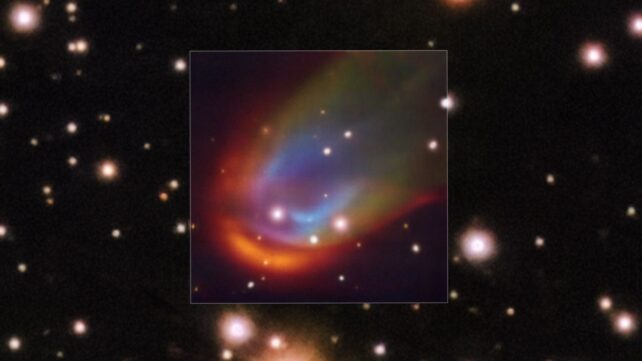
Astronomers studying a nearby dead star have stumbled upon something they did not expect and cannot yet fully explain. A glowing, rainbow-shaped bow shock surrounding the white dwarf RXJ0528+2838, located about 731 light-years from Earth, is forcing scientists to rethink how so-called “quiet” stellar remnants interact with their surroundings.
The discovery, made using the European Southern Observatory’s Very Large Telescope (VLT) and detailed in Nature Astronomy, reveals a massive arc of energized gas shining in hydrogen, oxygen, and nitrogen. Its vivid glow makes it resemble a cosmic rainbow, but its existence raises serious questions about long-standing models of stellar behavior.
What did astronomers observe around RXJ0528+2838?
RXJ0528+2838 is a white dwarf, the dense core left behind after a Sun-like star exhausts its fuel. White dwarfs are typically considered stable, slowly cooling objects, especially when they lack a surrounding disk of material.
Yet observations revealed a vast bow shock, a curved, luminous structure formed as the star plows through interstellar gas while orbiting the center of the Milky Way.
Key features of the bow shock:
- Composed primarily of hydrogen, oxygen, and nitrogen
- Bright enough to glow visibly in optical wavelengths
- Shaped like a curved arc, similar to a wave in front of a moving ship
- Estimated to have been forming for at least 1,000 years
That timescale is particularly puzzling. Diskless white dwarfs are not expected to drive long-lived, energetic outflows capable of shaping such large nebulae.
What is a bow shock, and why is this one unusual?
A bow shock forms when a fast-moving object compresses material in front of it, creating a shock wave. In astronomy, bow shocks are commonly seen:
- Around young, massive stars with strong stellar winds
- Near stars ejecting material at high speeds
- In systems with intense outflows driven by accretion disks
RXJ0528+2838, however, doesn’t fit neatly into any of these categories.
Why this bow shock breaks the rules
- The white dwarf lacks an accretion disk, usually essential for sustained outflows
- Known wind mechanisms from such stars are too weak to explain the structure
- The shock’s size and longevity exceed predictions by existing models
In short, by current understanding, this bow shock shouldn’t exist.
What could be powering the mysterious outflow?
RXJ0528+2838 is part of a binary system, meaning it has a companion star. Astronomers believe the white dwarf’s strong magnetic field may be pulling material directly from its companion and funneling it onto the stellar surface.
This process can release energy, but there’s a problem.
The unresolved mystery
- The magnetic field isn’t strong enough, on its own, to explain the sustained shock
- No known mechanism accounts for 1,000+ years of continuous outflow
- An additional, unknown energy source may be involved
“We found something never seen before and, more importantly, entirely unexpected,” said Simone Scaringi of Durham University.
“The surprise that a supposedly quiet, diskless system could drive such a spectacular nebula was one of those rare ‘wow’ moments.”
Why this discovery matters for stellar science
White dwarfs are often treated as the endpoint of stellar evolution, predictable, fading remnants. This discovery suggests thatthe assumption may be incomplete.
Implications for astronomy
- Challenges the standard model of mass transfer in binary systems
- Suggests white dwarfs can drive powerful outflows without disks
- Points to unknown magnetic or plasma processes at work
- May affect how astronomers interpret nebulae around other compact stars
“Our observations reveal a powerful outflow that, according to our current understanding, shouldn’t be there,” said Krystian Ilkiewicz of the Nicolaus Copernicus Astronomical Center in Poland.
What questions remain unanswered?
Despite the detailed observations, several major puzzles remain:
- What mechanism sustains the outflow for centuries?
- Is this phenomenon rare, or simply overlooked?
- Could similar bow shocks exist around other white dwarfs?
- How does magnetism interact with interstellar gas at these scales?
Astronomers say follow-up observations, especially in radio and X-ray wavelengths, may help identify the missing energy source.
A reminder that “dead” stars aren’t always quiet
RXJ0528+2838 serves as a powerful reminder that even well-studied cosmic objects can still surprise us. A star long past its prime is reshaping its environment in a way scientists didn’t think possible and glowing brightly while doing it.
As telescopes become more sensitive and surveys more comprehensive, astronomers expect more discoveries that challenge tidy theories and force revisions to how stars live and die.
TL;DR
- Astronomers found a rainbow-like bow shock around white dwarf RXJ0528+2838
- The structure shouldn’t exist based on current stellar models
- The shock appears to be over 1,000 years old
- Known mechanisms can’t fully explain its energy
- The discovery challenges how scientists understand dead stars and binary systems