
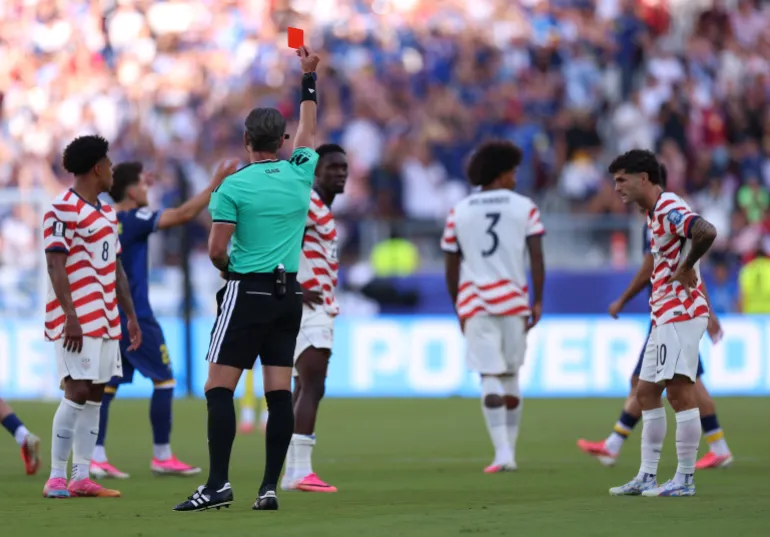
When FIFA suspended the automatic one-match ban handed to US striker Folarin Balogun, it did more than change one team’s lineup. It ignited one of the biggest governance controversies in modern World Cup history.
The decision came after US President Donald Trump publicly acknowledged that he had called FIFA president Gianni Infantino and requested a review of Balogun’s red card. While Trump insisted he merely asked for a review and did not pressure FIFA to reach a specific outcome, the timing of the reversal has raised uncomfortable questions about whether politics can influence football’s highest stage.
The controversy has shifted attention away from the pitch and toward FIFA’s disciplinary process, with players, coaches, former officials, and football federations questioning whether the governing body has blurred the line between legal discretion and competitive fairness.
TL;DR
- Folarin Balogun received a red card against Bosnia and Herzegovina.
- The dismissal automatically triggered a one-match suspension.
- Donald Trump later revealed he asked FIFA president Gianni Infantino to review the decision.
- FIFA suspended—not overturned—the automatic suspension using Article 27 of its disciplinary regulations.
- Balogun became eligible to play against Belgium, despite remaining officially guilty of the red-card offense.
- Belgium, UEFA, and several football figures criticised the move, arguing it threatens the integrity and consistency of FIFA’s disciplinary system.
What happened to Folarin Balogun?
The controversy began during the United States’ Round of 32 match against Bosnia and Herzegovina.
In the 64th minute, Balogun chased a loose ball and made contact with Bosnian defender Tarik Muharemović, planting his boot on the defender’s ankle.
Play immediately stopped.
Brazilian referee Raphael Claus consulted the Video Assistant Referee (VAR), reviewed the footage on the pitchside monitor, and issued a straight red card.
Although the United States comfortably won 2-0, the dismissal appeared to carry an unavoidable consequence: Balogun would miss the Round of 16 clash against Belgium due to FIFA’s automatic suspension rules.
That assumption lasted only a few days.
How did Donald Trump become involved?
The controversy escalated when Donald Trump disclosed that he personally contacted FIFA president Gianni Infantino.
Trump later explained his involvement by saying:
“I asked for a review because I didn’t think it was a foul. All I did was ask for a review.”
According to Trump, he did not instruct FIFA to overturn the punishment but simply requested another look at the incident.
Hours later, FIFA announced that Balogun’s automatic one-match suspension had been suspended, allowing the striker to play against Belgium.
Although FIFA insists its judicial bodies acted independently, the sequence of events immediately fueled speculation that political influence had entered football’s disciplinary process.
Did FIFA overturn the red card?
No.
This distinction lies at the center of FIFA’s legal defense.
The governing body did not rescind the red card.
Balogun remains officially guilty of the offense.
Instead, FIFA suspended the punishment attached to that offense.
That means:
- The red card stays on record.
- The automatic one-match suspension was paused.
- Balogun remained eligible to play immediately.
- He was placed on one year of probation.
If Balogun commits another similar disciplinary offense during that probationary period, FIFA could reactivate the suspended sanction in addition to imposing any new punishment.
How did FIFA justify the decision?
Article 27 became the key
FIFA relied on Article 27 of its Disciplinary Code.
The provision gives FIFA’s judicial bodies authority to suspend implementation of disciplinary sanctions while placing an individual under probation for one to four years.
Importantly, Article 27 specifically prohibits suspending punishments related to match manipulation—but does not prohibit doing so for red cards.
That legal wording became FIFA’s central argument.
The disciplinary committee later stated that the regulations give it broad discretion and contain no provision preventing Article 27 from being applied to Balogun’s case.
Supporters argue FIFA simply exercised authority already written into its rulebook.
Critics counter that the rule was never intended to override the mandatory suspension provisions governing World Cup red cards.
Why are critics calling this unprecedented?
Because automatic World Cup suspensions have traditionally been exactly that—automatic.
Since the modern disciplinary framework was introduced in 1970, a player sent off during a World Cup match has been expected to serve the following game.
Balogun’s case appears to be the first instance in the modern era where a player committed a World Cup red-card offense but avoided serving the automatic suspension through FIFA’s disciplinary discretion.
The closest historical comparison dates back to the 1962 World Cup.
Brazil legend Garrincha was dismissed during the semifinal against Chile but was later cleared to play in the final after disciplinary review.
However, today’s World Cup regulations are substantially different from those governing the tournament more than six decades ago.
Why does Belgium believe FIFA broke its own rules?
Belgium’s football federation quickly challenged FIFA’s decision.
Its argument rests on several regulations that appear to require an automatic suspension following a red card, including:
- Article 66.4 of the FIFA Disciplinary Code
- Article 10.5 of the 2026 FIFA World Cup Competition Regulations
- FIFA World Cup 2026 Circular No. 16
Belgium argues these provisions leave little room for exceptions once a player has been sent off.
The legal disagreement therefore isn’t about whether Article 27 exists.
It’s about whether Article 27 can legally override regulations specifically governing World Cup suspensions.
That question remains at the heart of the controversy.
Why are football figures concerned?
The criticism has come from across the football world—not simply from Belgium.
Former FIFA president Sepp Blatter questioned whether politics had entered football’s judicial process, arguing that disciplinary decisions should be determined by evidence rather than political intervention.
UEFA described the episode as crossing a “red line,” suggesting it undermines confidence in the sport’s governance.
Several prominent coaches also questioned the precedent.
Norway manager Ståle Solbakken warned that the decision creates uncertainty over how future dismissals will be handled.
England coach Thomas Tuchel accepted that Balogun’s challenge may have been debatable but emphasized that multiple officials, including VAR, had already reviewed the incident during the match.
His central question echoed throughout football:
If a completed VAR decision can later be suspended under these circumstances, where does the process stop?
Former England striker Ian Wright similarly criticized FIFA’s handling of the case, arguing that transparency and consistency are essential to maintaining trust in the tournament.
What has Gianni Infantino said?
Gianni Infantino acknowledged receiving Trump’s call but rejected suggestions that he personally influenced the outcome.
He said discussions with heads of state, government officials, football stakeholders, and business leaders are common during major tournaments.
According to Infantino, he informed Trump that FIFA’s independent judicial bodies—not the president—make disciplinary decisions.
That explanation has done little to quiet criticism because many observers argue perception matters almost as much as actual independence.
Even if the committee acted entirely on its own, the public disclosure of a presidential intervention has complicated FIFA’s efforts to demonstrate impartiality.
Did the decision ultimately change the tournament?
Only briefly.
Balogun returned to face Belgium after FIFA suspended his ban.
Belgium nevertheless defeated the United States 4-1, eliminating the Americans from the World Cup.
The result means the controversy ultimately had little effect on the tournament bracket.
Its long-term impact, however, may prove much larger than a single knockout match.
What does this controversy mean for FIFA?
The Balogun decision highlights a broader governance challenge facing global football.
Elite sporting organisations rely not only on written regulations but also on public confidence that those rules are applied consistently.
Whether FIFA acted fully within its legal authority may ultimately become less significant than whether fans, teams, and federations believe the process was transparent and insulated from outside influence.
The controversy has exposed an apparent tension between two principles:
- Legal discretion, allowing disciplinary committees flexibility in exceptional cases.
- Competitive certainty, ensuring every team understands that identical offenses receive identical consequences.
As FIFA continues expanding its global influence, balancing those competing principles may become one of its greatest governance tests.