
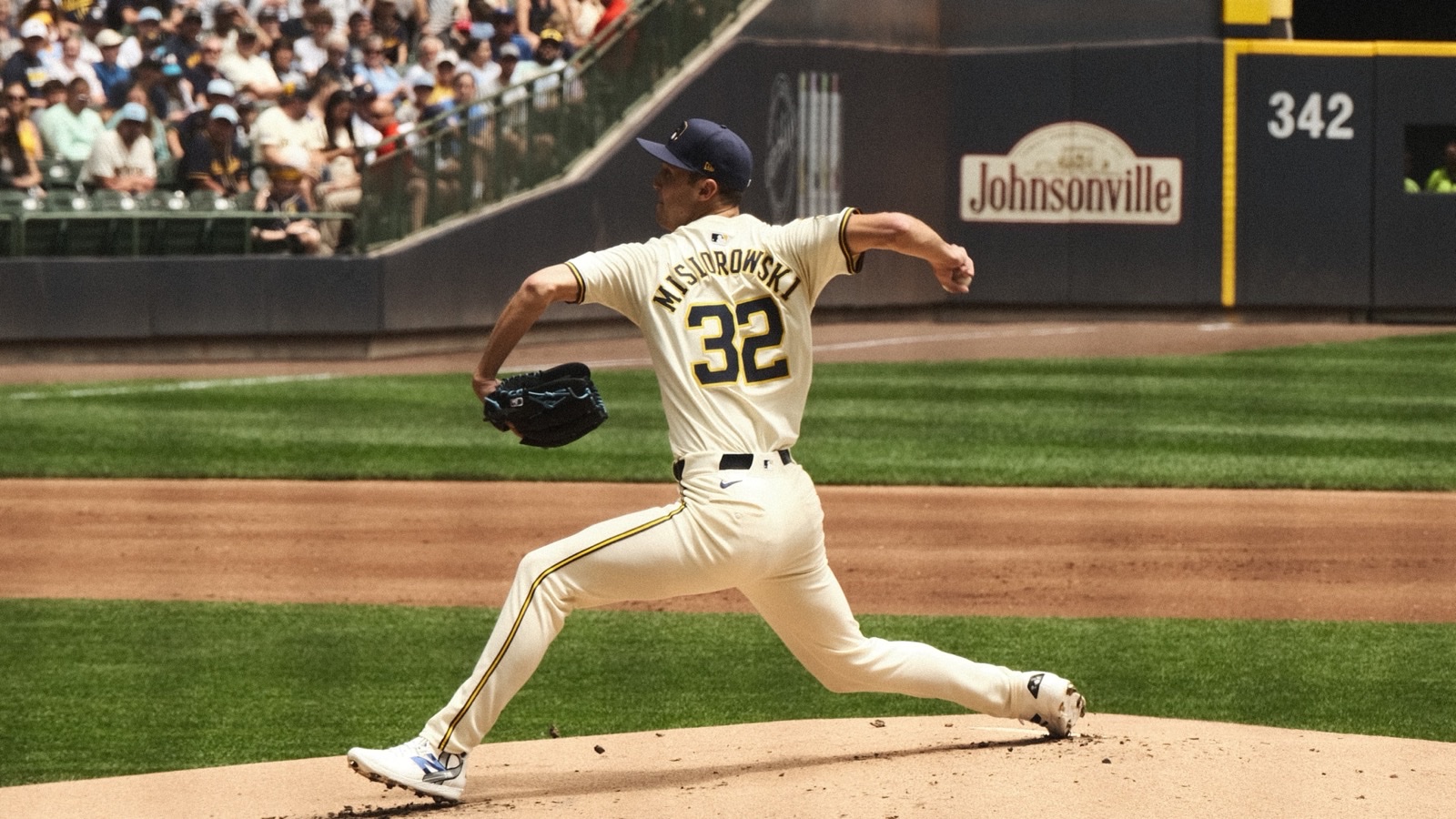

Jacob Misiorowski’s first pitch of the World Series was a 103.5 mph four-seam fastball. That is the fastest pitch in the Fall Classic since tracking began in 2008. The Brewers’ 24-year-old right-hander threw it to Tampa Bay’s Yandy Díaz on Friday night, and it sailed high for ball one, MLB.com reported. Milwaukee went on to win Game 1, 3-2.
The record says as much about where pitching is heading as it does about one arm. Velocity is what teams now pay for. It is also what Major League Baseball’s own experts named as the likeliest reason pitchers keep getting hurt.
A record pitch, then 37 more over 100
Statcast clocked the pitch at 103.5 mph, while the stadium boards showed 103.4, the Associated Press reported via theScore. The old World Series mark was Aroldis Chapman’s 103.2 mph for the Cubs in 2016. Among starters, the previous high was Noah Syndergaard’s 101.1 mph in 2015, the AP said.
The first pitch was no outlier. Misiorowski threw 13 pitches in a scoreless first inning, and 10 of his four-seamers topped 101 mph, according to MLB.com. He finished with 38 pitches at 100 mph or harder, a World Series record for the tracking era. He went five innings, allowed one run and left with a 2-1 lead.
This is normal for him. On October 3 he opened the NLDS against San Diego with a 104.8 mph strike to Fernando Tatis Jr. Both the AP and MLB.com list that as the fastest pitch in postseason history.
In the regular season he threw 1,115 pitches at 100 mph or harder. The previous high for any pitcher was 673, by Jordan Hicks in 2018, the AP reported.
His season line, per Baseball Savant, was a 1.80 ERA over 30 starts, with a National League-leading 252 strikeouts. His four-seamer averaged 100.6 mph. His top speed of the year was 105.5 mph on June 27, just short of Chapman’s regular-season record of 105.8.
Why his fastball arrives faster than the radar says
Three things make Misiorowski’s fastball play up, and only one of them is raw arm speed.
The first is his size. He is 6-foot-7 and releases the ball about 7½ feet in front of the rubber, MLB.com’s Anthony Castrovince wrote in June. That extension ranks in the 100th percentile on Baseball Savant. The ball leaves his hand closer to the hitter, so a batter gets less time to react than the radar reading suggests.
Statcast tracks that effect as “perceived velocity”. By that measure, Misiorowski is “comically far ahead of the pack,” Yahoo Sports’ Jack Baer wrote. Baer counted 710 of his fastballs with a perceived speed of 103 mph or more. No starter on record comes close; Jordan Hicks is second with six.
The second is spin. His four-seamer sits in the 99th percentile for spin rate, according to Baseball Savant. Baer also pointed to a low arm angle, which keeps the pitch on a flat path through the uppercut swings hitters now use.
The third is control of all that length. Castrovince reported that Misiorowski learned to stop his long stride from making his landing foot drift and his arm lag. A tighter, more repeatable delivery cut his walk rate from 11% to 7.3%. He also holds some velocity back early in games, so he has more left late.
What MLB’s own injury study blames
In December 2024, MLB published a 62-page report on why pitcher injuries have climbed. The league interviewed more than 200 people, including surgeons, biomechanists, pitchers and coaches, MLB.com’s David Adler reported. They broadly agreed on three causes: the chase for velocity, pitch design aimed at nastier “stuff”, and max-effort pitching and training.
The numbers line up with that view. The average MLB four-seamer rose from 91.3 mph in 2008 to 94.2 mph in 2024, the AP reported in its story on the study. Over a similar stretch, Tommy John surgeries in the majors and minors rose from 104 in 2010 to a peak of 314 in 2020. There were 281 in 2024.
One orthopedic surgeon quoted in the report said rising fastball velocity “has completely paralleled the increased incidence of injury.” Dr. Glenn Fleisig, MLB’s injury research adviser, called the report “a first step, and an encouraging step.” That caution matters, because the report describes a trend across the sport, not a cause in any one pitcher.
What the research can and can’t say about one elbow
The peer-reviewed studies are less settled than the headlines about them.
A 2016 study in the American Journal of Sports Medicine looked at 1,327 MLB pitchers using PitchFx tracking data. Pitchers who later needed ulnar collateral ligament reconstruction threw harder before the injury. Their peak velocity averaged 93.3 mph, against 92.1 mph for the rest. The authors, led by Peter Chalmers, called velocity “the most predictive factor” of the surgery.
Yet velocity, weight and age together explained only 7% of the variation in who had it.
A Journal of Shoulder and Elbow Surgery study that year, led by Robert Keller, compared 83 surgery patients with matched pitchers. It found no velocity gap: 91.5 mph against 91.2. What stood out was how often the injured group threw fastballs, at 46.7% of pitches against 39.4%.
Set those findings next to Misiorowski and the gap is striking. The difference that flagged risk in the Chalmers study was 1.2 mph. His average four-seamer is 6.4 mph above the 2024 league average in MLB’s report. Neither study included anyone near his speed, so neither can say what it means for his elbow.
The Brewers have shown they are watching. They scratched him from a July 12 start at Pittsburgh with arm fatigue, and he missed the All-Star Game, the AP reported. “I think we take that as kind of a reset,” manager Pat Murphy said when he returned on July 20. He did not go on the injured list.
Shohei Ohtani shows how the story can turn. He had a second elbow operation in September 2023 and did not pitch during his record 50-homer, 50-steal season in 2024.
Game 2, and the debate after the season
MLB’s report urged the league to consider rules that “increase the value of pitcher health and durability, and decrease the value of short-duration, max-effort pitching,” MLB.com reported. Misiorowski does not fit that split neatly. He brings reliever velocity to a starter’s workload, which is exactly the profile the research has the least data on.
The same kind of tracking data now settles arguments well beyond velocity. In Korea, a study of the robot strike zone found it took away star hitters’ edge.
The series moves on without Misiorowski for now. Logan Henderson starts Game 2 for Milwaukee against Tampa Bay’s Drew Rasmussen on Saturday, CBS Sports reported. First pitch at American Family Field is 8 p.m. ET on FOX, according to MLB.com, with the Brewers up 1-0.