
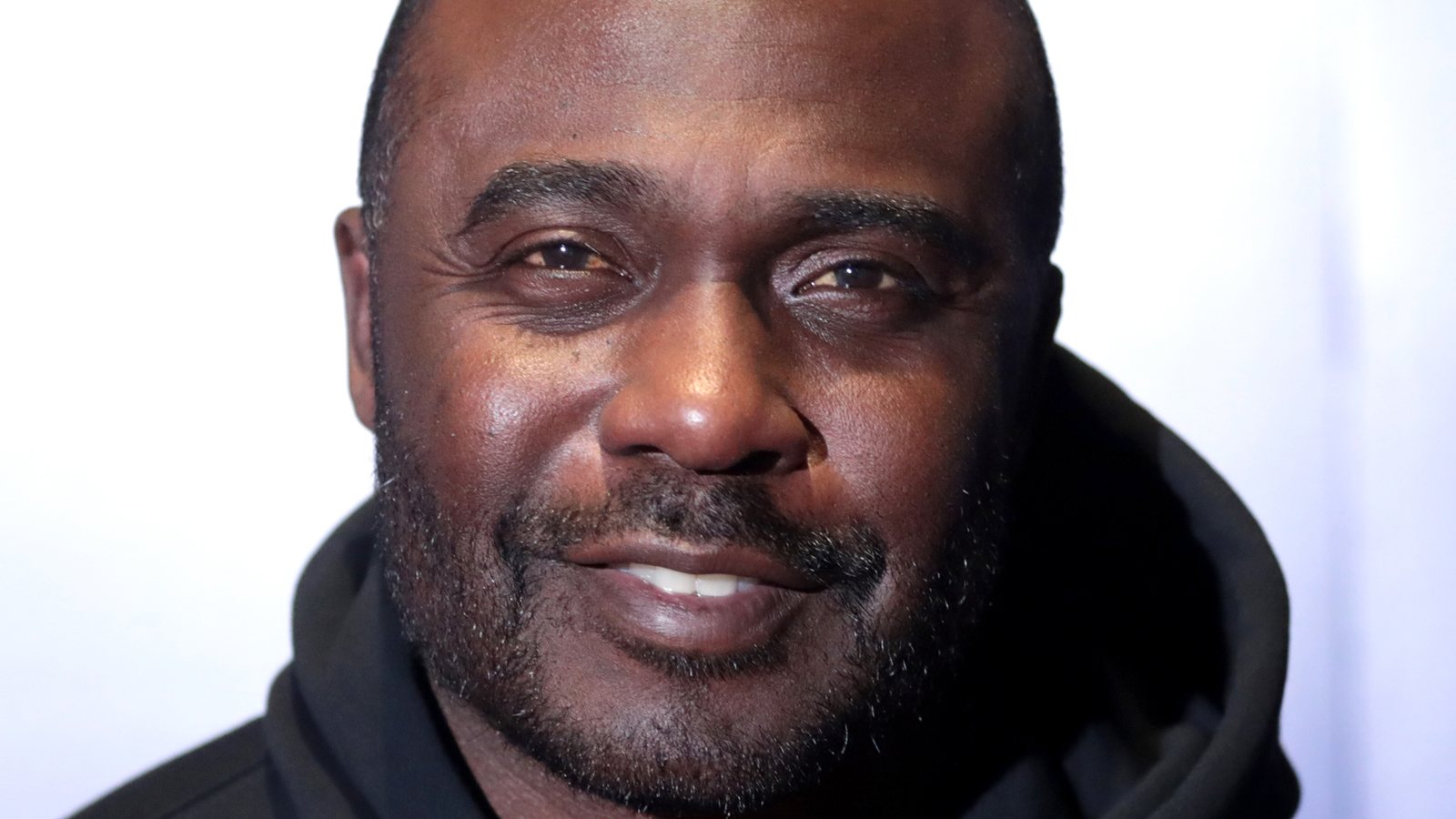

Marshall Faulk says he has been living with Parkinson’s disease for about 18 months. The first clue was stiffness in his hands after golf, which he raised at a routine physical. Faulk, 53, says medication has kept his symptoms steady and that he caught it early.
He told his story on “The Caring Neurologist,” a podcast hosted by neurologist Sandeep Thakkar, in an episode released Wednesday, Oct. 21. Faulk is a 2011 Pro Football Hall of Fame inductee and is in his first season as Southern University’s head coach. “I want to help as many people as I can,” he said, ESPN reported.
Stiff hands after golf, then a doctor’s push
Faulk told Thakkar he gets physicals twice a year. He had noticed “rigidity” in his hands after playing golf and at first blamed it on putting.
“I just thought it was normal nerves when putting and stuff like that,” he said, according to ESPN. Then it kept happening in casual rounds. “I was like, ‘Wow, is that something — is that normal?’ And the doctor was — he literally was like, ‘You need to go get checked.'”
Since starting treatment, Faulk says he is more active and sleeping more, CBS Sports reported. He still has hand rigidity, which he believes hasn’t worsened, along with “little tremors.” He says he has had no cognitive decline and feels “clear of thought.”
He hadn’t yet discussed the diagnosis with family or friends. “I’m functioning. I’m good,” he told Thakkar. “I just I think I caught it early. I’m in a good place.”
How his symptoms line up with the known early signs
Parkinson’s happens when dopamine-producing nerve cells in a part of the brain called the substantia nigra weaken and die. By the time symptoms appear, most people have lost 60% to 80% or more of those cells, according to the National Institute of Neurological Disorders and Stroke (NINDS).
We set what Faulk described against the descriptions published by NINDS and the Parkinson’s Foundation’s list of 10 early signs.
| What Faulk described | What the health sources say |
|---|---|
| Rigidity in his hands after golf | NINDS says rigidity “affects most people with PD,” with muscles that stay tense and tight. The Foundation lists stiffness that doesn’t go away with movement as an early sign. |
| “Little tremors” | A slight shaking of a finger, thumb, hand or chin, especially at rest, is “a common early sign,” the Foundation says. NINDS notes some people never develop a tremor. |
| “I just pay attention to my gait” and balance | NINDS lists balance problems and a stooped, shuffling walk among four common symptoms, and says walking can get harder as symptoms worsen. |
| Noticed it in his hands first | Symptoms “often begin on one side of the body,” and tremor often starts in a hand, per NINDS. |
The fit is close. Faulk’s first symptom is one NINDS says most patients have, and he spotted it in a fine-motor task he does constantly.
The Foundation says no single sign means you should worry, but more than one is a reason to see a doctor. Faulk’s doctor sent him for testing after hearing one symptom at a checkup.
Early, but not “young-onset”
A diagnosis in your early 50s can sound like young-onset Parkinson’s. By the standard definitions, Faulk’s isn’t.
The Parkinson’s Foundation defines young-onset as diagnosis before age 50, and says it accounts for about 4% of US cases. NINDS uses the same cutoff for “early-onset” and puts the average age at onset in a person’s early to mid-60s.
Faulk is 53 and says he has been dealing with the disease for about 18 months, so his symptoms began when he was 51 or 52. That is roughly a decade earlier than average, but above the young-onset line.
About 1.1 million Americans live with Parkinson’s, and nearly 90,000 are diagnosed each year, the Foundation estimates. The disease affects more men than women.
What research says about football and Parkinson’s
Faulk hasn’t connected his diagnosis to football in any reporting on the podcast, and no doctor has publicly linked the two in his case. Still, he spent 12 NFL seasons as a running back, so the question is fair.
The most cited study is a 2023 paper in JAMA Network Open from Boston University’s CTE Center and the Michael J. Fox Foundation. It surveyed 1,875 men who had played organized sports, through the online Fox Insight study. Those who had played tackle football had 61% higher odds of reporting a Parkinson’s or parkinsonism diagnosis than men who played other sports.
The odds rose with each season played. Men who reached college or professional football had nearly three times the odds of those who stopped at youth or high school level.
The limits matter. The sample was “enriched” for Parkinson’s, with 85% already diagnosed, and diagnoses and playing history were self-reported. Only five of the 729 football players had played professionally or semi-professionally, so the study says little directly about NFL careers like Faulk’s.
“The reasons for this relationship are not clear,” Michael Alosco, the study’s corresponding author, said in Boston University’s release.
Parkinson’s is also distinct from CTE, the disease most linked to football. CTE involves a distinctive buildup of a protein called tau and can only be diagnosed after death, according to the BU CTE Center. Parkinson’s is diagnosed in living patients, and NINDS says the damaged cells usually hold clumps of a different protein, alpha-synuclein.
Faulk isn’t the first star of his era to go public. Fellow Hall of Famer Brett Favre disclosed his diagnosis at a congressional hearing in September 2024, ESPN reported. He had earlier said he may have had hundreds or thousands of concussions. Faulk hasn’t said anything similar in the coverage so far.
Treatment, exercise and a team still playing
There is no cure. The main drug, levodopa, is usually paired with carbidopa and “usually works very well” on early movement symptoms, NINDS says. It doesn’t stop the disease, and doses often rise over time.
Exercise is the other pillar. In the Parkinson’s Foundation’s Parkinson’s Outcomes Project, people who started exercising early, at least 2.5 hours a week, had a slower decline in quality of life. That finding is observational. NINDS-supported trials are testing whether hard aerobic exercise can slow the disease itself.
Faulk compares the diagnosis to his surgically repaired right knee. “It’s something you live with,” he said, per ESPN.
He cited Michael J. Fox, who has lived with the disease for decades, and Muhammad Ali, whom he met at a dinner. “He’s all there,” Faulk recalled thinking.
For readers his age, the takeaway is narrow. Stiffness or a resting tremor that doesn’t go away is worth raising at a checkup, as Faulk did. Diagnosis isn’t always simple, as our report on Christina Applegate and how often MS is misdiagnosed showed.
His news landed the same week as Jalen Hurts’ season-ending lung clots. Faulk, though, is still on the sideline. Southern is 3-4, and the Jaguars play at Texas Southern on Saturday, Oct. 24, per ESPN’s schedule.