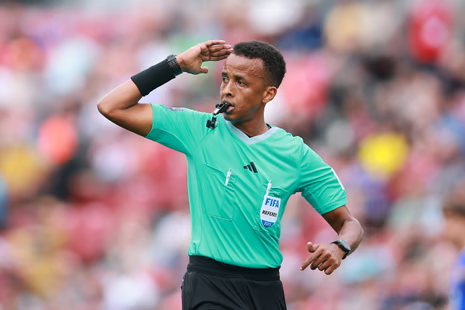
The 2026 FIFA World Cup has lost one of Africa’s most respected referees before the tournament has even begun.
Somali official Omar Abdulkadir Artan has been ruled out of officiating at the tournament after being denied entry into the United States, according to FIFA and US authorities. The decision has triggered disappointment across Somalia’s football community and reignited debate over how immigration restrictions could affect international sporting events hosted by the US.
Artan, who was selected as part of FIFA’s officiating pool for the expanded 2026 World Cup, reportedly arrived at Miami International Airport on Saturday but was refused entry following additional screening by US Customs and Border Protection (CBP).
FIFA later confirmed that he would no longer participate in the tournament.
FIFA Confirms Artan’s Removal From World Cup Duties
In an official statement, FIFA said the governing body had no authority over host nation immigration decisions.
“FIFA can confirm that match official Omar Abdulkadir Artan will be unable to train and officiate at the FIFA World Cup 2026 after he was denied entry into the United States,” the organization said.
FIFA added:
“FIFA is not involved in host country immigration processes, including visa adjudications.”
The statement underscores a growing challenge facing international sporting events hosted in politically sensitive immigration environments: global tournaments may promise inclusivity, but access ultimately depends on national border policies.
Why Was Omar Artan Denied Entry?
US authorities have not publicly disclosed a detailed reason for the decision.
However, CBP confirmed Artan underwent additional inspection upon arrival in Miami.
A spokesperson said:
“During processing, the traveler underwent additional inspection, a routine part of CBP’s inspection process when officers need to verify information or determine admissibility.”
The agency added that admissibility decisions are made individually using:
- Immigration records
- National security databases
- Law enforcement information
- Available travel documentation
Notably, reports indicate Artan possessed a valid US visa at the time he traveled.
That detail has intensified scrutiny around the decision because visa approval does not automatically guarantee entry into the United States. Under US law, border officials retain broad discretionary authority to deny admission even after a visa has been issued.
Somalia’s Inclusion in Travel Restrictions Adds Context
The incident comes amid expanded US travel restrictions affecting several countries, including Somalia, under policies linked to the Trump administration.
While officials have not explicitly stated that the travel ban caused Artan’s denial, Somalia’s inclusion on restricted-entry lists has become central to public discussion surrounding the case.
The controversy raises broader questions for international sporting bodies ahead of the 2026 FIFA World Cup, which will be jointly hosted by:
- The United States
- Canada
- Mexico
The US will host the majority of matches and serve as the tournament’s operational center.
That scale means immigration coordination will be critical not only for players and staff but also for referees, journalists, officials, sponsors, and fans traveling from around the world.
Somali Football Community Reacts With Frustration
Artan’s exclusion has prompted frustration and disappointment across Somalia’s football circles.
Ciise Aden Abshir, senior adviser to Somalia’s Ministry of Youth and Sports and captain of the national football team, described Artan as one of Africa’s elite referees.
“Omar Artan is among Africa’s most respected referees and deserves the support of the entire football community,” Abshir told Agence France-Presse.
He argued the decision damages more than just one individual’s career.
“Denying him entry undermines football’s commitment to fairness, merit, and fair play.”
The emotional reaction reflects how significant Artan’s rise has been for Somali sport, particularly given the country’s decades-long struggles with conflict, instability, and limited sports infrastructure.
Omar Artan’s Rise in African Football
Artan has built a strong reputation across African football over the past several years.
He became a FIFA-listed referee in 2018 and has officiated in major continental competitions, including the Africa Cup of Nations.
In 2025, he was named the Confederation of African Football’s Men’s Referee of the Year — one of the highest officiating honors in African football.
Earlier this year, Somali President Hassan Sheikh Mohamud publicly celebrated Artan’s appointment to the World Cup officiating panel, describing it as a historic milestone for the country.
For many Somali fans, the appointment represented:
- International recognition
- Sporting progress
- Increased African representation at elite tournaments
- A rare global success story tied to Somali football
That context has made his exclusion especially painful domestically.
A Potential Headache for FIFA Ahead of 2026
The incident also highlights a larger logistical and political challenge facing FIFA as it prepares for the biggest World Cup in history.
The 2026 tournament will feature:
- 48 national teams
- Expanded staffing requirements
- Larger officiating crews
- Millions of international visitors
Any perception that officials, athletes, or fans could face unequal treatment at borders risks creating diplomatic and reputational complications for both FIFA and host nations.
Sports and Immigration Are Increasingly Colliding
Major sporting events have historically operated under the assumption that athletes and officials would receive streamlined entry access regardless of geopolitical tensions.
But recent years have shown that assumption no longer holds automatically.
Global tournaments now increasingly intersect with:
- National security policy
- Visa restrictions
- Diplomatic disputes
- Travel bans
- Geopolitical tensions
That reality places organisations like FIFA in a delicate position:
They depend on host governments while simultaneously promoting ideals of global inclusion and equal participation.
What Happens Next?
At this stage, FIFA has confirmed Artan will not officiate at the 2026 World Cup.
There is no indication yet of whether appeals or diplomatic interventions are being explored.
The tournament itself is scheduled to run from June 11 to July 19, 2026, across North America.
For Somalia, however, the story has already become bigger than football.
To many observers, Artan’s exclusion symbolises the growing collision between international sport and modern border politics — where even elite global officials can find themselves caught between diplomacy, immigration systems, and national security policies.
TL;DR
- Somali referee Omar Abdulkadir Artan has been barred from officiating at the 2026 FIFA World Cup after being denied entry into the US.
- FIFA confirmed it has no authority over immigration decisions made by host countries.
- Artan reportedly had a valid US visa but was refused entry after additional screening in Miami.
- Somalia’s inclusion in US travel restrictions has intensified scrutiny around the decision.
- Artan is one of Africa’s top referees and won CAF Men’s Referee of the Year award in 2025.
- The incident raises broader concerns about immigration and access during the 2026 World Cup.