
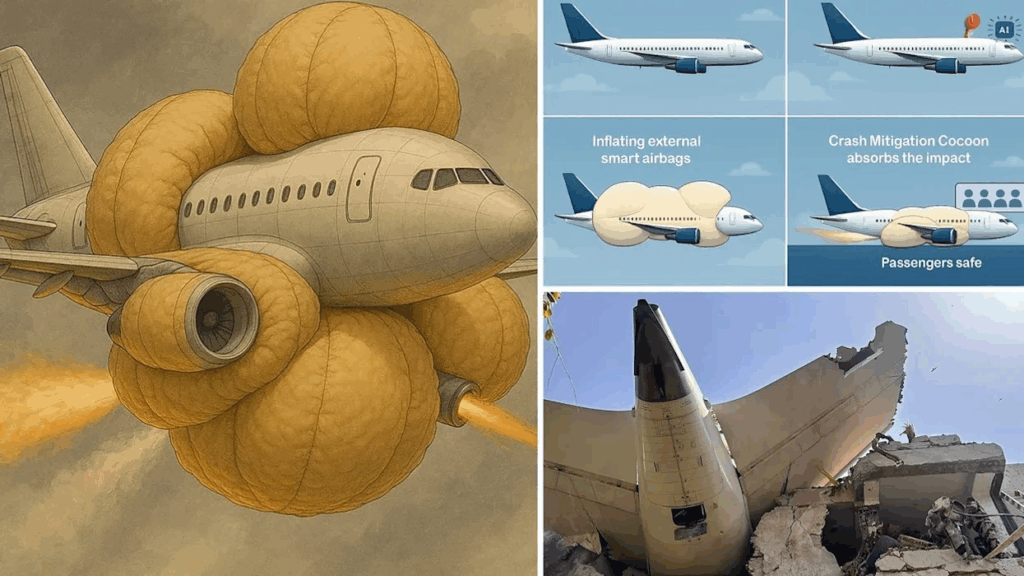
What inspired Project REBIRTH
Two young Indian engineers, Eshel Wasim and Dharsan Srinivasan, have proposed a bold new aviation safety system they call Project REBIRTH, an AI-powered airbags and crash mitigation system designed to make passenger planes more survivable in the event of catastrophic failure.
The idea stems from the Air India crash in Ahmedabad in June 2025, which killed 260 people, including passengers and bystanders on the ground. The tragedy deeply affected the inventors’ families, prompting them to rethink how aviation safety could evolve beyond conventional seatbelts, oxygen masks, and structural reinforcements.
“Project REBIRTH was born not in a lab, but from a moment of heartbreak,” they wrote in their submission to the James Dyson Award, an international competition that recognizes student innovations.
How the AI-powered airbag system works
Project REBIRTH combines artificial intelligence, impact-absorbing materials, and rescue signaling systems into one integrated safety mechanism. Its main features include:
- Real-time monitoring: AI continuously analyzes flight data to detect technical failures.
- Smart airbag deployment: External airbags deploy within two seconds from the plane’s nose, belly, and tail to cushion the impact.
- Reverse thrust and boosters: Gas boosters or reverse thrust mechanisms are activated to slow the aircraft’s descent.
- Impact-hardened fluids: Special fluids solidify on impact to absorb force and shield the cabin.
- Rescue optimization: A bright orange protective shell, GPS tracking, infrared beacons, and illuminated exits help rescuers locate survivors quickly.
The system is designed to activate automatically at altitudes below 3,000 feet if a crash is imminent. It can be retrofitted into existing planes or integrated into new aircraft designs.
Can planes ever be crash-proof?
Aviation safety experts note that commercial aviation is already one of the safest modes of travel, with accident rates steadily declining. However, catastrophic crashes—though rare—often leave little room for survival.
Project REBIRTH doesn’t claim to eliminate crashes but aims to make survival more likely by addressing two key challenges:
- Reducing impact force – through airbags and thrust mechanisms.
- Improving rescue response – through visibility, signaling, and rapid location.
While the system has generated online buzz, some critics question whether external airbags could withstand the massive forces of real-world crashes or whether they could inadvertently complicate evacuation efforts.
Why it matters for the future of aviation
If successful, Project REBIRTH could mark a paradigm shift in aviation safety—similar to how airbags transformed automobile safety decades ago.
The engineers argue that even if the technology cannot guarantee survival in every crash, increasing survivability by even 10–20% would represent thousands of lives saved over time.
This is especially significant as global air travel rebounds post-pandemic, with passenger numbers projected to surpass 4.7 billion annually by 2026 (source: International Air Transport Association).
What’s next for Project REBIRTH
The creators plan to move beyond the concept stage into prototype testing, though they acknowledge challenges ahead:
- Engineering validation – proving the system can deploy reliably under different crash conditions.
- Cost and retrofitting feasibility – ensuring airlines can integrate the technology affordably.
- Regulatory approval – passing stringent safety certifications from aviation authorities.
While still at an early stage, Project REBIRTH signals a growing interest in applying AI and adaptive materials to aviation safety.
TL;DR
Two engineers inspired by the 2025 Air India crash have designed Project REBIRTH, an AI-powered airbag system that deploys around planes during emergencies to absorb impact and aid rescue. While experts are cautious about its real-world feasibility, the idea could reshape the future of aviation safety if proven viable.