
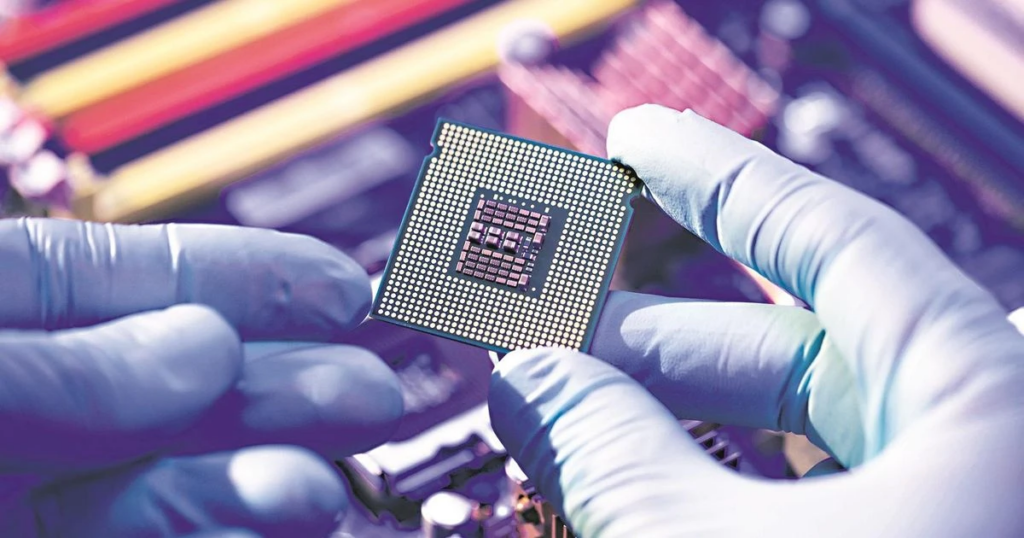
Artificial intelligence promised smarter software. What it quietly demanded was vastly more hardware, especially memory. That demand is now rippling through global markets, reshaping valuations, squeezing device makers, and enriching chip manufacturers.
The result: a growing global chip crisis centered not on processors, but on memory. And unlike past semiconductor shortages tied to consumer booms, this one is driven by data centers training and running AI models at an industrial scale.
Since late 2025, memory prices have surged so sharply that electronics stocks and semiconductor stocks have moved in opposite directions. Investors are effectively placing bets on who controls supply rather than who sells products.
Why is the global chip crisis centered on memory, not CPUs?
Modern AI systems don’t behave like traditional software. A typical application might process megabytes. An AI model processes terabytes continuously.
AI runs on memory bandwidth, not just compute
Training or operating large AI models requires high-bandwidth memory (HBM) attached to GPUs. The processor performs calculations, but memory feeds it data. Without enough memory throughput, even the most advanced GPU sits idle.
Think of GPUs as engines and memory as fuel lines. Recent AI models widened the pipes faster than manufacturers could build them.
Key differences between traditional computing and AI workloads:
- Traditional apps: compute-limited
- AI training: memory-limited
- AI inference: latency-sensitive and memory-intensive
- Generative AI: constant data streaming
That shift has pushed semiconductor manufacturers to reallocate production capacity toward HBM used in AI servers and away from conventional DRAM used in phones, cars, and PCs.
The supercycle effect
Spot DRAM prices have climbed more than 600% in recent months. Meanwhile, NAND storage demand has risen alongside AI workloads that store and retrieve massive datasets.
This is why analysts now describe a “memory supercycle” rather than a normal shortage.
Who benefits from the global chip crisis?
Memory manufacturers have become the market’s biggest winners.
Stocks tied to memory production have surged:
- SK hynix up more than 150%
- Kioxia and Nanya roughly +280%
- SanDisk over +400%
- Samsung among top performers
Investors are rewarding companies controlling supply rather than those selling finished products.
Why investors are betting on chipmakers
Unlike consumer electronics firms, memory producers can raise prices quickly because supply is limited and demand is structural.
AI data centers cannot simply delay purchases. Training models is time-sensitive and tied to competitive advantage. That makes demand unusually inelastic.
In past cycles:
- Consumers delayed buying phones
- Companies delayed PC upgrades
Now:
- AI companies cannot delay the compute capacity
This is the core difference driving market divergence.
Who loses when memory prices rise?
Hardware companies that rely on memory but don’t produce it face margin pressure.
Consumer tech
A global index tracking electronics manufacturers has dropped about 12% since September.
Affected companies include:
- PC accessory makers
- Game console manufacturers
- Smartphone brands
Nintendo shares fell sharply after warning about higher costs. Logitech has dropped roughly 30% from recent highs.
Smartphones and PCs
Manufacturers are responding in subtle ways rather than obvious price hikes:
- Reduced discounts and cashback offers
- Lower base storage configurations
- Delayed model launches
- “Shrinkflation” in specifications
Some brands are increasing retail prices, but many prefer hidden adjustments to avoid consumer backlash.
Automakers
Modern vehicles contain large amounts of memory for driver assistance systems and infotainment. Chinese manufacturers, including BYD and Xiaomi, have faced investor concerns about production constraints.
Cars now compete with AI data centers for the same components.
Why is this chip cycle different from past shortages
Historically, semiconductor cycles lasted three to four years and were tied to consumer demand swings. This one is tied to infrastructure.
AI demand doesn’t cool like consumer demand
Smartphone demand fluctuates with upgrades. AI demand grows with model capability.
Every new generation of AI requires:
- More parameters
- Larger datasets
- Faster inference
- Real-time responses
That multiplies memory demand per server rather than per user.
Supply cannot expand quickly
Building a memory fab costs tens of billions of dollars and takes years to complete. Even announced investments, such as large semiconductor projects in India and elsewhere, will not relieve pressure soon.
Fund managers increasingly expect tight supply to last through the year rather than normalize within a quarter.
How companies are adapting
Tech firms securing supply
Large AI companies are locking long-term contracts directly with memory manufacturers. This is similar to how cloud providers previously secured power generation capacity.
The industry is shifting from just-in-time purchasing to strategic resource control.
Device makers are redesigning products
Manufacturers are modifying hardware designs to reduce dependency:
- Optimized software using less RAM
- Lower default storage tiers
- Modular upgrades
- Fewer model variants
Investors repositioning portfolios
Markets are splitting into two camps:
Winners
- Memory producers
- AI infrastructure suppliers
- Data center hardware providers
Losers
- Consumer electronics brands
- Peripheral makers
- Cost-sensitive hardware manufacturers
What happens next?
The most important variable is whether AI growth slows. Currently, evidence suggests the opposite.
As models expand into video generation, robotics, and real-time assistants, memory requirements multiply again.
If supply expansion lags demand, the global chip crisis becomes less of a shortage and more of a permanent pricing floor.
In other words, memory may shift from commodity to strategic resource.
Why this matters beyond tech stocks
Consumers will eventually feel the effects:
- Phones cost more for the same storage
- PCs upgrade slower
- Cars ship with fewer digital features
- Gaming hardware cycles lengthen
Meanwhile, AI services may grow more powerful but also more expensive to run.
This is not just a semiconductor story. It is the first economic ripple of an AI infrastructure economy, where compute resources behave more like energy markets than electronics components.
TL;DR
- AI requires massive memory bandwidth, not just processing power
- Manufacturers redirected production to AI data centers
- Memory prices surged over 600%
- Chipmakers are booming while electronics companies struggle
- Shortage may last longer than traditional semiconductor cycles
- Consumers will eventually pay through higher device costs