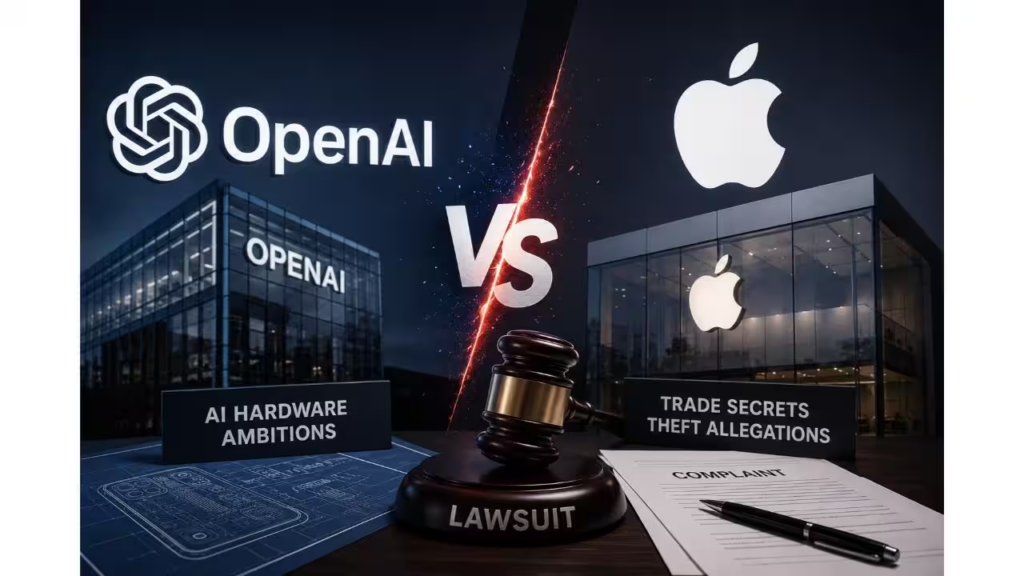
Apple has accused OpenAI of orchestrating a wide-ranging campaign to obtain confidential hardware information, filing a 41-page lawsuit that alleges trade secret theft involving former Apple employees now working at the artificial intelligence company.
Filed in the U.S. District Court for the Northern District of California, the lawsuit claims Apple’s proprietary manufacturing techniques, engineering designs, supplier information, and confidential internal documents were improperly taken as OpenAI accelerated its ambitions in consumer hardware.
OpenAI has denied the allegations, saying it has “no interest in other companies’ trade secrets” and that it is unaware of evidence supporting Apple’s claims. The allegations have not been proven in court.
What Is Apple’s Lawsuit About?
Apple alleges that OpenAI benefited from confidential information taken by former Apple employees who later joined the AI company.
Rather than accusing OpenAI of copying products such as the iPhone, Apple argues that the company sought to obtain the knowledge behind how its hardware is designed and manufactured.
According to the complaint, this information could have helped accelerate OpenAI’s efforts to build consumer hardware following its acquisition of Jony Ive’s hardware startup, io.
The lawsuit seeks to protect what Apple describes as years of proprietary engineering and manufacturing expertise.
What Does Apple Say Was Stolen?
According to the complaint, Apple alleges that the following categories of confidential information were improperly taken or accessed:
1. Metal Manufacturing and Finishing Processes
Apple says proprietary techniques used to manufacture and finish metal components for its devices were among the trade secrets allegedly taken.
These processes are developed over years of research and are considered commercially valuable because they influence product durability, appearance, and production efficiency.
2. Battery and Power System Designs
The lawsuit alleges that confidential engineering information relating to batteries, charging systems, and internal power-management components was improperly retained or shared.
Apple argues these designs represent proprietary research that competitors cannot legally obtain outside authorized channels.
3. Supplier and Manufacturing Network Information
Apple claims confidential information about:
- Manufacturing partners.
- Component suppliers.
- Vendor relationships.
- Internal supply-chain operations.
was included among the alleged trade secrets.
The company argues this information provides a competitive advantage by supporting efficient production and procurement.
4. Internal Supplier Terminology
The complaint also alleges that Apple-specific language and terminology used in communications with suppliers was taken.
Although seemingly minor, Apple argues such terminology reflects proprietary internal processes and manufacturing workflows.
5. CAD Files and Engineering Designs
One of the lawsuit’s central allegations concerns confidential engineering materials, including:
- Computer-aided design (CAD) files.
- Product design documents.
- Engineering drawings.
- Design artifacts.
Apple says these materials contain detailed technical information used during product development.
6. Physical Prototypes
The complaint alleges that actual hardware prototypes and components were shown during job interviews conducted by OpenAI.
According to Apple, some interview candidates were allegedly encouraged to bring physical Apple parts for discussion.
OpenAI has not publicly accepted these allegations.
Apple’s Allegations Against Former Employees
Tang Yew Tan
Apple names Tang Yew Tan, now OpenAI’s Chief Hardware Officer and formerly an Apple executive, in its complaint.
According to Apple, Tan allegedly encouraged Apple employees interviewing with OpenAI to bring confidential hardware materials, including parts, prototypes, and design files, to interviews.
These allegations remain contested and have not been proven in court.
Chang Liu
Apple also alleges that former engineer Chang Liu continued accessing Apple’s internal network after leaving the company because of what it describes as an authentication flaw.
According to the complaint, Liu allegedly:
- Accessed confidential network storage after resigning.
- Downloaded internal documents.
- Retained company-issued equipment.
These allegations are part of Apple’s complaint and have not been adjudicated.
Yu-Ting “Alyssa” Peng
Apple also references former employee Yu-Ting “Alyssa” Peng.
While Peng is reportedly not named as a defendant, Apple alleges that her work-issued computer contained communications relevant to the investigation.
Apple’s Broader Allegations Against OpenAI
Beyond individual employees, Apple argues the alleged conduct reflects a broader pattern rather than isolated incidents.
Among the broader claims in the lawsuit are allegations that:
- More than 400 former Apple employees now work at OpenAI.
- Confidential internal documents marked “Need to Know” were circulated beyond Apple.
- Departing employees were allegedly advised on how to avoid Apple’s exit-security procedures.
- Apple’s manufacturing partners were allegedly misled into sharing proprietary information.
These remain allegations contained in Apple’s complaint.
Is Apple Claiming OpenAI Copied the iPhone?
No.
Apple’s complaint does not allege that OpenAI copied the iPhone or other Apple products.
Instead, the lawsuit focuses on what Apple describes as confidential knowledge behind its products, including manufacturing methods, engineering processes, and supply-chain expertise.
The distinction is important because trade secret cases generally concern confidential business information rather than direct copying of finished products.
Why Is Consumer Hardware Central to the Case?
The lawsuit comes as OpenAI expands beyond software into consumer devices.
Apple argues the alleged trade secrets could have helped accelerate OpenAI’s hardware development after its acquisition of io, the startup founded by former Apple Chief Design Officer Jony Ive.
OpenAI has publicly stated its intention to develop AI-powered consumer hardware, making the dispute particularly significant for the future of AI devices.
How Has OpenAI Responded?
OpenAI has rejected Apple’s allegations.
In public statements, the company has said:
- It has no interest in competitors’ trade secrets.
- It is unaware of evidence supporting Apple’s claims.
- Employees are free to change employers and continue their careers.
OpenAI has indicated it intends to defend itself against the lawsuit.
What Happens Next?
The case is expected to proceed through the U.S. legal process.
One of the most significant upcoming stages is discovery, during which both parties may be required to produce documents, communications, and other evidence relevant to the dispute.
The outcome could influence:
- The legal boundaries of employee mobility in the technology sector.
- Protection of trade secrets in AI development.
- Recruitment practices among major technology companies.
- Competition in the emerging AI hardware industry.
No court has yet ruled on the merits of Apple’s allegations.
The Bottom Line
Apple’s lawsuit presents one of the most significant trade secret disputes in the AI industry to date. The company alleges that confidential manufacturing techniques, engineering files, prototypes, supplier information, and other proprietary materials were improperly taken as OpenAI expanded into hardware development.
OpenAI categorically denies the allegations, and the case is now expected to move through the courts. Until a judge or jury reaches a decision, the accusations remain allegations rather than established facts.
TL;DR
- Apple has filed a trade secrets lawsuit against OpenAI in a U.S. federal court.
- The complaint alleges former Apple employees improperly retained or shared confidential information.
- Apple says the alleged trade secrets include manufacturing processes, battery designs, CAD files, supplier information, and prototypes.
- The lawsuit also alleges unauthorized access to Apple’s internal systems after an employee left the company.
- OpenAI denies the allegations, and the claims remain unproven pending court proceedings.