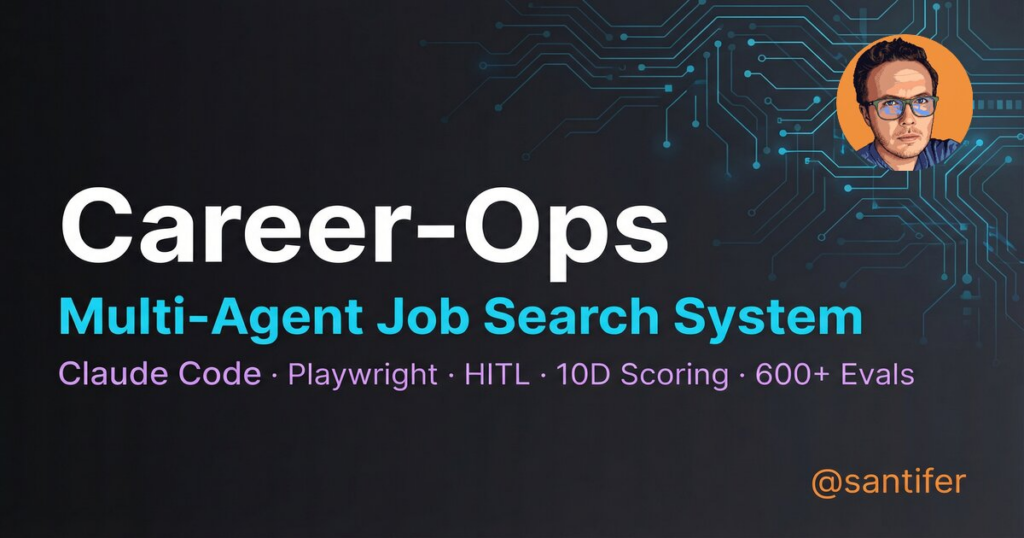
A Reddit user has turned the frustration of job hunting into a case study in applied AI, and it paid off. The developer built an automated workflow called Career-Ops that evaluates job listings, generates tailored resumes, and manages applications end-to-end.
The result: more than 740 roles analyzed, over 100 customized resumes created, and ultimately, a job offer for a Head of Applied AI role.
This isn’t just a viral story. It’s a glimpse into how AI is reshaping one of the most tedious processes in modern work.
What is Career-ops, and how does it work?
At its core, career-ops is a one-command pipeline for job hunting.
The basic workflow
Paste a job URL into the system, and it automatically:
- Scores the job fit (A–F or numeric scale)
- Generates a tailored, ATS-friendly resume
- Provides salary insights
- Prepares interview questions and answers
- Logs the opportunity in a tracking system
What usually takes hours, research, editing, and formatting, is compressed into minutes.
Why it stands out
Unlike typical job tools, Career-ops doesn’t just automate tasks. It structures decision-making, helping users focus on roles that actually match their skills.
What features make Career-Ops powerful?
The system goes far beyond basic automation.
1. Multi-mode AI engine
Career-ops includes 14 different skill modes, covering the following:
- Job evaluation
- Resume generation
- Batch processing
- Negotiation scripts
- LinkedIn outreach
This turns it into a full-stack job search assistant.
2. Portal scanning and discovery
- Preloaded with 45+ companies
- Uses 19 search queries across job platforms
- Continuously surfaces relevant opportunities
This reduces the need to browse job boards manually.
3. Smart resume generation
- Creates polished PDFs using browser automation tools
- Optimizes for ATS (Applicant Tracking Systems)
- Tailors content to each specific job
Instead of one generic resume, users get dozens of targeted versions.
4. Built-in job tracker
- Automatically logs every role evaluated
- Tracks application status
- Eliminates spreadsheets
How does the AI “think” about jobs?
This is where Career-ops separates itself from typical automation tools.
Beyond keyword matching
Most job tools rely on:
- Keyword overlap
- Simple filters
Career-ops instead evaluates:
- Skill alignment
- Role expectations vs. experience
- Career trajectory fit
The scoring system
- Jobs are scored out of 5
- Roles below 4.0 are often rejected
- Focus is on quality over quantity
This prevents the common trap of mass applying to unsuitable roles.
What is the “story bank,” and why does it matter?
One of the most interesting features is the Story Bank.
What it does
- Stores structured interview answers
- Uses the STAR method (Situation, Task, Action, Result)
- Adds reflection for deeper insight
Over time, this builds a personalized interview knowledge base.
Why it’s useful
- Reduces last-minute interview prep
- Improves consistency in answers
- Helps candidates articulate their experience more clearly
How did it actually help land a job?
The developer didn’t just build the tool—they used it extensively.
Key outcomes
- 740+ jobs evaluated
- 100+ tailored resumes generated
- Focused applications instead of mass submissions
This approach likely improved the following:
- Resume relevance
- Interview readiness
- Overall efficiency
In short, the system didn’t just save time—it improved decision quality.
Why this matters for job seekers
Career-ops reflects a broader shift in how people approach job hunting.
Traditional job search
- Manual applications
- Generic resumes
- Spreadsheet tracking
- High volume, low precision
AI-assisted job search
- Automated evaluation
- Tailored applications
- Centralized tracking
- Low volume, high precision
This shift mirrors what’s happening in other fields: AI isn’t just speeding things up—it’s changing how decisions are made.
Are there downsides to this approach?
Yes—and they’re worth considering.
Potential concerns
- Over-reliance on automation
- Risk of homogenized resumes
- Ethical questions around AI-generated applications
- Possible pushback from recruiters
There’s also the question of fairness, as advanced tools may give some candidates a significant advantage.
Why Career-ops is gaining traction
The project has already attracted attention in the developer community.
Key signals
- Over 8,000 GitHub stars
- Open-source under MIT license
- Built on a customizable AI framework
Because it’s open-source, users can:
- Modify workflows
- Add features
- Adapt it to different industries
What this says about the future of hiring
Tools like Career-ops suggest that hiring itself may need to evolve.
Emerging trends
- AI vs. AI: candidates using AI, companies using AI filters
- Greater emphasis on real skill validation
- Shift from volume-based hiring to fit-based hiring
If both sides continue optimizing with AI, the hiring process could become:
- Faster
- More data-driven
- Potentially more competitive
TL;DR
- A developer built an AI job search tool using Claude Code
- The system evaluates jobs, creates resumes, and tracks applications
- It helped land a Head of Applied AI role
- Career-ops focuses on quality over quantity in applications
- The project highlights how AI is transforming job hunting