
Musk hints at Tesla’s biggest product leap since the Cybertruck
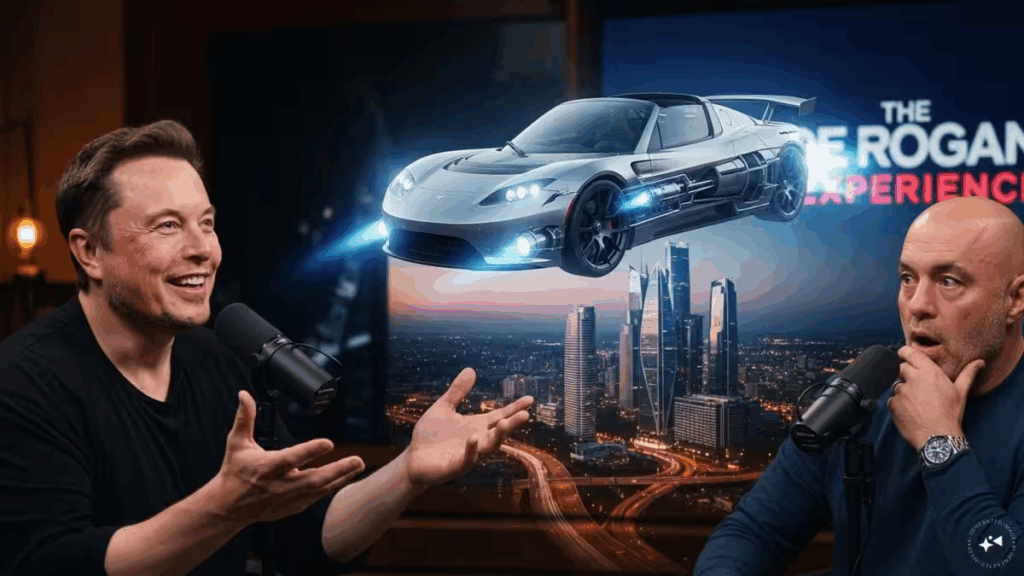
Tesla CEO Elon Musk has once again ignited global curiosity—this time by revealing plans to unveil a flying car prototype before the end of the year. Speaking on The Joe Rogan Experience podcast, Musk described the forthcoming demo as “unforgettable,” adding that it could become “the most memorable product launch ever.”
His remarks immediately triggered speculation about whether Tesla, already at the forefront of electric mobility, is about to redefine transportation itself.
What did Elon Musk actually reveal about Tesla’s flying car?
Elon Musk was responding to a question about Tesla’s delayed second-generation Roadster, originally announced in 2017 and expected to debut by 2020. While acknowledging setbacks, Musk pivoted to something bigger.
“We’re getting close to… demonstrating the prototype,” Musk said, pausing before adding, “One thing I can guarantee is that this product demo will be unforgettable.”
When podcast host Joe Rogan pressed him for details, Musk cryptically replied that the event would be “unforgettable whether it’s good or bad.” Eventually, he linked his comments to his longtime friend and fellow tech billionaire Peter Thiel, saying, “My friend Peter Thiel once said the future was supposed to have flying cars. I think if Peter wants one, we should be able to buy one.”
While Musk refused to confirm technical details—such as whether the car would feature retractable wings or vertical takeoff capability—he emphasized that Tesla’s prototype would “outdo all the James Bond cars combined.”
Why a Tesla flying car could be plausible now
Flying cars have been a science fiction staple for decades, but recent technological trends make Musk’s claim less far-fetched than it might appear.
1. Advancements in battery density
Tesla’s innovations in lithium-ion and upcoming solid-state batteries have drastically improved energy storage-to-weight ratios—a key constraint for airborne vehicles.
2. AI-assisted flight control
Tesla’s Autopilot and Full Self-Driving (FSD) software could easily extend to aerial navigation, combining machine learning with radar and lidar-based sensors to ensure stability in flight.
3. Regulatory groundwork
The U.S. Federal Aviation Administration (FAA) has already begun certifying small-scale electric vertical takeoff and landing (eVTOL) aircraft for testing. Companies like Joby Aviation and Archer Aviation—both backed by major investors—are in advanced stages of development.
How would Tesla’s flying car differ from current eVTOL projects?
Musk’s track record suggests that Tesla won’t settle for incremental improvement. Unlike existing eVTOL startups focused on short-distance air taxis, Tesla could aim for a consumer-grade flying car—a hybrid between a luxury EV and a personal aircraft.
Possible distinctions include:
- Fully electric propulsion integrated with Tesla’s existing EV platform.
- Autonomous takeoff and landing capabilities through Tesla’s FSD network.
- Rechargeable via Supercharger stations, expanding Tesla’s infrastructure advantage.
- Dual-mode operation—drivable on roads and lift-enabled for short flights.
If realized, this would mark a radical departure from the urban air mobility focus of current industry leaders.
Why Musk’s timing matters
Tesla’s share price and public perception have been under pressure amid slowing EV demand and rising competition from Chinese automakers. Analysts suggest that a flying car reveal could serve as a strategic distraction, reigniting investor enthusiasm and positioning Tesla once again as the frontier innovator.
However, industry watchers caution that the flying car market remains speculative. Development costs, safety certification, and infrastructure requirements pose enormous barriers.
Expert take
Aviation analyst Richard Aboulafia told Reuters earlier this year that “turning an eVTOL into a consumer product is ten times harder than building one for regulated taxi use.” Tesla’s entry could change that calculus—but only if Musk can deliver.
What challenges could delay Tesla’s flying car launch?
Even for Elon Musk, several formidable obstacles remain:
- Regulatory approval: The FAA and National Highway Traffic Safety Administration (NHTSA) would both need to greenlight dual-mode operations.
- Public safety: Urban air corridors and emergency landing zones must be defined before mass adoption.
- Battery weight: Even Tesla’s advanced cells may struggle to balance flight power with passenger capacity.
- Noise and cost: eVTOL noise pollution and production expenses could limit scalability.
Musk’s “before year-end” target should thus be viewed as aspirational rather than guaranteed.
The bigger picture: A new phase for Tesla innovation
If Tesla truly unveils a functional flying car, it could signal a new era of mobility convergence, blending automotive, aerospace, and AI industries.
It would also align with Musk’s broader vision of human advancement—mirroring projects like SpaceX’s Starship and Neuralink’s brain-computer interface. Each represents an attempt to push humanity beyond conventional boundaries.
For now, Musk’s flying car remains an enigma—but the mere prospect has reasserted his mastery of what one analyst called “visionary showmanship.”
TL;DR
- Elon Musk announced plans to unveil a Tesla flying car prototype before year-end.
- The revelation came on The Joe Rogan Experience podcast.
- Musk described the demo as “unforgettable” and hinted it could surpass all previous Tesla launches.
- Advancements in battery tech, autonomous flight, and FAA regulation make the concept feasible.
- Experts warn that regulatory and safety hurdles could delay commercialization.