
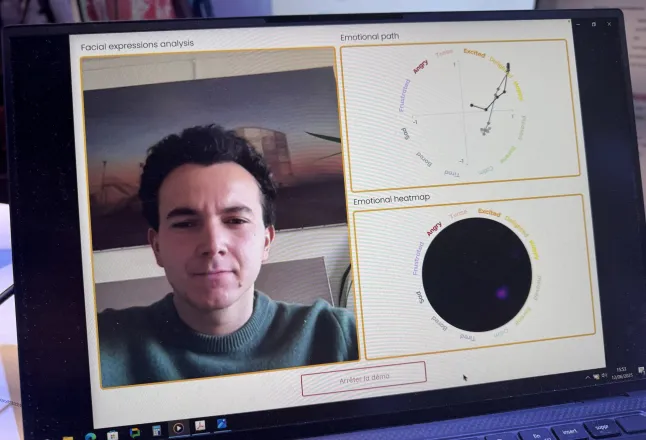
What is Emobot, and how does it work?
A new mental health tool is turning your front-facing camera into a real-time mood monitor. Emobot, an AI-powered app, is being used by hundreds of patients in France to assess the effectiveness of depression treatment and flag early signs of relapse, all by analysing subtle shifts in facial expression throughout the day.
Here’s how it works:
- The app keeps your front camera active in the background as you go about your day.
- Using on-device AI, it scans micro-expressions and builds a data profile of your emotional state.
- Instead of storing photos or videos, the app processes the data locally, then deletes it.
- A visual dashboard (think: mood graph, similar to a heart rate or step tracker) is shared with medical professionals to help monitor patient progress.
According to co-founder Samuel Lerman, Emobot is legally classified as a medical device in France. It is being prescribed by psychiatrists as part of a broader treatment plan, and early trials suggest patients aren’t as creeped out by the constant camera usage as the creators feared.
“The camera is open in the background all the time,” Lerman told The Metro. “We were a bit skeptical about that aspect… however, the feedback was pretty good.”
Is it safe? What about privacy?
Let’s address the elephant in the room: this app is watching your face all day. That’s bound to raise concerns.
Here’s what Emobot says in response:
- No images or video are transmitted or stored in the cloud.
- All processing happens locally on your phone, which means your facial data never leaves your device.
- Future updates may include tone-of-voice analysis using your phone’s microphone—but again, the company insists that audio will not be stored or transmitted.
These features are designed to meet France’s strict data protection laws (among the toughest in Europe), but it still presents a grey area in terms of personal comfort and long-term privacy norms.
Consider linking to our guide on AI and privacy in healthcare apps for readers concerned about digital surveillance.
How effective is emotion tracking for mental health?
While the technology is new, the concept isn’t: facial expression recognition has been used in psychological studies for decades. Emobot takes that research and automates it, providing a continuous, passive stream of data to therapists or psychiatrists.
According to Lerman, this helps:
- Track how patients are responding to medication or therapy over time.
- Flag early signs of mood deterioration or relapse risk before a crisis hits.
- Encourage a more data-driven approach to psychiatry, which is often reliant on subjective reporting.
This could be a game-changer, particularly for patients who struggle to articulate their feelings or downplay symptoms during appointments.
“We tried the software at VivaTech,” The Metro reported. “The real-time image showed [the reporter] as appearing both ‘pleased’ and ‘bored’ at the same time.”
Where else is this technology being used?
Emobot is part of a broader wave of AI-powered mood detection tools that surfaced at VivaTech 2025, a leading tech expo in Paris. Of the 14,000 startups present from over 50 countries, many were focused on health and emotional well-being.
Other applications included:
- Monitoring office workers’ engagement levels via facial expressions or eye movement.
- Emotion-aware learning tools that adjust difficulty based on student frustration or confusion.
- Tools for caregivers of the elderly or those with cognitive decline to spot emotional distress.
While AI’s presence at the event was expected, what stood out was how deeply intertwined it has become with mental health tech. Emotional analytics, once a niche area, is now being packaged as a core feature in consumer and clinical devices alike.
The mental health industry is watching closely
Healthcare providers and researchers are cautiously optimistic. Unlike fitness trackers that measure movement, mood is subjective—and harder to quantify. Emobot offers a new way to objectively capture emotional patterns, similar to how continuous glucose monitors track diabetes.
But this shift also raises ethical questions:
- Who owns your emotional data?
- Can insurance companies or employers request access?
- Will emotion-tracking become a new form of social surveillance?
There’s no consensus yet—but with mental health demand soaring and staffing shortages growing, the incentive to adopt tools like Emobot is clear.
What’s next for emotion-tracking apps?
Emobot is still early in its rollout, but here’s what we know:
- It’s currently available by prescription in France.
- The company plans to expand internationally, pending regulatory approvals.
- Future versions may offer voice analysis and integration with wearable biosensors.
This technology could one day be embedded into smartphones, smartwatches, or even cars, creating a web of emotion-aware systems around us. That makes it even more critical to establish ethical frameworks and consent protocols now, before they become industry standard.
TL;DR
- Emobot is an AI-powered app that uses your front-facing camera to track mood by analyzing facial expressions.
- It’s used in France as a medical device to monitor depression treatment and detect relapse risk.
- The app does not store or transmit images; it processes data locally on the user’s device.
- Despite initial privacy concerns, early patient feedback has been positive.
- The app was featured at VivaTech 2025, alongside other emotion-tracking tools for healthcare and workplace use.
- Experts see potential for better mental health care—but also raise concerns about consent, privacy, and future surveillance risks.