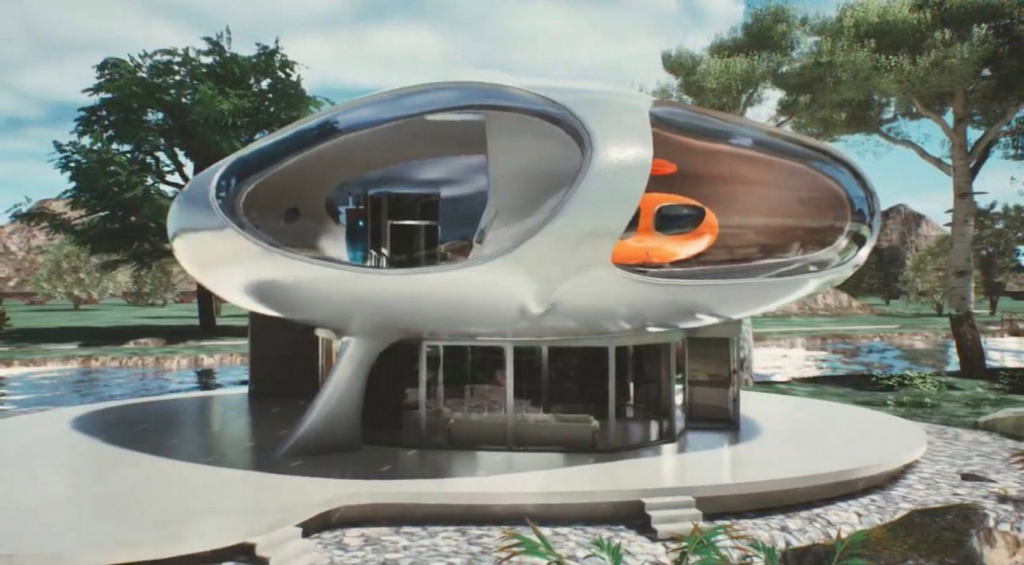
In Denmark this winter, visitors can step inside a future imagined not by a human architect, but by a humanoid robot. A new exhibition at the Utzon Center is showcasing what its creators describe as the first architectural concept designed by a humanoid robot—raising fresh questions about authorship, creativity, and how artificial intelligence might shape the spaces we live in.
The designer is Ai-Da, an AI-driven robot artist best known for portraits, paintings, and drawings that have already made their way into some of the world’s most prestigious cultural venues. This time, however, the canvas is much larger: a speculative home designed for humans and robots to live together.
What Is Ai-Da, and Why Is She Designing Architecture?
Ai-Da was completed in 2019 as an experimental art project exploring creativity in the age of artificial intelligence. She has a lifelike face, camera “eyes” that allow her to see, and a mechanized arm that enables her to draw and paint.
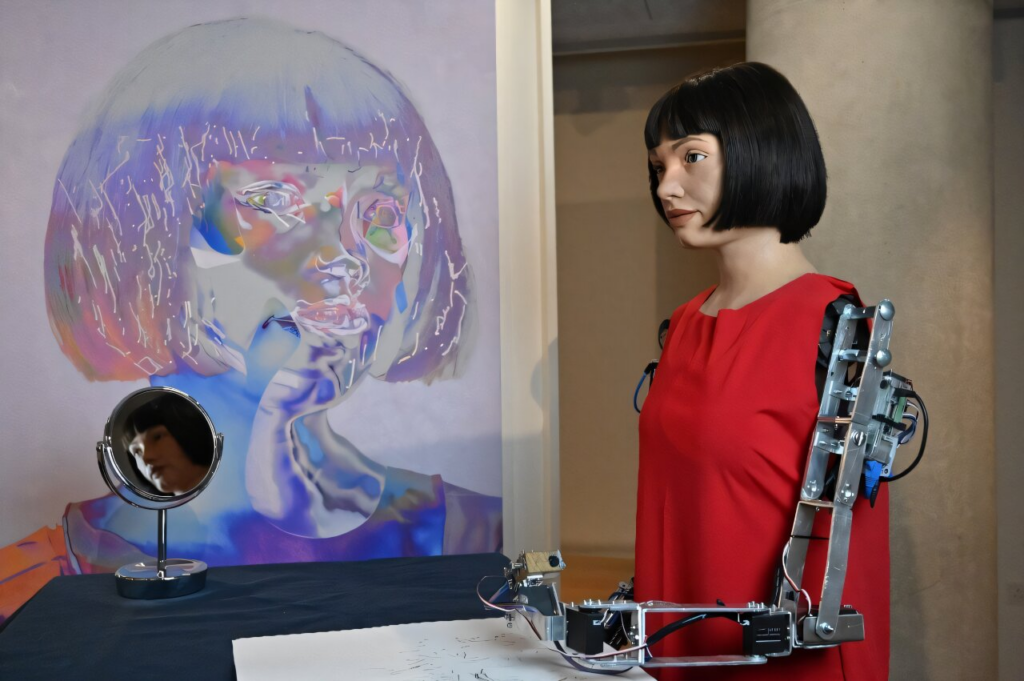
Before this architectural turn, Ai-Da’s work had been exhibited at institutions including the Victoria and Albert Museum, the Venice Biennale, and even near the Great Pyramid of Giza, a résumé that already placed her at the intersection of art, spectacle, and debate.
So why architecture?
In a recorded interview shown alongside the exhibition, Ai-Da describes architecture as a “natural extension” of her work. If art examines the relationship between humans and technology, she suggests, architecture is where that relationship becomes lived experience—where ideas about coexistence are tested every day.
What Does the Robot-Designed Home Look Like?
The building concept is a retro-futuristic pod house, instantly reminiscent of the space-age optimism of the 1950s and 60s. Its closest historical cousin is the iconic Matti Suuronen–designed Futuro House, with its rounded shell and sci-fi silhouette.
Ai-Da’s version leans heavily into that lineage:
- Bulbous, organic curves instead of sharp angles
- Oversized porthole windows that evoke spacecraft design
- A modular structure that could, in theory, connect to other pods via corridors
According to the robot’s own description, the house is imagined not just for Earth, but for extreme environments like the Moon or Mars—where space agencies often propose modular, self-contained living units.
How Was the Building Concept Created?
Ai-Da’s architectural project spans multiple media rather than a single finished blueprint. On display are
- Rough pen sketches made by her robotic arm
- More detailed paintings exploring form and layout
- Digital renders showing exterior and interior possibilities
Together, these works suggest a compact but layered living space: two living areas, a spiral staircase, a small kitchenette or bathroom, and a curious feature, a miniature pod inside the larger one, which appears designed as a dedicated sleeping or resting area for a robot.
From a technical standpoint, Ai-Da generates ideas using generative AI systems, digitally translates them into visual concepts, and then physically executes drawings and paintings using her arm. The result is less a construction plan than a provocation, a way of asking what “design” means when machines participate creatively.
Who’s Really the Architect Here?
One of the exhibition’s most provocative aspects is its deliberate ambiguity around authorship.
Ai-Da’s creator, Aidan Meller, is open about the fact that the robot works with a team of human “studio technicians.” The original brief—to design a building of the future that considers space exploration and human-robot cohabitation—came from the Utzon Center itself.
Meller describes Ai-Da as having “rising agency,” arguing that while she responds to prompts, she remains the primary creative driver and executor of the work. The setup, he suggests, mirrors how many contemporary artists operate: influenced by collaborators, commissions, and prior experiences.
This framing doesn’t end the debate; it sharpens it. Is Ai-Da the designer, the tool, or something in between? And does the answer matter if the work succeeds in pushing architectural thinking forward?
Why Does a Robot-Designed House Matter Right Now?
Architecture has been slower than many creative fields to adopt artificial intelligence. As of early 2025, only a small fraction of American architecture firms reported using AI meaningfully in their design processes, and those were largely large, well-resourced studios.
That makes Ai-Da’s project notable, not because it offers a build-ready solution, but because it reframes the conversation. Instead of AI as software quietly optimizing floor plans, this is AI positioned as a visible, debatable creative partner.
The concept also arrives at a moment when humanoid robots are edging closer to domestic life. At the 2026 Consumer Electronics Show in Las Vegas, companies including LG unveiled humanoid robots designed to assist with household tasks, signaling that human-robot cohabitation is no longer pure science fiction.
Is This Art, Architecture, or Something Else?
Ai-Da’s pod house occupies an uncomfortable and productive middle ground. Architects may bristle at calling it architecture without structural calculations or planning constraints. Artists may see it as speculative design rather than sculpture or painting.
But that liminality is arguably the point.
The exhibition, titled I’m Not a Robot: Architecture and Design Between Human and Machine, positions the project as a thought experiment. It asks visitors to consider not just what future homes might look like, but who—or what—gets to imagine them.
What Comes Next for Ai-Da’s Architectural Work?
The Utzon Center exhibition runs until October 18, 2026, after which Ai-Da’s building designs are expected to be shown in London later in the year. Whether these concepts remain gallery pieces or influence real-world architectural experimentation remains an open question.
For now, the pod house stands as a cultural marker: evidence that AI’s role in creative fields is no longer hypothetical. It’s visible, contested, and, at least in this case—open for public debate.
TL;DR
- A humanoid robot named Ai-Da has designed a speculative home now on display in Denmark
- The retro-futurist pod house explores human-robot cohabitation and space living
- The project blurs lines between art, architecture, and AI authorship
- It arrives as humanoid robots and generative AI begin edging into everyday life