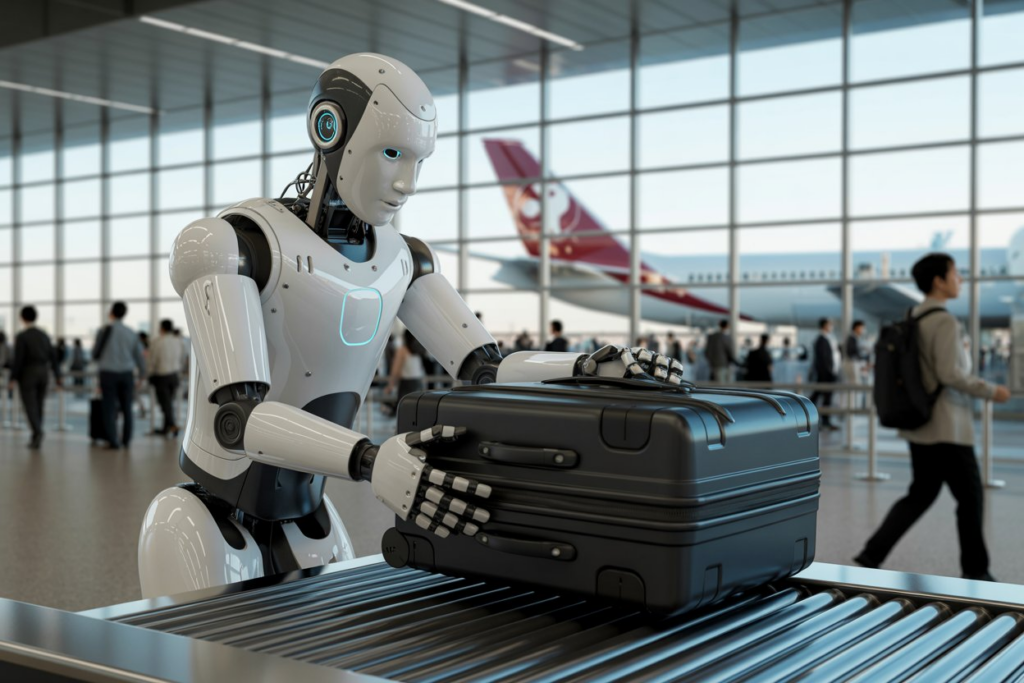
Japan Airlines is testing a futuristic solution to a very real problem. Beginning in May, the carrier will deploy humanoid robots at Tokyo’s Haneda Airport as part of a multi-year trial running through 2028. The goal: ease a growing labor shortage while keeping up with a surge in international travel.
The move puts Japan Airlines (JAL) at the center of a broader shift, where automation isn’t just about efficiency but about filling gaps that humans increasingly can’t.
What Is Japan Airlines’ Humanoid Robot Trial?
The Japan Airlines humanoid robot initiative focuses on ground operations—specifically, the physically demanding, repetitive tasks that keep airports running behind the scenes.
What the Robots Will Do
Developed by Unitree Robotics, these robots are designed to assist with:
- Moving luggage and cargo on the tarmac
- Loading items onto conveyor belts
- Potential future tasks like cleaning aircraft cabins
Standing about 130 cm (just over 4 feet) tall, the robots are compact but capable. In demonstrations, they’ve already been seen pushing cargo alongside parked aircraft—work typically done by ground staff in all weather conditions.
How Long Will the Trial Run?
- Start: May 2026
- End: 2028
- Location: Haneda Airport
This extended timeline suggests JAL isn’t just experimenting—it’s evaluating long-term integration.
Why Is JAL Turning to Humanoid Robots?
The short answer: Japan doesn’t have enough workers—and the gap is widening.
A Growing Labor Shortage
Japan faces a structural workforce issue driven by:
- An aging population
- Declining birth rates
- Limited immigration
Estimates suggest that by 2040, the country may need over 6.5 million foreign workers to sustain economic growth.
At the same time, industries like aviation—especially ground operations—struggle to attract and retain workers due to physically demanding conditions.
Tourism Is Surging Again
Demand isn’t slowing down. According to the Japan National Tourism Organization:
- Over 7 million visitors arrived in Japan in just the first two months of 2026
That surge puts pressure on airport infrastructure, especially behind-the-scenes operations that passengers rarely see.
The Political Reality
While Japan has increased its foreign workforce in recent years, immigration remains a sensitive political issue. That makes automation an attractive alternative.
Will Robots Replace Human Workers at Airports?
Not anytime soon, and not in critical roles.
Human Oversight Remains Essential
JAL has made it clear:
- Safety management will remain fully human-controlled
- Robots will assist, not replace, ground crews
- Workers will supervise and coordinate robotic operations
This hybrid model reflects a broader trend in automation—machines handle repetitive strain, while humans retain judgment-heavy responsibilities.
What Workers Gain
According to JAL Ground Service President Yoshiteru Suzuki, the goals are to:
- Reduce physical strain
- Improve working conditions
- Increase operational efficiency
In other words, robots are being positioned as tools, not replacements.
What Makes These Humanoid Robots Different?
Airports already use automation, so why humanoid robots?
Flexibility in Complex Environments
Unlike fixed machines, humanoid robots can:
- Navigate dynamic environments
- Adapt to different tasks
- Work alongside humans without major infrastructure changes
This is critical in airports, where layouts, cargo types, and schedules constantly shift.
Continuous Operation
The robots can operate for:
- 2–3 hours per cycle
While that’s not all-day endurance, it’s enough to handle peak workloads or supplement human shifts.
How Does This Fit Into Global Automation Trends?
JAL’s experiment isn’t happening in isolation—it’s part of a larger shift across industries.
Automation Is Moving Beyond Factories
Traditionally, robots dominated controlled environments like manufacturing. Now they’re entering:
- Airports
- Hospitals
- Retail and logistics hubs
These are spaces where unpredictability and human interaction make automation more complex.
Why Airports Are a Testing Ground
Airports are ideal for robotics trials because they:
- Have repetitive, labour-intensive tasks
- Operate under tight time constraints
- Already use partial automation
Yet, as noted by robotics experts, backend operations still rely heavily on human labor.
What Could Happen If the Trial Succeeds?
If JAL’s humanoid robots prove effective, the implications could extend far beyond Tokyo.
Potential Expansion Areas
- Other major Japanese airports
- Airlines are facing similar labour shortages globally
- Non-aviation sectors like logistics and warehousing
New Use Cases
Future deployments may include:
- Aircraft cabin cleaning
- Maintenance support
- Passenger assistance roles (longer term)
Industry Ripple Effects
Success could accelerate the following:
- Investment in humanoid robotics
- Partnerships between airlines and tech firms
- Policy discussions on automation vs. immigration
The Bigger Question: Can Robots Solve Labor Shortages?
JAL’s trial raises a fundamental issue: Is automation a stopgap or a long-term solution?
Strengths of Automation
- Reduces dependence on shrinking workforces
- Handles physically demanding tasks
- Improves efficiency and consistency
Limitations
- High upfront costs
- Limited battery life and adaptability
- Ongoing need for human oversight
In short, robots can ease pressure—but they don’t eliminate the need for people.
TL;DR
- Japan Airlines is testing humanoid robots at Haneda Airport from 2026 to 2028.
- The robots will assist with cargo handling and other labor-intensive tasks.
- The move aims to address Japan’s labor shortage amid rising tourism.
- Humans will continue to oversee safety-critical operations.
- If successful, the trial could expand automation across airports and beyond.