
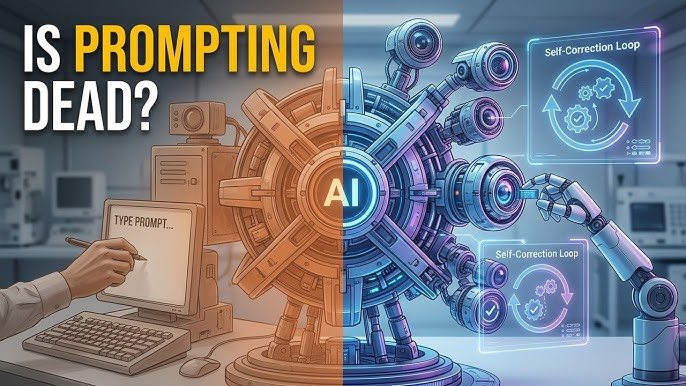
For the past two years, learning how to write the perfect AI prompt has been widely promoted as the key to getting better results from tools like ChatGPT, Claude, and Gemini. But some of the biggest names in artificial intelligence now say that era is already giving way to something more powerful: loop engineering. Instead of manually telling an AI assistant what to do at every step, loop engineering involves creating automated systems that continuously generate, refine, and manage prompts on the user’s behalf. In other words, humans define the goal, while AI handles much of the prompting process itself.
The concept is gaining traction among AI developers as companies increasingly rely on autonomous AI agents capable of planning, executing, and revising complex tasks with minimal human intervention.
What is loop engineering?
Loop engineering is the practice of designing automated feedback systems that guide AI agents through a task instead of manually prompting them at every stage.
Traditional prompting follows a simple pattern:
Human → Prompt → AI Response
Loop engineering changes that process into something more dynamic:
Human → AI Supervisor → AI Agent → Review → Improved Prompt → AI Agent
The system continuously evaluates results, creates new prompts when needed, corrects mistakes, and repeats the process until it reaches the desired outcome.
Rather than acting as the person writing every instruction, the user becomes the designer of the overall workflow.
Why are AI experts moving beyond manual prompts?
Several AI researchers argue that manually writing prompts becomes inefficient once AI agents begin handling multi-step projects.
Boris Cherny, creator of Claude Code, recently explained that he no longer writes prompts directly. Instead, he interacts with an enhanced AI system that generates and coordinates prompts for other AI models.
Similarly, OpenAI engineer Peter Steinberger has encouraged developers to focus on designing loops instead of individual prompts.
The idea is simple: if AI can already write effective prompts, humans can spend more time defining goals and evaluating outcomes rather than crafting instructions line by line.
How does loop engineering work?
Loop engineering relies on repeated cycles of planning, execution, evaluation, and refinement.
Step 1: Define the objective
The user specifies the overall goal, such as building an application, analyzing research, or generating documentation.
Step 2: AI creates its own prompts
Instead of waiting for detailed instructions, an AI coordinator generates prompts for one or more specialized AI agents.
Step 3: Results are reviewed
The system checks whether the output meets predefined quality standards.
Step 4: The loop repeats
If improvements are needed, the AI automatically adjusts its prompts and retries the task until it reaches an acceptable result.
This feedback loop enables AI systems to solve increasingly complex problems without constant human supervision.
What are the building blocks of a loop?
According to AI practitioners discussing the approach, effective loop engineering often combines several components.
Automation
Tasks are triggered automatically without requiring repeated user input.
Skills
Specialized AI capabilities are assigned to different stages of a workflow.
Plugins
External tools allow AI agents to search the web, write code, analyze documents, or interact with software.
Connectors
These enable communication between different AI models, databases, APIs, and business applications.
Worktrees
Separate workspaces allow AI agents to test ideas or make changes without affecting the primary project until they’re ready.
Together, these components create workflows that resemble a team of AI assistants collaborating toward a shared objective.
Why does loop engineering matter?
Loop engineering represents a shift in how people interact with artificial intelligence.
Instead of treating AI as a chatbot that responds to individual questions, organizations increasingly view it as a collection of autonomous workers capable of handling extended projects.
This approach can improve:
- Software development
- Customer support
- Research and analysis
- Content creation
- Business automation
- Scientific workflows
For businesses, the potential productivity gains are significant because AI can operate continuously with limited human oversight.
Are manual prompts becoming obsolete?
Not entirely.
Manual prompting remains the simplest and most effective way to use conversational AI for everyday tasks such as writing emails, brainstorming ideas, summarizing documents, or asking questions.
Loop engineering is primarily designed for advanced users building AI-powered systems, coding assistants, research agents, and enterprise automation tools.
For most consumers, prompt engineering will continue to be useful. However, as AI agents become more capable, users may increasingly interact with high-level goals rather than detailed prompts.
What are the challenges of loop engineering?
While powerful, loop engineering introduces new challenges.
Higher operating costs
Each automated step consumes AI tokens. Complex loops involving multiple AI agents can quickly become expensive if limits are not carefully managed.
Reports have highlighted cases where organizations accumulated unexpectedly large AI bills after failing to impose token usage caps.
Greater complexity
Designing reliable loops requires careful planning, monitoring, and testing. Poorly designed systems may repeat mistakes or waste computing resources.
Oversight remains essential
Even autonomous AI systems require human supervision to verify accuracy, detect bias, and prevent unintended actions.
Loop engineering reduces manual prompting, but it does not eliminate the need for human judgment.
Is loop engineering the future of AI?
Many researchers believe AI is moving toward systems that can plan, reason, and coordinate multiple tasks independently.
Loop engineering fits naturally into that evolution because it allows AI to manage much of its own workflow while humans focus on strategy and decision-making.
Rather than replacing prompt engineering overnight, it builds upon it. Understanding how AI thinks, structures tasks, and responds to instructions will remain valuable, even if AI increasingly generates those instructions itself.
For developers, businesses, and power users, the next competitive advantage may not be writing better prompts but designing better systems that write them automatically.
TL;DR
- AI experts say loop engineering is emerging as the next step beyond manual prompting.
- Rather than writing every prompt yourself, you design workflows that let AI generate and improve prompts automatically.
- The approach is particularly useful for AI agents handling long or complex tasks.
- Companies including Anthropic and OpenAI have discussed similar ideas for autonomous AI workflows.
- While powerful, loop engineering can significantly increase AI usage costs if left unchecked.