
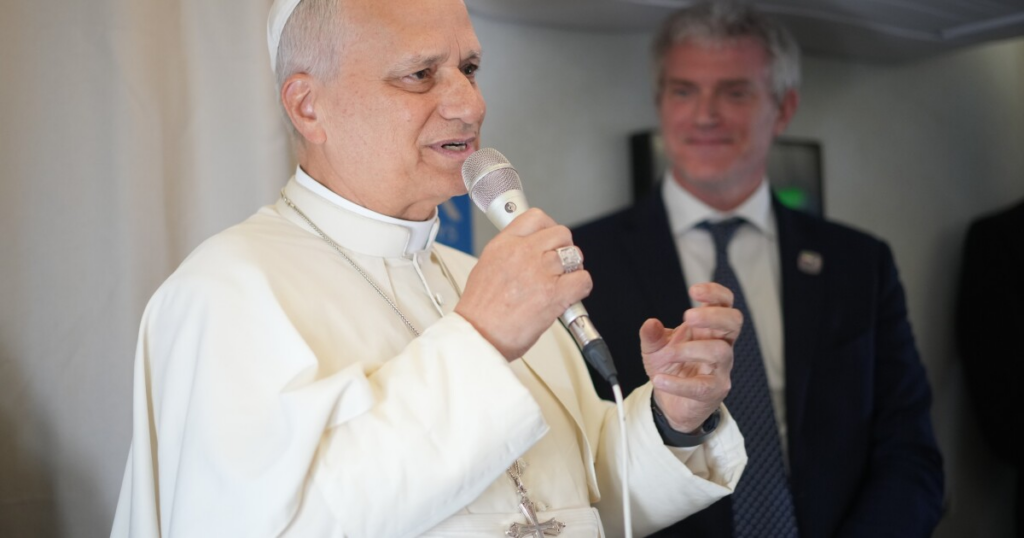
Pope Leo XIV is preparing to release what may become one of the most consequential Vatican documents of the AI era:
an encyclical focused entirely on artificial intelligence, human dignity, labor, and morality.
The document, titled Magnifica Humanitas (“Magnificent Humanity”), is scheduled for release on May 25 and will reportedly examine how artificial intelligence is reshaping society, warfare, work, and human identity itself.
The launch will also feature Christopher Olah, a prominent AI researcher and co-founder of Anthropic, signaling that the Vatican is no longer treating AI as a distant philosophical issue.
It now sees AI as one of the defining moral and political questions of the century.
Why this encyclical matters far beyond the Catholic Church
In the Catholic tradition, an encyclical is not just a speech or opinion piece.
It is one of the most important forms of papal teaching, often shaping:
- Church doctrine
- Global ethical debates
- Political conversations
- Social justice movements
Historically, encyclicals have influenced:
- Labor rights
- Capitalism debates
- Nuclear ethics
- Climate policy
- Human rights discussions
This AI-focused document could become the Vatican’s equivalent of a “moral constitution” for the machine age.
And because the Catholic Church represents over a billion people worldwide, its position could influence policymakers, educators, ethicists, and even technology companies.
The symbolism behind the timing is deliberate
The Vatican reportedly confirmed that Pope Leo XIV signed the document on May 15, exactly 135 years after Pope Leo XIII issued the landmark encyclical Rerum Novarum in 1891.
That document transformed Catholic social teaching during the Industrial Revolution.
It addressed:
- Workers’ rights
- Industrial capitalism
- Labor exploitation
- Economic inequality
The symbolism here is impossible to miss.
The Vatican appears to be framing AI as the new Industrial Revolution.
Just as factories and machines transformed society in the 19th century, AI systems are now reshaping:
- Employment
- Creativity
- Warfare
- Human relationships
- Economic power
The Church seems intent on establishing moral guardrails before those systems become too deeply embedded.
Why Christopher Olah’s presence is so significant
Anthropic co-founder Christopher Olah attending the launch is a major signal.
Olah is widely respected in AI research circles for his work on:
- Neural network interpretability
- AI safety
- Understanding how AI “thinks”
- Alignment research
His inclusion suggests the Vatican is not approaching AI purely as theology.
It wants direct engagement with the people building these systems.
That matters because many global AI debates currently revolve around a core question:
Can humanity still meaningfully control systems it increasingly does not fully understand?
The Vatican appears eager to participate in that discussion early.
Why this could create friction with the Trump administration
The political backdrop makes the story even more explosive.
According to recent reports, the Trump administration has clashed heavily with Anthropic over military access to AI systems.
The administration reportedly:
- Ordered US agencies to stop using Anthropic technology
- Imposed restrictions linked to defense cooperation
- Faced lawsuits from Anthropic alleging retaliation
That context means the Vatican’s decision to prominently feature an Anthropic executive could be interpreted politically, even if indirectly.
The tension reflects a much larger divide emerging globally:
- Should AI development prioritize military advantage?
- Or should it prioritize ethical constraints and human oversight?
The Vatican appears increasingly aligned with the second camp.
Pope Leo XIV’s concerns about AI warfare
One of the clearest themes emerging from Vatican statements is concern over autonomous warfare.
Pope Leo XIV has reportedly warned about:
- AI-assisted combat systems
- Automated killing technologies
- Reduced human accountability in war
- Ethical erosion in military decision-making
This places the Vatican in growing alignment with:
- AI safety researchers
- Human rights organizations
- Some European regulators
The concern is not only about robots replacing soldiers.
It is about humans slowly surrendering moral responsibility to algorithms.
A useful infographic here could compare:
- Human-controlled military systems
- AI-assisted targeting systems
- Autonomous weapons categories
- Existing global AI regulation proposals
The Vatican is entering the AI race unusually early
Religious institutions have often reacted slowly to technological revolutions.
But the Vatican appears determined not to repeat that pattern with AI.
In recent years, the Holy See has already:
- Hosted AI ethics conferences
- Engaged with major tech companies
- Discussed algorithmic bias
- Warned about digital dehumanization
- Explored AI governance frameworks
This encyclical could consolidate those concerns into a formal doctrine.
That would give Catholic institutions worldwide a shared framework for approaching:
- AI education
- AI research
- Workplace automation
- Digital ethics
- AI in healthcare
- AI in warfare
The labor question may become central again
The strongest historical parallel may not be warfare.
It may be labor.
Like the Industrial Revolution, AI is raising fears about:
- Job displacement
- Wealth concentration
- Worker surveillance
- Economic inequality
- Loss of human agency
The Vatican has historically positioned itself as a defender of human dignity within economic systems.
That suggests Magnifica Humanitas may argue:
- Human beings must remain economically meaningful
- Labor has moral value beyond productivity
- AI should augment humans, not erase them
- Technological progress requires ethical boundaries
Those ideas could resonate well beyond religious audiences.
Why the Vatican’s voice still carries global influence
Even in increasingly secular societies, the Vatican retains unusual diplomatic and moral reach.
It operates as:
- A religious authority
- A sovereign entity
- A global diplomatic network
- A moral platform with worldwide visibility
Its positions often influence:
- UN debates
- Human rights discussions
- Bioethics frameworks
- International law conversations
On AI, where governments still lack clear global consensus, moral authority may become increasingly important.
The Vatican seems to understand that vacuum.
Could this become AI’s “climate moment”?
The comparison may sound ambitious, but there are parallels.
Just as climate change evolved from a scientific issue into:
- A political debate
- A moral issue
- A civilizational question
AI may be heading down the same path.
The Vatican appears to be trying to frame AI not simply as a technology story, but as a question about:
- What it means to be human
- Who controls power
- How society distributes dignity
- Whether ethics can keep pace with machines
That is much bigger than Silicon Valley.
TL;DR
- Pope Leo XIV will release an AI-focused encyclical titled Magnifica Humanitas on May 25
- The document will address AI, human dignity, labor, justice, peace, and warfare
- Anthropic co-founder Christopher Olah will attend the launch
- The Vatican appears increasingly concerned about AI in military systems and social inequality
- The encyclical deliberately echoes Pope Leo XIII’s Industrial Revolution-era labor teachings
- The move could place the Vatican at the center of global AI ethics debates