
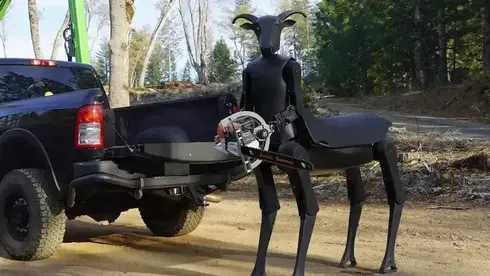
A new rescue robot from a California startup is drawing attention for an unusual reason: people can’t stop talking about how frightening it looks.
Developed by robotics company Satyress, the four-legged machine, called ThreeHalves, was built to enter environments too dangerous for human rescuers, including wildfire zones, collapsed buildings, and hazardous industrial sites. But instead of focusing on its technical capabilities, much of the internet has zeroed in on its appearance.
Standing more than six feet tall with curved horn-like structures, an aggressive stance, and optional chainsaw attachments, ThreeHalves has been compared to everything from a demonic creature to a post-apocalyptic war machine. The viral reactions have reignited a broader debate in robotics: Should life-saving machines be designed to comfort people—or simply perform their job as effectively as possible?
TL;DR
- California startup Satyress has introduced ThreeHalves, a four-legged rescue robot.
- The robot is designed for hazardous environments such as wildfires, collapsed structures, and toxic industrial sites.
- Its horned, intimidating appearance has gone viral on social media, with many comparing it to a demon or mechanical beast.
- Satyress says the robot includes multiple safety mechanisms and has even published instructions on how to disable it if necessary.
- The viral discussion highlights how robot design can influence public trust and acceptance.
What Is ThreeHalves?
ThreeHalves is a heavy-duty quadruped robot built for one purpose: going where humans safely cannot.
Emergency responders often face situations where unstable buildings, toxic chemicals, extreme heat, or fire make rescue operations exceptionally dangerous. Robots capable of entering these environments can reduce risks to first responders while gathering information or assisting with rescue efforts.
According to Satyress, ThreeHalves is designed to operate in environments such as:
- Wildfire zones
- Collapsed buildings
- Disaster response areas
- Hazardous industrial facilities
- Other high-risk rescue scenarios
Unlike humanoid robots designed for homes or customer service, ThreeHalves prioritizes rugged mobility and durability over an approachable appearance.
Why Does the Robot Look So Intimidating?
The feature generating the most discussion isn’t its engineering—it’s its design.
ThreeHalves stands over six feet tall and features:
- Four powerful mechanical legs
- Curved horn-like structures above its body
- A low, forward-leaning posture
- Chainsaw attachments for certain rescue tasks
- Dark industrial styling that emphasizes functionality over friendliness
The result is a silhouette that many social media users have likened to a robotic demon, a goat-headed creature, or something from a science fiction horror film.
Unlike many technology companies that soften robot designs with rounded edges, expressive faces, or bright colors, Satyress appears to have embraced a more aggressive aesthetic.
What Is the Robot Actually Designed to Do?
Despite the dramatic appearance, ThreeHalves is intended for practical rescue work.
Robots deployed in disaster zones often need to:
- Navigate unstable terrain
- Climb over debris
- Carry equipment
- Remove obstacles
- Operate in areas unsafe for human responders
The optional chainsaw attachments, while visually striking, are designed to help clear debris or cut through obstacles during rescue operations rather than function as weapons.
Its four-legged platform also offers greater stability than wheeled robots when moving across uneven or collapsed surfaces.
Satyress Says Safety Comes First
Recognizing that its appearance could raise concerns, Satyress has taken an unusually transparent approach to safety.
The company describes ThreeHalves as “more dangerous than it looks,” while also publicly explaining how the machine can be disabled if something goes wrong.
According to the company, the robot includes:
- Emergency braking systems
- Mechanical locking mechanisms
- Built-in safety controls
- Manual methods for disabling the machine during malfunctions
Publishing information about a robot’s vulnerabilities is uncommon in the industry, but Satyress says the goal is to reassure the public that humans remain in control.
Social Media Is Divided Over the Design
The robot quickly became a viral topic after videos and images circulated online.
Many commenters questioned why a rescue robot needed such an intimidating appearance.
Some reactions included:
- “Why did you make it look like Satan?”
- “Have you considered making it look less scary?”
- “Looks demonic with the head of a goat.”
- “Why the devil goat face?”
Others argued that appearance should be secondary if the robot is capable of saving lives.
Supportive comments praised both the engineering and its intended mission, while some suggested relatively simple changes—such as lighter colors or softer visual features—could make it less frightening for people awaiting rescue.
One commenter noted that encountering such a machine during an emergency might itself become a memorable—and unsettling—part of the experience.
Does a Robot’s Appearance Really Matter?
The Psychology of Robot Design
The debate surrounding ThreeHalves highlights an important concept in robotics known as robot acceptance.
Research has shown that people often respond emotionally to a robot’s appearance before evaluating its capabilities.
Friendly design elements—such as rounded shapes, expressive “eyes,” or human-like proportions—can make machines appear more trustworthy.
Conversely, sharp angles, dark colors, and aggressive silhouettes may evoke caution or fear, even when the machine poses no threat.
This phenomenon is especially important in emergency situations, where victims may already be under significant stress.
Function Versus Familiarity
Designers of rescue robots face competing priorities.
A more rugged frame may improve durability, mobility, or visibility in hazardous environments, while a friendlier appearance may reduce anxiety among survivors.
ThreeHalves appears to prioritize function over familiarity, even if that choice sparks controversy.
Whether that approach proves effective may depend less on internet reactions and more on how the robot performs in real-world rescue operations.
The Bigger Picture
As robots become increasingly common in disaster response, healthcare, manufacturing, and public spaces, companies will likely face growing scrutiny over not only what their machines can do but also how they look.
ThreeHalves demonstrates that industrial design can shape public perception almost as much as engineering innovation. Its viral popularity shows that aesthetics matter—even for machines built for life-saving missions.
If the robot ultimately proves effective in dangerous environments, public opinion may shift from focusing on its intimidating appearance to appreciating the practical role it could play in keeping both victims and rescue workers safe.
For now, however, ThreeHalves has accomplished something few rescue robots ever do: it has sparked a global conversation about the intersection of engineering, psychology, and design.