
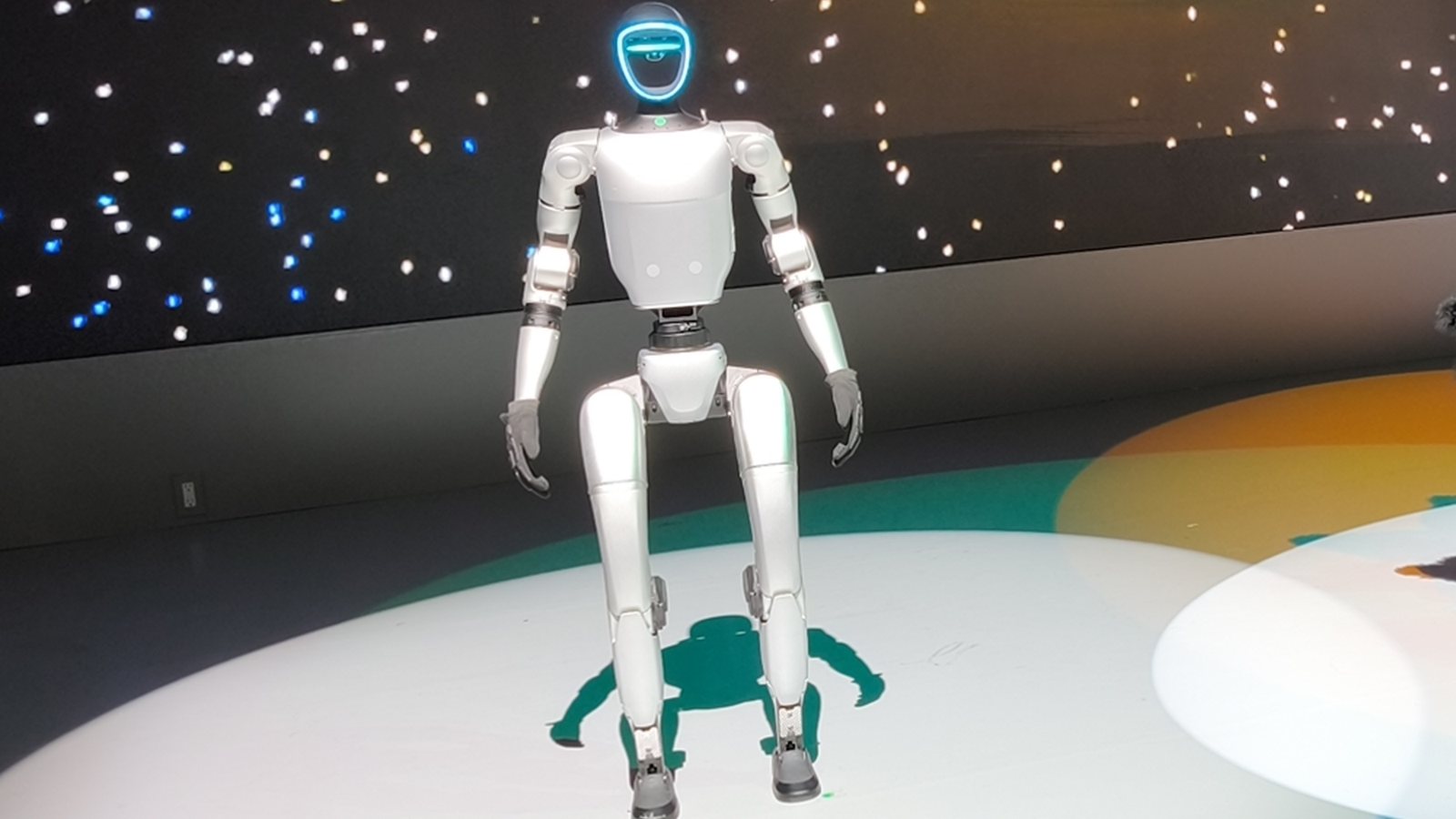

Chinese robot maker Unitree Robotics is pitching its next humanoid as a bodyguard. In a 61-second ad posted to its YouTube channel on Oct. 21, the H2-X fends off an intruder, dents a sedan with its fists, and lifts a car’s front off a trapped dummy.
The robot is real, and the video comes from Unitree’s official channel. But it is a staged commercial with props and mannequins, and Unitree has not said whether the robot acted on its own or followed a script. It also hasn’t given a price or release date.
A dancing robot recast as a guardian
Unitree built the H2-X on the H2, the 6-foot humanoid Unitree introduced in October 2025 with a dance-and-martial-arts reveal video. That model is on sale now. Unitree’s H2 product page lists it at $29,900 before tax and shipping.
The new ad, titled “H2-X Kung Fu Legend Guardian,” turns that performer into a protector. The YouTube description promises “powerful performance to serve and guard you, with a maximum endurance of approximately 8 hours.” It had about 327,000 views by Oct. 22.
Interesting Engineering catalogued the scenes. The robot jumps off a platform about 4 meters high, kicks its way through a scrapyard and fights off an intruder armed with a stick. In one rescue scene it raises the front end of a car so a bystander can pull a trapped dummy free. In another it pushes a child mannequin out of the path of a slow-moving car.
Unitree has form here. Its smaller G1 humanoids performed a kung fu routine at China’s Spring Festival Gala in February, and in May it showed off the GD01, a pilotable “mecha” that walks and smashes through walls.
The car lift doesn’t match the H2’s spec sheet
The car scene is the clip that went viral. A Weibo topic, “Unitree robot demonstrated lifting a car to rescue people,” trended in China on Thursday, according to Global Times.
Unitree’s own numbers make that scene hard to judge. The company rates the standard H2’s arms at about 7 kilograms of payload, with a peak of about 15 kilograms. Its strongest leg joints reach 360 newton-meters of torque. Raising one end of a passenger car means taking a large share of a vehicle that weighs well over a ton.
So one of three things is true. The H2-X has far stronger arms than the H2, it is using its legs and torso as a lever, or the crew prepared the car for filming. The ad doesn’t say which, and Unitree has not published the H2-X’s specifications. No outside tester has reported on the robot either.
The battery claim also needs a footnote. The standard H2 runs for about three hours on a 0.972 kWh pack. Interesting Engineering reports that the on-screen caption ties the H2-X’s eight-hour figure to standing time, not eight hours of kicks and jumps.

Staged, labeled ‘extreme testing’ and missing an autonomy answer
None of the outlets covering the ad has suggested the footage is computer-generated. It is, however, plainly choreographed. The South China Morning Post noted that Unitree did not clarify whether the actions were autonomous or choreographed in some way.
That is the question that decides whether this is a bodyguard or a stunt performer. A robot following a pre-planned routine can hit its marks on a closed set. A guard has to tell an attacker from a delivery driver, in real time, and respond with the right amount of force.
Unitree has made autonomy claims before. On Sept. 7 it released footage of a G1 sparring with a person using its UnifoLM-X2-1.0 model, which the company said predicts an opponent’s moves without a human pilot. That was also a controlled company demo, and no independent benchmark exists.
Gizmodo’s Mike Pearl mocked the ad as a robot playing “(staged) good and evil.” He also noted the fine print. The video labels the stunts “Extreme testing,” adds “No imitation!” and tells people to keep 2 to 3 meters (about 6.5 to 10 feet) from the robot.
The YouTube description ends with a request: “Please use the robot safely and in a friendly manner.” Unitree’s H2 page goes further. It calls the H2 a civilian robot and warns buyers against dangerous modifications.
Why a robot maker is selling security now
The pitch fits a wider race to give humanoids a job. US rivals have been more guarded. Tesla, for one, stopped showing Optimus in public in April, citing fears of copying. Unitree has gone the other way, releasing a steady stream of viral clips.
Its founder is talking up the timeline too. Speaking in Hangzhou on Thursday, Wang Xingxing said physical AI is “already showing signs of a breakthrough,” according to Global Times. He also called the G1 “the world’s best-selling humanoid robot,” a claim the paper did not check.
Security makes an eye-catching sales pitch, and the eight-hour claim targets guard shifts. It is also the job where mistakes are most dangerous. A 70-kilogram robot that misreads a situation could hurt the very person it should protect.
What Unitree still has to show
The open items are concrete. Unitree has not said what the H2-X will cost, when it ships, or whether consumers can buy it at all. It has also not released a spec sheet showing how its arms, joints and battery differ from the H2’s.
The useful test will be footage that isn’t a commercial: an unedited, single-take demo, ideally run by someone outside Unitree, showing the robot spotting and reacting to a threat on its own. Until that exists, the H2-X is best read as a capable machine performing a script.