
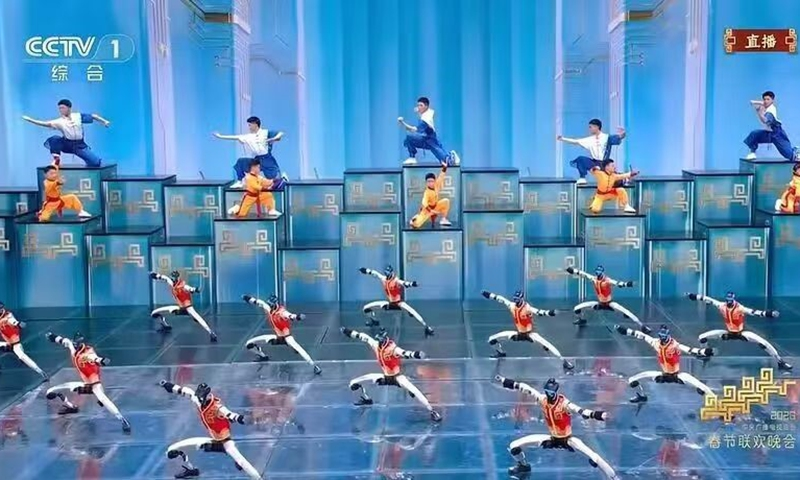
When humanoid robots perform kung fu at China’s New Year gala, it’s not just entertainment—it’s a statement. This year’s Spring Festival Gala, the world’s most-watched television broadcast, became an unexpected stage for China’s robotics ambitions.
Dozens of G1 humanoid robots developed by Unitree Robotics executed what organizers described as the world’s first fully autonomous kung fu showcase by machines. The performance blended martial arts, artificial intelligence, and national spectacle into a carefully choreographed display of technological muscle.
The result: a viral moment that was as much about industrial strategy as it was about celebration.
What Happened at the Spring Festival Gala?
China’s Spring Festival Gala, broadcast annually on Lunar New Year’s Eve, routinely attracts hundreds of millions of viewers. This year, the spotlight shifted from pop stars and comedians to machines.
A Fully Autonomous Kung Fu Routine
The G1 humanoid robots performed:
- Swift stance transitions
- Rapid footwork and balance shifts
- Tightly synchronized formations
- Real-time spatial adjustments
The choreography mimicked traditional kung fu sequences, including weapon routines with swords, staffs, and nunchucks. More than a dozen humanoids executed intricate combat movements while positioned near child performers—an intentional juxtaposition of tradition and future tech.
According to event organizers, the robots operated autonomously rather than through manual remote control. If verified, that would mark a meaningful milestone in real-time motion control and machine balance systems.
Who Built the Kung Fu Robots?
Unitree Robotics and the G1 Humanoid
The primary robots featured were G1 humanoids developed by Unitree Robotics, a Chinese robotics company known globally for its quadruped robotic dogs.
Unitree has steadily expanded into bipedal systems, competing in a space dominated internationally by firms like Boston Dynamics and Tesla’s Optimus project. The G1 model showcased at the gala emphasizes:
- Advanced joint actuators
- AI-driven balance algorithms
- Motion-planning systems
- Lightweight mechanical design
For technical accuracy, readers would benefit from sourcing Unitree’s official specifications or white papers from its website or from Chinese tech ministry disclosures.
Other Companies on Display
The broadcast also featured demonstrations from emerging humanoid robotics firms, including
- Galbot
- Noetix
- MagicLab
These appearances suggest that China is cultivating a broader ecosystem of humanoid robotics startups, not relying solely on one flagship company.
How Advanced Were the Movements?
Motion Control and Balance
Kung fu isn’t forgiving. It demands rapid center-of-gravity shifts, precise limb coordination, and controlled landings.
The robots demonstrated:
- Stable pivoting on one leg
- Coordinated group timing
- Recovery from rapid directional changes
Such movements indicate progress in dynamic control systems—an area where humanoid robotics has historically struggled.
While not equivalent to elite martial artists, the robots’ fluidity appeared beyond the stiff, pre-programmed gestures often seen in earlier prototypes.
The “Somersault Cloud” Moment
The gala also introduced the H2 robot, which appeared at venues in Beijing and Yiwu dressed in “Great Sage” armor—a reference to Sun Wukong, the Monkey King from Chinese folklore.
The H2 robot rode a robotic dog and performed a move inspired by the legendary “Somersault Cloud.” Though symbolic, the segment reinforced the theme: blending mythology with machine intelligence.
Why Does It Matter That Humanoid Robots Perform Kung Fu at China’s New Year Gala?
A National Stage for Industrial Ambition
The Spring Festival Gala isn’t a tech expo—it’s a cultural institution. Featuring humanoid robots during prime-time programming sends a clear signal: robotics is central to China’s industrial strategy.
China has repeatedly identified robotics and AI as priority sectors in its long-term manufacturing plans. While specific references would need sourcing—such as official documents from China’s Ministry of Industry and Information Technology—the strategic direction is well documented.
By placing robots in a culturally revered event, the message becomes domestic and global:
- Domestically: AI is part of national pride.
- Globally: China is serious about leading in intelligent manufacturing.
Soft Power Through Technology
This wasn’t just about engineering; it was about narrative.
When humanoid robots perform kung fu—a symbol of Chinese heritage—it reframes robotics as culturally integrated rather than imported or purely industrial.
It’s comparable to how Japan once used robotics exhibitions to shape its global image as a tech-forward nation.
How Does This Compare to Global Humanoid Robotics Efforts?
United States
American companies like Boston Dynamics and Tesla are also advancing humanoid robotics. However:
- Public demonstrations often occur in controlled lab environments.
- Few have integrated robots into mainstream cultural broadcasts.
Tesla’s Optimus robot has been showcased in company events but not in mass cultural programming on this scale.
Japan and South Korea
Japan has long invested in humanoid robotics, especially for elder care and service industries. South Korea has pushed robotics in manufacturing and AI research.
What differentiates China’s approach here is spectacle. The kung fu performance wasn’t a technical demo—it was prime-time entertainment viewed by an enormous audience.
This approach amplifies both domestic adoption and international attention.
Are These Robots Ready for Real-World Deployment?
The gala performance demonstrated coordination and balance, but that doesn’t necessarily translate into immediate industrial readiness.
Humanoid robots still face challenges:
- Battery life limitations
- High production costs
- Limited real-world adaptability
- Safety concerns in unpredictable environments
Experts often caution that live performances are optimized scenarios. Real-world environments—factories, hospitals, disaster zones—are far less controlled.
What This Signals About China’s Robotics Future
When humanoid robots perform kung fu at China’s New Year gala, the deeper story is strategic positioning.
China is attempting to:
- Scale domestic robotics manufacturing
- Integrate AI into physical systems
- Build public familiarity with humanoid machines
- Project leadership in next-generation technologies
The performance was symbolic—but symbolism shapes markets. Public enthusiasm can accelerate funding, policy support, and workforce development.
If the goal is to normalize robots in daily life, placing them alongside children and traditional performers is a deliberate step.
What Readers Should Watch Next
To assess whether this was a publicity moment or a turning point, watch for:
- Commercial deployment announcements
- Government funding disclosures
- Export partnerships
- Robotics performance benchmarks
If humanoid robotics continues appearing in high-profile public venues, it suggests sustained momentum rather than a one-off showcase.
TL;DR
- Humanoid robots performed a fully autonomous kung fu routine at China’s Spring Festival Gala.
- The robots were primarily G1 models developed by Unitree Robotics.
- The performance highlighted advances in motion control, synchronization, and balance.
- It doubled as a national statement about China’s ambitions in AI and intelligent manufacturing.
- While impressive, the technology still faces real-world deployment challenges.