
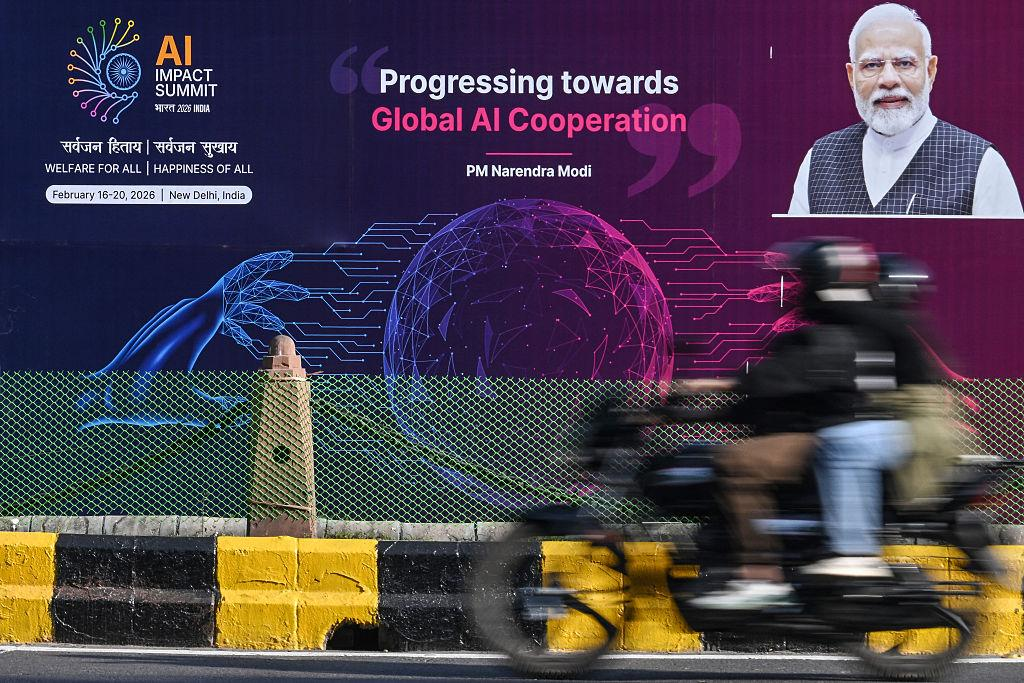
At the India AI Impact Summit 2026 in New Delhi, Prime Minister Narendra Modi unveiled what he called a defining roadmap for the artificial intelligence era: the MANAV Vision.
“MANAV means human,” Modi said, framing the initiative as a human-centric blueprint for governing AI in the 21st century.
Positioned as both a domestic policy direction and a global governance proposal, MANAV Vision lays out five core principles for how AI systems should be designed, regulated, and deployed. Here’s what it means, and why it matters.
What Is MANAV Vision?
MANAV is an acronym that defines India’s approach to artificial intelligence governance.
According to Modi, it stands for:
- M – Moral and ethical systems
- A – Accountable governance
- N – National sovereignty
- A – Accessible and inclusive systems
- V – Valid and legitimate AI
Together, these pillars form what the government describes as a human-first AI framework — one designed to balance innovation with safeguards.
The announcement places India more assertively in the global AI governance debate, alongside frameworks emerging from the European Union, the United States, and China.
Breaking Down MANAV: What Each Principle Means
M: Moral and Ethical Systems
Modi emphasized that AI must be grounded in ethical guidance.
This includes:
- Preventing bias and discrimination
- Ensuring fairness in algorithmic decision-making
- Building systems that align with societal values
The ethical AI debate has intensified globally, particularly around generative AI tools and automated decision systems used in hiring, finance, and law enforcement.
If India formalizes ethical standards under MANAV, it could lead to:
- National AI audit requirements
- Mandatory bias testing
- Ethics review boards for high-risk AI deployments
A: Accountable Governance
The second pillar focuses on transparency and oversight.
Modi called for:
- Clear regulatory rules
- Defined lines of responsibility
- Robust oversight mechanisms
Accountability is especially relevant in cases where AI systems cause harm, whether through misinformation, faulty automation, or misuse of personal data.
This pillar suggests India may pursue:
- Traceability standards for AI models
- Clear liability frameworks
- Public disclosure requirements for high-risk systems
For readers, an explainer on how AI liability currently works in India would add context.
N: National Sovereignty
Perhaps the most geopolitically significant pillar is “National Sovereignty.”
Modi framed it as: “Whose data, his right.”
This underscores:
- Data ownership
- Digital self-determination
- Control over domestic AI infrastructure
India has already moved toward stronger data localization policies. Under MANAV Vision, sovereignty could expand into:
- Mandating local data storage
- Encouraging domestic AI model development
- Reducing reliance on foreign AI platforms
This aligns with broader trends in digital nationalism worldwide.
A: Accessible and Inclusive Systems
The second “A” emphasizes access.
Modi said AI should be a “multiplier, not a monopoly.”
This suggests policies aimed at:
- Expanding AI tools to rural and underserved populations
- Supporting startups beyond major tech hubs
- Promoting multilingual AI systems
India’s linguistic diversity makes inclusive AI especially relevant. Systems trained primarily in English risk excluding large segments of the population.
If implemented effectively, this pillar could:
- Boost AI tools in regional languages
- Expand digital literacy programs
- Support AI adoption in agriculture, healthcare, and education
V: Valid and Legitimate AI
The final pillar focuses on legality and verification.
AI systems, Modi said, must be lawful and verifiable.
This includes:
- Compliance with national laws
- Auditability
- Clear validation standards
Verification becomes increasingly critical as AI-generated content spreads across media platforms.
This pillar may lead to:
- Watermarking standards for AI-generated content
- Certification processes for high-impact AI systems
- Regulatory approval mechanisms for advanced AI deployments
Why Is MANAV Vision Significant?
The global AI race is no longer just about innovation, it’s about governance.
Countries are competing to:
- Lead AI development
- Shape regulatory norms
- Influence global standards
Modi’s announcement positions India as a rule-setter, not just a technology consumer.
At a time when the United Nations Secretary-General António Guterres has warned that AI’s future “cannot be decided by a handful of countries,” India’s MANAV Vision signals a push for broader participation in shaping AI norms.
India is the world’s most populous country and one of the fastest-growing digital markets. Any AI framework it adopts could have global ripple effects.
What About Risks? Children and AI Safety
Modi also flagged child safety as a key concern.
He warned that the AI ecosystem must be “child safe and family guided.”
This comes as tech platforms face mounting scrutiny globally over:
- Social media addiction
- Algorithm-driven content exposure
- Psychological impact on minors
In the United States, companies like Meta and YouTube are under legal pressure regarding allegations of engineering addictive systems for children.
By raising child safety during the summit, Modi connected AI governance to broader tech accountability debates already playing out worldwide.
Expect child-specific safeguards to become part of India’s AI regulatory framework.
How Does MANAV Compare to Other AI Frameworks?
While full policy documents are yet to be released, MANAV appears to echo elements from
- The EU’s risk-based AI regulation model
- U.S. executive guidelines emphasizing safety testing
- China’s emphasis on data sovereignty and content control
What sets MANAV apart is its branding around human-centric governance and its strong emphasis on sovereignty.
If India formalizes these principles into law, it could create:
- A hybrid regulatory model blending Western-style oversight with domestic control priorities
- A framework tailored for emerging markets rather than established tech economies
What Happens Next?
At this stage, MANAV Vision functions as a strategic framework rather than a finalized law.
Key questions remain:
- Will Parliament introduce AI-specific legislation?
- How will enforcement mechanisms work?
- Will India coordinate with global AI governance bodies?
The next steps will determine whether MANAV becomes a policy slogan or a structural shift in AI governance.
TL;DR
MANAV Vision is India’s new AI governance framework, unveiled by Prime Minister Narendra Modi at the India AI Impact Summit 2026. The acronym stands for Moral, Accountable, National sovereignty, Accessible, and Valid AI systems. It emphasizes ethical AI, data sovereignty, inclusivity, accountability, and child safety. While details are still emerging, MANAV positions India as a major voice in global AI regulation debates.