

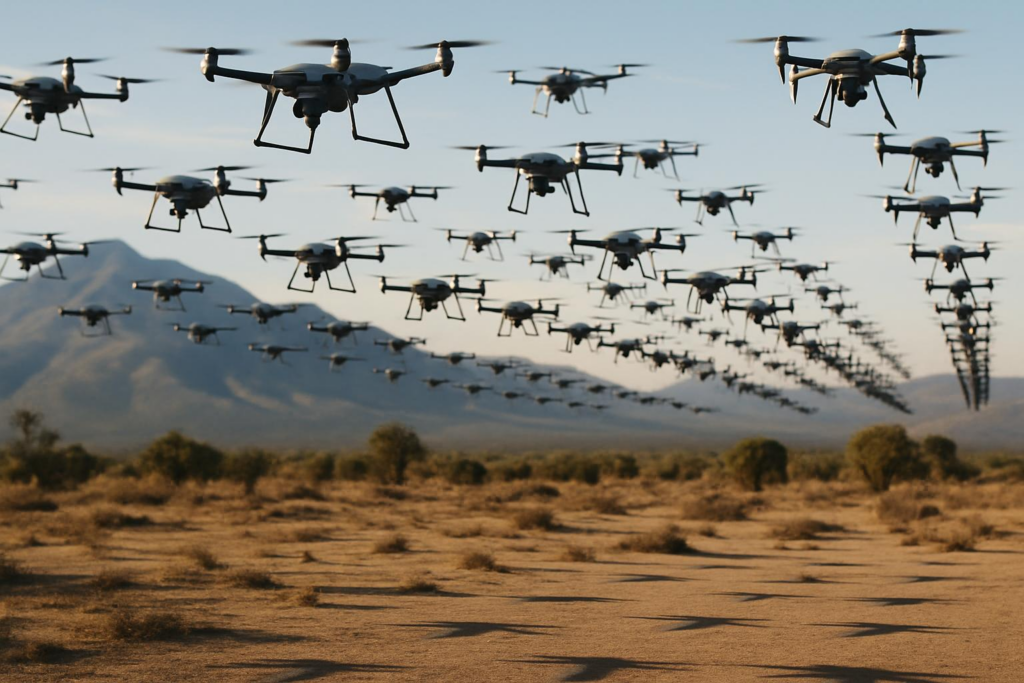
Chinese researchers have taken a meaningful step toward untethered flight. A team from Xidian University has developed a wireless power transmission system for drones that can recharge aircraft mid-air using microwave energy. If it scales beyond controlled tests, the technology could reshape how drones operate—especially in military and surveillance roles.
Published in the peer-reviewed journal Aeronautical Science & Technology, the work moves a long-discussed concept, beaming power through the air, from theory into early real-world validation.
What is wireless power transmission for drones?
At its core, wireless power transmission for drones eliminates the need for onboard fuel or frequent battery swaps. Instead of landing to recharge, drones receive energy continuously from a ground-based source.
How is this different from traditional drone power?
Most drones today rely on:
- Lithium-ion batteries with limited flight time (typically 20–60 minutes for commercial drones)
- Fuel-based systems for larger military UAVs, which add weight and logistical complexity
The new system flips that model:
- Power is generated on the ground
- Energy is transmitted wirelessly via microwaves
- The drone becomes more like a receiver than a self-contained unit
Think of it less as a flying battery and more as a device plugged into an invisible extension cord.
How Does the System Work?
The system relies on three core components working in sync.
Ground-Based Microwave Emitter
A vehicle-mounted emitter sends a focused beam of microwave energy upward. This is the “power source” for the drone.
Antenna Array on the Drone
Mounted on the underside of the aircraft, this array captures incoming microwave energy and converts it into electrical power usable by the drone’s systems.
Dynamic Tracking and Alignment System
Keeping the beam locked onto a moving target is the hard part. The researchers addressed this by integrating:
- GPS positioning
- Real-time tracking algorithms
- Automated flight control adjustments
Together, these systems ensure the drone stays aligned with the energy beam during flight.
Why Alignment Is the Biggest Challenge
Wireless energy transmission isn’t new—but doing it reliably with moving objects is.
The problem
- Even slight misalignment can disrupt energy transfer
- Drones are constantly affected by wind, turbulence, and movement
- Microwave beams require precision targeting
The solution
The research team combined:
- Dynamic beam steering
- Onboard flight corrections
- Continuous positional feedback
This closed-loop system allows the drone and emitter to “track each other” in real time.
What Did the Tests Show?
Early trials offer a glimpse of what’s possible—but also highlight limitations.
Key test results
- Flight duration: Up to 3.1 hours
- Altitude: Approximately 15 meters (49 feet)
- Platform: Car-mounted emitter system
- Drone type: Fixed-wing UAV
This is significantly longer than typical battery-powered drone flights at similar scales.
What the results mean
- The system works under controlled conditions
- Endurance improves dramatically when power is continuous
- Low-altitude operation is currently a constraint
The 15-meter ceiling is important—it suggests the technology still needs refinement for higher-altitude or long-range missions.
Why This Matters: Military and Strategic Implications
The most immediate applications are likely military.
The “Land-Based Aircraft Carrier” Concept
Analysts have compared the system to a mobile aircraft carrier on land.
Instead of a runway or ship, imagine an armoured vehicle that:
- Launches drones
- Powers them wirelessly
- Controls their missions in real time
This creates a self-contained drone hub on the battlefield.
Potential use cases
- Continuous surveillance
Drones could stay airborne for hours or even days with uninterrupted power. - Persistent strike capability
Armed drones could loiter until needed, reducing response times. - Electronic warfare
An extended flight enables jamming, signal interception, and reconnaissance missions. - Border and perimeter security
Always-on aerial monitoring without rotation gaps.
Why militaries care
The biggest constraint in drone warfare today is endurance. Remove that, and you change:
- Mission planning
- Logistics
- Tactical flexibility
Civilian Applications: What Could Come Next?
While defense applications will likely lead adoption, civilian use cases are just as compelling.
Infrastructure monitoring
- Power lines
- Pipelines
- Railways
Drones could patrol continuously without returning to base.
Disaster response
- Real-time aerial mapping
- Search-and-rescue missions
- Communication relay in damaged areas
Agriculture
- Continuous crop monitoring
- Precision spraying over large fields
Delivery networks (long-term)
If scaled, wireless power could remove one of the biggest barriers to drone delivery: limited range.
Limitations and Open Questions
This is a breakthrough—but not a finished product.
Technical challenges
- Range limitations
Current tests are at low altitude and short distances. - Energy efficiency
Microwave transmission loses power over distance. - Weather interference
Rain, fog, and atmospheric conditions could affect performance.
Safety concerns
- Microwave exposure risks need thorough evaluation
- Airspace safety regulations will need updating
- Risk of interference with other systems
Scalability
- Can this work for multiple drones simultaneously?
- Can it operate in urban environments?
- What happens when drones move out of range?
How This Compares to Other Wireless Power Technologies
Wireless power isn’t new—but most systems are short-range.
Existing methods
- Inductive charging (like phone pads): requires close contact
- Resonant charging: works over small distances
- Laser-based power beaming: another emerging approach
What makes this different
- Uses microwaves for longer-range transmission
- Designed for moving targets
- Focuses on real-time alignment and tracking
Each method has trade-offs in efficiency, safety, and range.
What Comes Next?
The next phase of development will likely focus on:
- Increasing altitude and range
- Improving energy efficiency
- Scaling to multiple drones
- Testing in real-world environments
If those hurdles are cleared, this could move from lab demonstration to operational deployment within the decade.
TL;DR
- Chinese researchers have demonstrated wireless power transmission for drones using microwave beams.
- The system allows drones to stay airborne for over 3 hours without landing.
- The biggest challenge—alignment—was solved using GPS and dynamic tracking.
- Military use cases include persistent surveillance and mobile drone hubs.
- Civilian applications could span infrastructure, disaster response, and agriculture.
- Major hurdles remain, including range, safety, and scalability.