
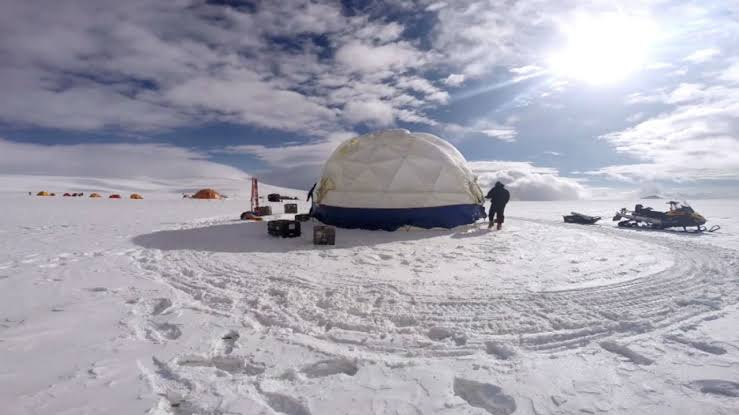
Deep beneath the Guliya Ice Cap on the Tibetan Plateau, scientists have found evidence that parts of the glacier preserve a climate record stretching back more than 128,000 years.
The finding pushes back the known history of mountain glacier ice in Tibet and provides rare evidence that parts of the high-altitude ice cap survived the last ice age.
Researchers led by paleoclimatologist Lonnie Thompson of The Ohio State University analysed ice cores drilled from Guliya during expeditions in 1992 and 2015. Their results, published in Science Advances on September 30, 2026, indicate that the ice record extends beyond 100,000 years, with evidence supporting a timescale reaching approximately 128,000 years.
The discovery matters not only because of the ice’s age, but because ancient ice contains a chemical archive of Earth’s atmosphere and climate. Bubbles, dust, isotopes and other material trapped inside it can help scientists reconstruct what the environment looked like long before modern instruments existed.
Where is the ancient Guliya ice?
The Guliya Ice Cap lies in northwestern Tibet, high on the Tibetan Plateau.
The region is part of what scientists sometimes call Earth’s “Third Pole” because of its enormous concentration of glaciers and frozen water outside Antarctica and the Arctic.
Guliya is located at extremely high elevation, with parts of the ice cap rising above 6,000 metres. That altitude and the region’s cold conditions have helped preserve ice through multiple climatic periods.
For decades, however, scientists were uncertain about just how far back the deepest layers of the Guliya ice actually extended.
Earlier research had already suggested that some Guliya ice could be far older than the relatively young Holocene layers found at many other Tibetan glacier sites. The new work provides additional evidence for an ice record spanning the last glacial cycle.
Why the 128,000-year estimate matters
The age is significant because roughly 128,000 years ago Earth was in the last interglacial period, a relatively warm interval that preceded the most recent ice age.
The climate eventually shifted into the last glacial period, during which large ice sheets expanded across parts of North America and Eurasia.
Finding evidence that glacier ice in Tibet survived through this transition tells scientists something important about the long-term stability of high-altitude ice in Central Asia.
It also means the Guliya Ice Cap can potentially provide a climate record covering an interval far longer than the instrumental measurements available for the region.
The researchers say the Guliya record is currently the oldest known ice record recovered from Tibet.
It also represents one of the longest climate records obtained from a mountain glacier outside the polar regions.
Scientists compared ice cores drilled 23 years apart.
One of the strongest aspects of the research is that it does not rely on a single drilling expedition.
Scientists compared a roughly 309-metre ice core recovered in 1992 with a roughly 310-metre core drilled nearby in 2015.
The two cores were collected more than two decades apart, yet they showed remarkably similar patterns in their oxygen isotope records.
Oxygen isotopes can preserve information about past temperature and precipitation conditions. When comparable patterns appear in separate cores from the same ice cap, scientists gain greater confidence that the signal represents genuine environmental history rather than a quirk of one particular drilling location.
For Thompson and his colleagues, that reproducibility was critical.
It helped demonstrate that the climate information preserved within Guliya’s ice is consistent across the ice cap and can be used to construct a longer chronology.
How do scientists date ice that is more than 100,000 years old?
Dating extremely old glacier ice is difficult.
Unlike tree rings, which can sometimes be counted year by year, the deepest layers of an ancient glacier may be compressed, disturbed or difficult to separate into individual annual layers.
The Guliya team therefore used several independent clues to establish the age of the core.
One important tool involved radioactive isotopes of beryllium-10 and chlorine-36.
These isotopes are produced naturally through interactions involving cosmic rays and can become incorporated into environmental materials. Their presence and ratios provide useful chronological markers under appropriate conditions.
The researchers also identified evidence associated with the Laschamp Geomagnetic Excursion.
The Laschamp event occurred about 41,000 years ago, when Earth’s magnetic field underwent a major temporary weakening and reorganization.
Because the event is independently known from other geological records, identifying its signature in the Guliya core provides an important time marker within the ice record.
Tibetan cave deposits offered another time check
The scientists did not stop with the radioactive-isotope evidence.
They also compared the oxygen isotope record from Guliya’s ice with records preserved in cave deposits from the Asian monsoon region.
These cave formations, known as speleothems, preserve chemical signatures that can be dated independently and used to reconstruct past climate conditions.
The similarity between the ice-core and cave records helped researchers extend the Guliya timescale deeper into the past.
Together, the evidence supports a climate record reaching back approximately 128,000 years.
That does not mean every layer of Guliya’s ice is exactly 128,000 years old. Rather, the evidence indicates that the ice-core record contains material and climate signals that can be placed within a chronology extending to that age.
Did the Guliya glacier really survive the last ice age?
The evidence strongly indicates that at least portions of the Guliya Ice Cap survived the last glacial period.
That is significant because scientists have long debated how persistent some high-altitude Tibetan glaciers were during major shifts in global climate.
The latest research provides multiple lines of evidence that glacial-stage ice remains preserved within Guliya.
The study also uses radiocarbon dating from ice near the glacier margin to support the presence of glacial-age material.
The result is a more complete picture of Guliya as a long-lived ice archive rather than simply a modern glacier containing relatively young snow and ice.
Why is old mountain ice so rare?
Antarctica and Greenland contain the planet’s most extensive archives of ancient ice, with polar ice cores preserving climate records hundreds of thousands of years into the past.
Mountain glaciers are generally less stable as long-term climate archives.
They can melt, flow, thin, retreat or undergo major changes when temperatures rise. Ice can also be lost from the bottom or disturbed by glacier movement.
That is why finding a mountain ice cap capable of preserving a climate record for more than 100,000 years is unusual.
Before the latest Guliya research, some of the oldest known mountain glacier records outside the polar regions were far younger. Ice from Peru’s Nevado Huascarán, for example, preserves records extending back more than 30,000 years.
Guliya’s much older record therefore fills an important gap in the global network of ancient climate archives.
What can scientists learn from 128,000-year-old ice?
Ancient ice functions as a natural time capsule.
Scientists can study oxygen isotopes to investigate past temperatures and moisture sources. Dust particles can reveal changes in atmospheric circulation and aridity. Chemical compounds and other trapped material can provide clues about environmental conditions far from the glacier itself.
In polar ice, trapped air bubbles can directly preserve samples of ancient atmosphere. Guliya’s ice offers a different but complementary record, particularly valuable for understanding conditions across the Tibetan Plateau and broader Asian climate system.
The record could help researchers examine how the Asian monsoon interacted with westerly winds, how temperatures changed during different glacial phases and how the high-elevation environment responded to orbital variations.
The ice could reveal climate changes across an entire glacial cycle
The newly established chronology gives researchers a chance to study climate conditions across several major transitions.
The last glacial cycle included repeated shifts between colder and warmer periods. These changes were linked to large-scale variations in Earth’s orbit, ice sheets, atmospheric circulation and ocean conditions.
The Guliya record contains oxygen-isotope variations that the researchers found to track orbital changes in ways that can be compared with polar ice records.
That allows scientists to investigate whether distant regions of the planet responded to the same large-scale climate forces and whether those responses occurred simultaneously or with regional differences.
Why the Guliya record could matter for future climate research
Understanding how the Tibetan Plateau responded to past warming and cooling can provide a useful baseline for interpreting what is happening today.
Modern climate observations cover only a small slice of Earth’s history.
A record extending back more than 100,000 years allows scientists to compare modern conditions with naturally occurring climate variations that occurred long before industrial greenhouse-gas emissions.
That does not provide a simple prediction of the future. Earth’s past climate was influenced by different combinations of factors, and today’s conditions are occurring in a very different atmospheric context.
But ancient records can show how sensitive glaciers and regional climate systems have been to major environmental changes.
Is this the oldest ice on Earth?
No.
The oldest ice on Earth is found in Antarctica, where researchers have recovered ice more than 800,000 years old and are pursuing even older material.
The significance of Guliya is different.
It provides an exceptionally old climate record from a high-altitude mountain environment outside the polar regions.
Calling it simply “the oldest ice on Earth” would therefore be incorrect.
A more accurate description is that Guliya contains the oldest known ice record so far recovered from Tibet and one of the oldest known mountain glacier records outside the polar ice sheets.
What scientists will study next
The newly established chronology is only the beginning.
Researchers can now use the Guliya cores to investigate past atmospheric chemistry, dust transport, temperature changes, biological material and other environmental indicators.
They also want to refine the chronology further and better understand how the glacier behaved during different periods of the last glacial cycle.
One particularly interesting feature is that the relationship between Guliya’s oxygen-isotope record and June solar radiation appears to change after the last deglaciation. The authors say further investigation will be needed to understand that reversal.
That makes the ice valuable not merely as an archive of ancient temperatures, but as a record that could reveal how regional climate systems responded differently during different stages of Earth’s climate history.
A frozen archive more than 100,000 years deep
The Guliya Ice Cap has now become an extraordinary window into Earth’s past.
Two ice cores drilled decades apart tell a consistent story. Radioactive isotopes provide chronological markers. Evidence from the Laschamp geomagnetic excursion anchors part of the record, while Tibetan cave deposits help extend the timeline farther back.
Together, these clues point to a climate archive reaching approximately 128,000 years.
The frozen layers high on the Tibetan Plateau therefore hold something more valuable than ancient ice alone.
They hold a record of how Earth’s climate changed through an entire major glacial cycle, preserved in a place where scientists can now begin reading the environmental story in much greater detail.