
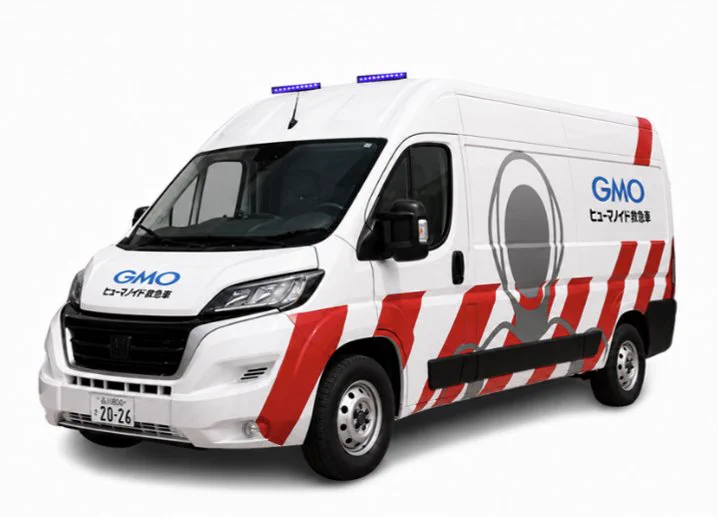
Tokyo has a new kind of emergency vehicle, and its patients are not human. Japanese company GMO AI & Robotics Commerce has introduced the “GMO Humanoid Ambulance”, a mobile maintenance vehicle designed to rush to humanoid robots when they break down at commercial sites. The service began in September 2026 and is being described by the company as Japan’s first vehicle specifically designed for humanoid robot maintenance.
The concept is simple: rather than sending a malfunctioning robot back to a repair centre and leaving a workplace without it, engineers travel directly to the robot.
The vehicle carries technicians, diagnostic equipment, tools, replacement parts and even a spare humanoid robot that can temporarily take over if the damaged machine cannot be repaired immediately.
How does the robot ambulance work?
The vehicle is essentially a mobile robotics workshop.
When a humanoid robot develops a fault, engineers can travel to the site, inspect the machine and attempt repairs there. The goal is to reduce the amount of time the robot remains out of service.
The vehicle also carries a replacement humanoid. If repairing the original machine at the location is impractical, technicians can swap it with the spare and transport the damaged robot to a facility equipped for more extensive work.
That turns what could have been a lengthy service interruption into a much quicker replacement-and-repair process.
Who operates the humanoid ambulance?
Despite its futuristic appearance, the vehicle is not an autonomous robot.
Human engineers ride inside it and handle the diagnosis and repairs. GMO says the technicians are already involved in the secondary development and tuning of humanoid robots at its physical-AI development facility, the GMO Humanoid Lab in Tokyo.
That familiarity is important because different robots can have different hardware, software and operating requirements.
The company says the vehicle is currently intended to maintain humanoid robots whose deployment it has handled.
How quickly can it reach a broken robot?
The initial operation is centered on Tokyo.
Japanese broadcaster TV Asahi reported that the service is designed to reach sites in the Tokyo area in roughly one to two hours, including the possibility of responding at night.
At present, GMO has one such vehicle. The company says it could expand the fleet and establish additional regional bases as demand for humanoid robots grows.
That could become increasingly important as humanoid machines move beyond demonstrations and into workplaces.
Why do humanoid robots need an ambulance?
Humanoid robots are being developed for environments where they can perform physical tasks alongside or instead of human workers.
That includes logistics facilities, factories, security operations and other commercial settings. But putting robots into real workplaces introduces a very ordinary problem: things break.
A robot that falls, suffers a mechanical failure or develops a software or hardware fault could become unusable until a technician arrives or the machine is transported to a repair center.
For a business depending on the robot for day-to-day work, that downtime can translate directly into lost productivity.
GMO’s approach is to bring the service infrastructure to the machine instead.
What does the vehicle carry?
The ambulance has been designed around the practical requirements of field repairs.
It carries diagnostic equipment, major replacement components, repair tools and spare parts. A replacement humanoid is also transported inside the vehicle for situations in which the original machine cannot be fixed on site.
Japanese media reports showed a humanoid robot positioned on a dedicated stretcher inside the vehicle, underscoring just how literally the “ambulance” concept has been designed.
Its exterior also borrows visual cues from conventional emergency vehicles, although its passengers are decidedly more mechanical.
Is this a sign humanoid robots are becoming mainstream?
Not by itself.
The existence of a dedicated repair vehicle does not mean humanoid robots are already widespread enough to replace large numbers of human workers. But it does highlight an important transition in the robotics industry.
Developing a robot is only one part of deploying it commercially. Businesses also need installation, software updates, diagnostics, maintenance, replacement components and emergency support.
Those services form the less glamorous but essential infrastructure required to keep physical AI systems operating.
GMO is building more than a repair service
The humanoid ambulance was announced alongside another GMO service called “GMO LOOP for Physical AI”.
That programme is designed to collect data from robots operating in the field, use the information to improve their models and then feed those improvements back into the physical machines. The company began offering the service on September 8.
Together, the two initiatives point toward a broader business model.
One service keeps robots physically operational. The other aims to make them perform better over time.
Could robot ambulances become a normal sight?
That depends on how quickly humanoid robots move into large-scale commercial deployment.
If companies eventually operate fleets of humanoid machines across warehouses, factories, hotels and other workplaces, a breakdown-response network could become as important to robotics as field technicians are to today’s industrial equipment.
GMO itself says that keeping humanoid robots continuously operational will be essential to their wider social adoption.
For now, Tokyo has only one of these unusual vehicles.
But the idea reveals something significant about the next phase of the robotics race: once machines start working in the real world, someone has to look after them when they fall over.