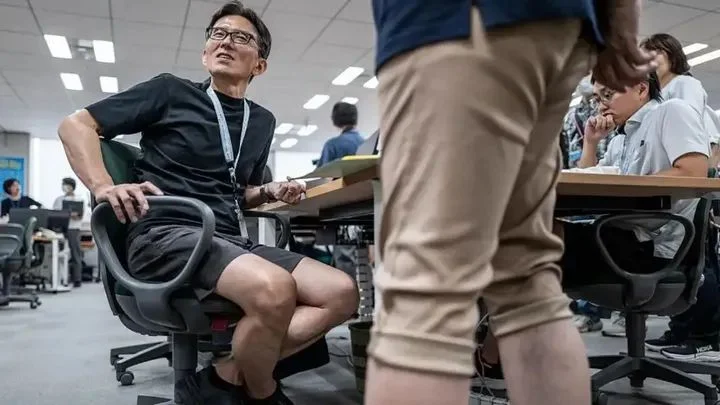
Japan’s record-breaking summer heat is changing more than how people dress. As temperatures push workers toward shorts and lighter clothing, an unexpected grooming trend is gaining attention: more men are turning to clinics and salons for leg and body hair removal.
The trend has become linked to the Japanese slang term “sunehara,” a combination of sune (shin or lower leg) and harassment. The term is used online to describe discomfort caused by exposed leg hair, particularly when people wear shorts in public or at work.
The debate sits at the intersection of Japan’s increasingly relaxed summer dress codes, workplace expectations and changing attitudes toward male grooming.
What is the “sunehara” trend in Japan?
“Sunehara” is not a formal legal or workplace category. It is an internet-era expression used to describe the perceived discomfort or awkwardness some people associate with seeing another person’s leg hair.
As Japan experiences increasingly intense summer heat, the issue has gained visibility because shorts are becoming more practical in places where they were traditionally considered too casual.
Some men are reportedly responding by shaving, waxing or undergoing laser hair-removal treatments on their legs and other parts of the body.
The motivation is not necessarily purely cosmetic. For some, it is about feeling comfortable and presentable when more skin is exposed.
Why are more Japanese men wearing shorts?
The immediate driver is simple: heat.
Japan has increasingly faced periods of extreme summer temperatures, prompting renewed attention to how people dress in offices and other workplaces.
Tokyo has promoted more flexible approaches to workplace clothing as part of efforts to reduce reliance on air conditioning and help people cope with heat.
The broader philosophy behind Japan’s Cool Biz campaign has long been to encourage lighter clothing during the warmer months rather than requiring offices to maintain very low indoor temperatures.
As workplace dress codes become more flexible, shorts can become less unusual—particularly when employees are commuting or working in exceptionally hot conditions.
Tokyo Metropolitan Government environmental official Noboru Watanabe told the BBC that the aim was to give people more options during severe heat rather than dictate what workers should wear.
Why does leg hair matter when shorts become acceptable?
The controversy is less about hair itself than about social expectations surrounding appearance.
Body hair is natural, but standards of grooming vary significantly between countries, workplaces and generations. When shorts become more common in professional settings, parts of the body that were previously hidden become visible.
That can make grooming preferences more noticeable.
Some people argue that employees should not feel pressured to remove natural body hair simply because workplace dress codes have become more relaxed.
Others believe that if shorts are being worn in professional environments, employees should take the same approach to grooming that they would with other aspects of workplace presentation.
The debate therefore raises a larger question: How much should personal grooming matter when workplace dress codes become more casual?
Are Japanese men actually removing more body hair?
Reports from Japan’s grooming industry suggest that some men are increasingly seeking hair-removal treatments, including laser procedures.
The reasons vary.
Men may choose hair removal because they:
- Prefer the appearance of hair-free legs.
- Find exposed body hair uncomfortable in professional settings.
- Want to feel more confident wearing shorts.
- Prefer the sensation or appearance of smoother skin.
- Are responding to changing social expectations around male grooming.
However, it is important not to portray the trend as a nationwide behavioral shift among Japanese men.
The available discussion appears to center on individual experiences, online debate and reports from grooming businesses. There is not enough evidence to conclude that most Japanese men are removing their leg hair because of “sunehara.”
How has Japan’s grooming culture changed?
Male grooming has become increasingly mainstream in Japan, as it has in many other countries.
Hair removal is no longer exclusively associated with women. Men can increasingly find dedicated services for facial hair, legs, underarms and other areas.
Laser hair removal is particularly attractive to people looking for longer-lasting reduction rather than repeatedly shaving.
That does not mean Japanese men have suddenly adopted a single standard of appearance. Instead, the market now offers more choices for men who want to manage body hair according to their own preferences.
The summer shorts debate has simply made those choices more visible.
Is “sunehara” really harassment?
This is where the term needs context.
Calling visible leg hair “harassment” can be provocative because body hair is a normal physical characteristic. There is also a difference between someone personally finding body hair unpleasant and an actual workplace harassment complaint.
Online discussions about “sunehara” should therefore not be treated as evidence that Japanese workplaces formally consider leg hair inappropriate.
The controversy is better understood as a cultural debate over:
- Professional appearance
- Personal grooming
- Gender expectations
- Workplace dress codes
- Individual freedom during extreme heat
Some online reactions have also criticized the apparent double standard, arguing that women have historically faced much stronger pressure to remove body hair than men.
That criticism has become part of the broader conversation.
Why are women part of the debate?
Much of the online discussion has focused on whether expectations surrounding men’s body hair mirror the standards historically imposed on women.
Women in Japan have long faced social pressure around removing visible body hair, particularly from areas such as the legs and underarms.
The emergence of “sunehara” as a discussion around men’s grooming has therefore prompted some people to ask whether men are now experiencing a smaller version of the same appearance pressure.
Critics argue that nobody should be made to feel embarrassed about natural body hair.
Others see the trend less as pressure and more as an example of changing personal grooming preferences.
Both interpretations can coexist: men can voluntarily choose hair removal while society can still question whether they should feel compelled to do so.
What does the trend say about Japan’s changing workplace?
The most interesting part of the story may not be leg hair at all.
It is the changing definition of professional clothing in extreme heat.
For decades, Japanese office culture has often emphasized formal appearance, including suits and conservative clothing. But extreme temperatures make those expectations harder to maintain.
Cool Biz challenged that culture by encouraging lighter clothing. As climate conditions become more difficult, the question is shifting from “What looks formal?” to “What is reasonable for workers in this weather?”
Shorts represent the next step in that debate.
Once more skin becomes visible, grooming becomes part of the conversation too.
Could “sunehara” become a bigger grooming trend?
Possibly, but it is too early to call it a major national movement.
Beauty and grooming markets often grow when social norms change. If shorts become increasingly accepted in Japanese offices, demand for leg grooming could rise simply because more people are paying attention to their legs.
But the opposite could also happen.
As casual clothing becomes normalized, society may become less concerned about whether exposed legs are shaved, waxed or naturally hairy.
In that scenario, the “sunehara” debate could ultimately help normalize body hair rather than eliminate it.
The real story is about choice
Japan’s summer grooming debate highlights a tension that extends far beyond body hair.
Extreme heat is forcing employers and employees to reconsider long-standing workplace norms. As shorts become more acceptable, people are also confronting questions about how much control workplaces and colleagues should have over personal appearance.
For some Japanese men, hair removal may be a practical way to feel comfortable and confident in shorts. For others, there is no reason to alter natural body hair at all.
Neither choice necessarily needs to define professionalism.
The bigger change may be that Japanese workplaces are slowly moving toward a model where comfort, climate and personal choice carry more weight alongside traditional expectations of formal appearance.
And if the summer keeps getting hotter, the question of what counts as “office appropriate” may become less about whether someone’s legs are hairy—and more about whether the office itself is prepared for the heat.
TL;DR
Japan’s extreme summer heat is pushing more workplaces toward casual clothing, including shorts. That has made male body hair more visible and fueled online discussion around “sunehara,” a slang term for discomfort associated with exposed leg hair. Some men are reportedly responding with shaving, waxing or laser hair removal.
But the trend is about more than grooming. It reflects a broader debate over workplace appearance, gender expectations and how much traditional dress codes should matter when temperatures become extreme.