
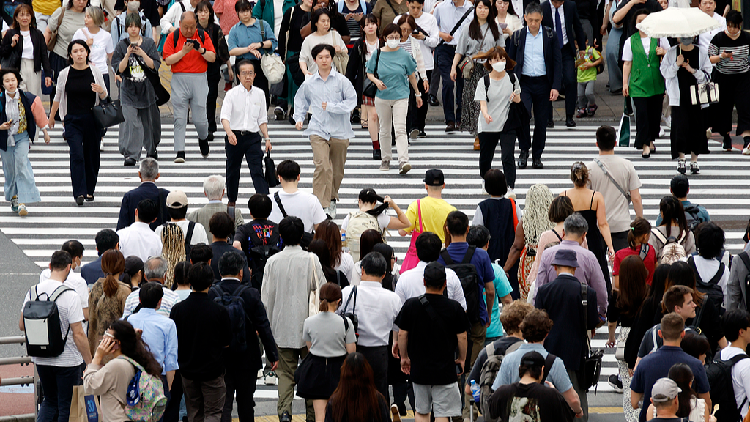
Japan’s demographic crisis has reached another historic milestone. The country’s child population has now declined for the 45th consecutive year, falling to a record low of 13.29 million as of April 1, 2026, according to new government estimates.
Children under the age of 15 now account for just 10.8 percent of Japan’s total population, one of the lowest ratios in the world and the second-lowest among major nations after South Korea.
The numbers are more than a statistical warning. They reflect a profound transformation underway in one of the world’s largest economies: fewer births, a rapidly aging population, shrinking schools, mounting labor shortages, and growing anxiety about the country’s long-term economic future.
Japan is not merely getting older.
It is becoming structurally older.
What do the latest numbers show?
According to the Japanese government:
- The child population fell by 350,000 from the previous year
- Total children under 15 now stands at 13.29 million
- Boys account for 6.81 million
- Girls account for 6.48 million
The percentage of children within the total population dropped another 0.3 percentage points to 10.8 percent.
Those marks:
- the 45th straight annual decline in child population
- the 52nd consecutive yearly drop in the child-population ratio
The figures are the lowest recorded since comparable government tracking began in 1950.
Japan now has one of the world’s oldest societies
Among countries with populations above 40 million, Japan now has the second-lowest proportion of children globally.
Only South Korea ranks lower at 10.2 percent.
Other countries trailing behind include:
- Italy at 11.7 percent
- Spain at 12.6 percent
The comparison highlights a broader demographic crisis unfolding across several advanced economies:
fewer young people and rapidly expanding elderly populations.
But Japan remains the clearest example of how long-term population decline can reshape an entire nation.
Why are fewer children being born in Japan?
Japan’s declining birth rate is tied to several overlapping economic and social factors.
High cost of living
Raising children in Japan has become increasingly expensive, especially in major urban centers like:
- Tokyo
- Osaka
Housing, education, childcare, and daily living costs place heavy pressure on young families.
Delayed marriage and parenthood
Many younger Japanese adults are:
- marrying later
- having fewer children
- delaying family planning
- remaining single longer
Economic uncertainty and work culture play major roles.
Demanding work culture
Japan’s famously intense work culture continues to affect family formation.
Long working hours and limited work-life balance often make parenting difficult, particularly for women balancing careers and childcare expectations.
Economic insecurity
Many younger workers increasingly rely on:
- temporary contracts
- gig employment
- unstable wages
That uncertainty discourages long-term family planning.
Births in Japan also hit another record low
Separate preliminary data from Japan’s Health Ministry showed:
births in 2025 dropped to just 705,809.
That represents:
- the 10th consecutive annual decline
- another all-time low
Japan’s birth numbers have now fallen far below the level needed to maintain population stability.
For a society to sustain its population without immigration, fertility rates generally need to remain near:
2.1 births per woman.
Japan’s fertility rate remains well below that threshold.
Why this matters far beyond Japan
Japan’s demographic struggles are being closely watched globally because many developed countries face similar trends.
Governments across:
- Europe
- East Asia
- parts of North America
are grappling with:
- aging populations
- declining birth rates
- shrinking workforces
Japan effectively functions as a demographic preview of challenges other advanced economies may eventually face.
Those challenges include:
- pension strain
- healthcare burdens
- labor shortages
- slower economic growth
- declining rural populations
Some villages and towns in Japan are already confronting near-total depopulation.
Schools have closed.
Businesses struggle to hire workers.
Entire neighborhoods are aging in place.
What is Japan doing to reverse the decline?
Successive Japanese governments have introduced policies aimed at boosting birth rates, including:
- childcare subsidies
- parental leave programs
- financial support for families
- expanded daycare access
- marriage and fertility incentives
But results have remained limited.
Experts say the issue cannot be solved through financial incentives alone because it is tied to:
- cultural expectations
- workplace structures
- gender inequality
- economic insecurity
In other words:
this is not simply a “baby shortage.”
It is a structural societal challenge.
Could immigration help Japan?
Immigration remains one of the most debated aspects of Japan’s demographic future.
Historically, Japan has maintained relatively strict immigration policies compared to many Western nations.
However, labor shortages are increasingly forcing policy adjustments in sectors like:
- healthcare
- construction
- hospitality
- elder care
Some economists argue larger-scale immigration may eventually become unavoidable if Japan wants to maintain economic growth and workforce stability.
Others warn that immigration alone cannot fully offset demographic decline without deeper structural reforms.
Why East Asia is facing especially severe population decline
Japan is not alone.
Across East Asia:
- South Korea
- China
- Taiwan
- Hong Kong
are all experiencing historically low fertility rates.
Several common pressures exist across the region:
- expensive housing
- demanding education systems
- intense work expectations
- high childcare costs
- economic uncertainty
South Korea currently has one of the world’s lowest fertility rates, while China is also confronting population decline after decades of falling births. Meanwhile, a United Nations survey found that Japan has the second-lowest proportion of children among nations with populations exceeding 40 million, behind South Korea, where children make up 10.2 per cent of the population.
The demographic slowdown increasingly appears regional rather than isolated.
The bigger picture: a shrinking population changes everything
Population decline affects far more than birth statistics.
It reshapes:
- economies
- politics
- healthcare systems
- military recruitment
- education
- housing markets
- consumer spending
A shrinking younger generation means fewer workers supporting larger elderly populations.
That imbalance places enormous strain on:
- pension systems
- tax revenues
- healthcare infrastructure
At the same time, countries facing demographic decline may experience slower innovation and weaker economic dynamism over time.
Japan’s numbers are therefore not simply national data points. They are part of a much larger global conversation about how modern societies adapt when populations stop growing.