
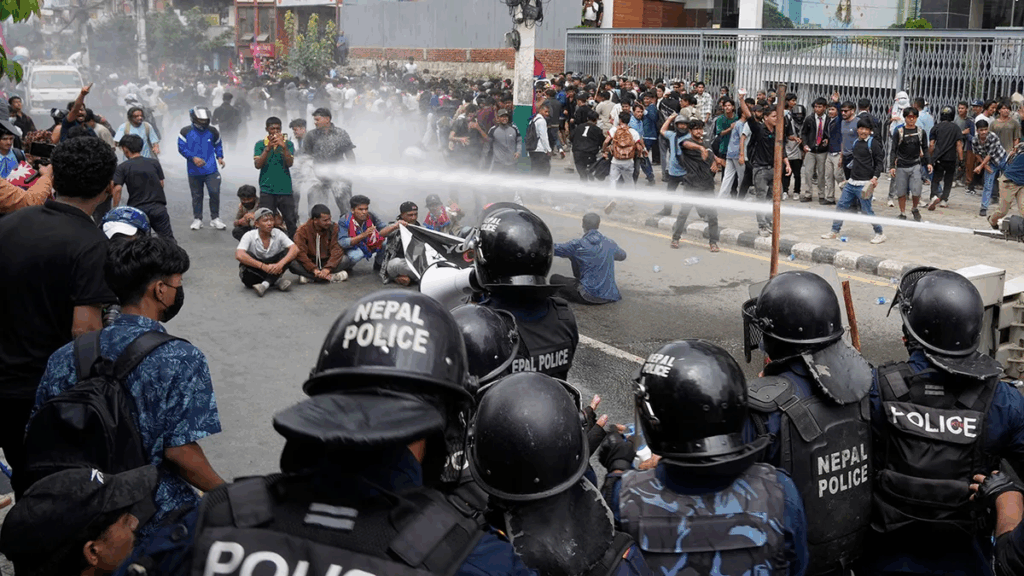
Nepal’s Gen-Z-led uprising has triggered one of the country’s most dangerous security breakdowns in recent history. Amid fiery street protests, curfews, and the collapse of public order, over 1,500 prisoners have escaped from multiple jails across the nation—from Kathmandu to Pokhara—leaving authorities scrambling to restore control.
How did the jailbreaks happen?
The jailbreaks unfolded between September 8 and September 10, coinciding with violent anti-government protests sparked by two flashpoints:
- A controversial social media ban, widely seen by young Nepalis as an attack on free expression.
- Mounting public anger over corruption and governance failures, fueling calls for systemic change.
With security forces overwhelmed by unrest, inmates in at least seven facilities seized the moment. Reports indicate that protestors in some cities actively stormed prisons, while in others, prisoners overpowered guards and forced their way out.
Which jails saw mass escapes?
According to local media and on-ground correspondents, the largest breakouts happened at these facilities:
- Jaleswar Jail, Mahottari district: Possibly the biggest escape in Nepal’s history, with between 576 and 900 inmates fleeing, leaving just one confirmed behind bars.
- Pokhara Jail, Kaski district: Around 773 prisoners fled after protestors breached the compound.
- Gaur Jail, Rautahat district: Nearly the entire prison population escaped.
- Tulsipur Jail, Dang province: At least 127 inmates broke free during clashes.
- Jumla Jail: 36 prisoners escaped after attacking guards, though 62 remain in custody.
- Central Jail, Kathmandu & Kailali Prison: Numbers remain unclear, but several inmates are unaccounted for.
Meanwhile, Birgunj Jail and Malangwa Jail were directly attacked by mobs. In Birgunj, the army stepped in to regain control, while Malangwa was reportedly set ablaze.
Why does this matter for Nepal’s stability?
The jailbreaks add a new layer of instability to a country already on edge:
- Public safety crisis: Many of the escaped inmates include convicted criminals, raising fears of rising crime.
- Government credibility: The Oli administration—already weakened by protests and parliamentary collapse—is facing mounting criticism for losing control of both the streets and the prisons.
- Military involvement: With curfews and prohibitory orders extended, the army is now in charge of restoring order—raising concerns about excessive force and potential human rights violations.
- Regional implications: Nepal borders India and China, and instability could spill over through refugee flows, security risks, and economic disruption.
How is the government responding?
- Curfews extended: Authorities have imposed a nationwide curfew, restricting movement in key cities.
- Army deployment: Military units now guard major prisons and government buildings.
- Recapture efforts: Police have launched a manhunt to track escapees, but with protests ongoing, the capacity to pursue fugitives is limited.
Officials admit the number of escapees may rise as more prisons report missing inmates.
The role of Gen-Z in Nepal’s uprising
Unlike past movements in Nepal, this wave of unrest is youth-driven and digitally coordinated. Gen-Z protesters, fueled by anger over censorship and corruption, have used VPNs and encrypted apps to bypass restrictions after the social media ban.
- Protest methods: Flash mobs, coordinated strikes, and digital campaigns.
- Demands: Restoration of internet freedoms, government accountability, and structural reforms.
The jailbreaks, while not directly organized by protesters, highlight how civil unrest can unravel state authority when institutions are already fragile.
What could happen next?
Nepal stands at a crossroads:
- Escalation scenario: If protests intensify and jailbreaks continue, the state could declare emergency rule, cementing military control.
- De-escalation scenario: If opposition parties and youth leaders engage in dialogue, reforms could calm tensions—but that window is rapidly closing.
- Security challenge: Tracking and re-incarcerating over 1,500 prisoners will strain Nepal’s already stretched police force for months, if not years.
Global comparisons
Mass jailbreaks during civil unrest are rare but not unprecedented:
- In Iraq (2006–2013), coordinated jailbreaks released hundreds of militants amid war and insurgency.
- In Sri Lanka (2022), prison riots coincided with anti-government protests during its economic collapse.
- In Haiti (2021–2024), recurring jailbreaks worsened gang violence and political instability.
Nepal’s crisis is now being viewed through the same lens: a warning sign of a state under severe internal strain.
TL;DR
Nepal’s Gen-Z-led protests against social media bans and corruption have spiraled into a nationwide security crisis. Over 1,500 prisoners escaped from at least seven jails in just two days, with some prisons nearly emptied. The government has imposed curfews, deployed the army, and launched recapture efforts, but the crisis underscores Nepal’s deep political fragility and uncertain future.