
What Did the Taliban Ban?
The Taliban government has ordered Afghan universities to ban hundreds of textbooks and scrap dozens of courses, deepening its clampdown on higher education.
According to documents obtained by Independent Persian and confirmed by BBC Afghan and NDTV, 679 textbooks have been prohibited, including 140 written by women and 310 by Iranian authors or publishers.
Among the banned works are academic staples such as Safety in the Chemical Laboratory, Globalisation: A Critical Introduction, and Comparative Human Rights. Texts in sociology, law, and journalism were also targeted.
The Ministry of Higher Education, in a letter signed by Deputy Minister Ziaur Rahman Aryubi, instructed universities to immediately remove these books and replace them with materials “compatible with Islamic law.”
Which Courses Were Removed?
The crackdown extends beyond textbooks. Eighteen university courses have been eliminated, including:
- Human Rights
- Gender and Development
- Women’s Sociology
- Afghan Constitutional Law
- Globalisation and Development
- Sexual Harassment Studies
Another 201 courses are under review for potential removal.
“These removals create a substantial void in higher education,” a Kabul University professor told the BBC.
Why Were the Books and Courses Banned?
The ministry said the curriculum was reviewed for “ideological, cultural, religious, and scientific” content. Works deemed to contradict Sharia principles and the policies of the Islamic Emirate were banned.
Officials framed the purge as part of an effort to align Afghan education with Islamic values. But the scope of the bans—covering subjects like human rights, women’s studies, and constitutional law—signals a broader strategy to erase concepts that challenge Taliban ideology.
The Wider Context: Women Targeted Again
The bans are part of a broader pattern of restrictions since the Taliban’s return to power in 2021:
- Education bans: Girls are barred from attending school beyond sixth grade.
- Professional bans: Women have been blocked from working in most public sector jobs.
- Health sector impact: Midwifery courses were shut down in late 2024.
- Curriculum purge: Courses explicitly about women—like The Role of Women in Communication—are now being erased.
Earlier this year, the Ministry of Information and Culture also confiscated hundreds of books from libraries and bookstores in Kabul and Herat.
The Taliban continues to claim it “respects women’s rights within the framework of Afghan culture and Islamic law,” but its actions tell another story.
Impact on Afghan Academia
The bans are reshaping Afghanistan’s universities:
- Professors fired: Hundreds of faculty members, especially in law, political science, economics, psychology, journalism, and fine arts, have been dismissed.
- Clerical oversight: Dozens of clerics have been installed to teach Islamic principles across campuses.
- Mandatory indoctrination: Professors must attend weekly Sharia sessions.
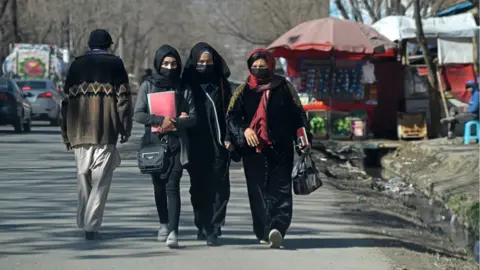
For Afghan students, especially women, the educational landscape is shrinking dramatically. With key courses eliminated and access restricted, opportunities for higher learning—and critical thinking—are vanishing.
Why This Matters
Education in Afghanistan has long been seen as a lifeline for social and economic development. By stripping away disciplines tied to rights, law, and global engagement, the Taliban is not only marginalizing women but also cutting the country off from international academic norms.
The immediate impact:
- Students are left without access to standard global curricula.
- Women’s participation in higher education is being systematically erased.
- Afghan academia risks becoming isolated and intellectually impoverished.
As one professor put it: the bans create not just “a void,” but a vacuum that could take generations to recover from.
TL;DR
- Taliban bans 679 textbooks, including 140 authored by women.
- 18 university courses scrapped, including Human Rights, Women’s Sociology, and Afghan Constitutional Law.
- 201 more courses under review.
- Move framed as aligning education with Sharia but seen as part of a broader crackdown on women and academic freedom.
- Professors fired, Sharia sessions imposed, clerics installed in universities.