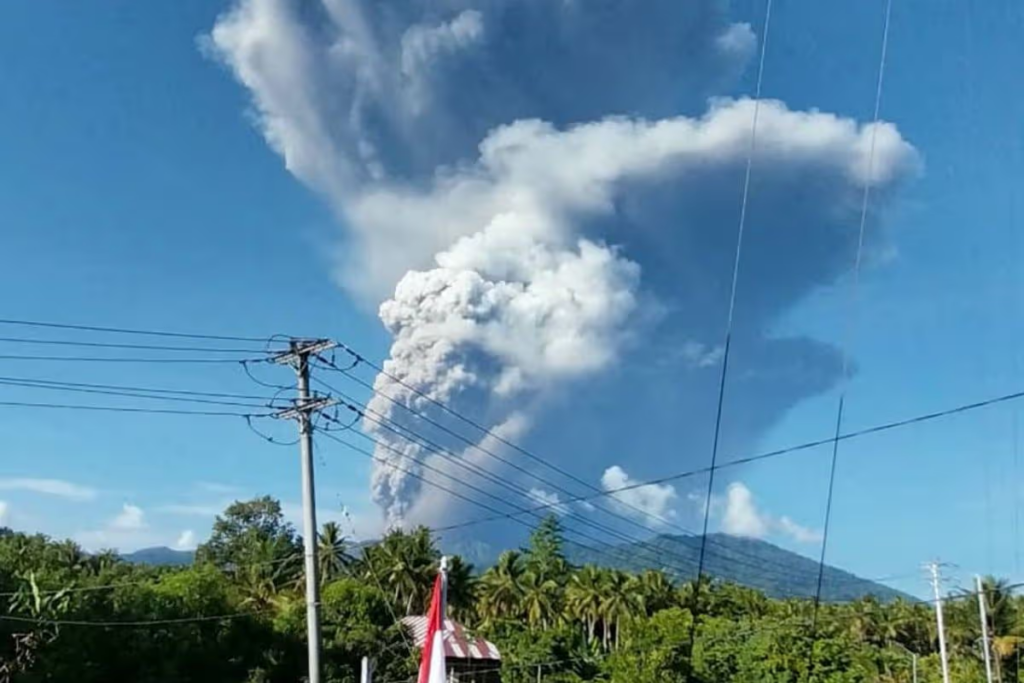
Three hikers died after a dramatic eruption at Mount Dukono sent a massive ash cloud nearly 10 kilometers into the sky on Friday morning, triggering panic, rescue operations, and renewed warnings from Indonesian authorities.
The eruption occurred at 7:41 a.m. local time on Indonesia’s remote eastern island of Halmahera, where officials say several hikers had entered a restricted danger zone near the crater despite ongoing warnings.
Where is Mount Dukono?
Mount Dukono is located on Halmahera Island in North Maluku, part of Indonesia’s vast Maluku archipelago.
Mount Dukono’s geographic location
The volcano sits:
- in eastern Indonesia
- between the islands of Sulawesi and Papua
- within the Pacific “Ring of Fire”
The Ring of Fire is one of the world’s most geologically active zones, known for:
- earthquakes
- volcanic eruptions
- tectonic plate movement
Indonesia is home to nearly 130 active volcanoes, the highest number of any country in the world.
Why the region is volcanically dangerous
Indonesia lies at the intersection of several tectonic plates, including:
- the Indo-Australian Plate
- the Eurasian Plate
- the Pacific Plate
This constant geological pressure makes eruptions frequent and often unpredictable.
What happened during the Mount Dukono eruption?
According to Indonesia’s volcanology agency, the volcano erupted with:
- a loud booming sound
- dense grey ash clouds
- volcanic material launched high into the atmosphere
Authorities said the ash plume rose nearly 10 kilometers (about 6.2 miles) above the crater.
Hikers caught inside restricted zone
Officials confirmed that:
- two hikers from Singapore died
- one Indonesian hiker also died
- about 20 hikers were near the volcano during the eruption
The area had already been declared off-limits weeks earlier due to heightened volcanic activity.
Indonesia’s geology agency had banned access within a four-kilometer radius around the crater on April 17 after detecting signs of increased danger.
Despite those warnings, several hikers reportedly entered the restricted area before Friday’s eruption.
Rescue operations underway on Halmahera Island
Emergency teams, police officers, and disaster response personnel were deployed to the volcano after reports emerged that hikers were stranded on ash-covered slopes.
Difficult rescue conditions
Local authorities said crews faced:
- steep volcanic terrain
- heavy ash deposits
- low visibility
- unstable conditions near the crater
Some stranded hikers may require stretcher evacuations because the ash made descent routes slippery and dangerous. Local rescue chief Iwan Ramdani told Reuters that nine of the hikers were from Singapore while the others were Indonesian nationals.
Survivors safely evacuated
Officials later confirmed that:
- 15 hikers had safely descended
- others were still being assisted by rescue teams
According to local authorities, nine of the hikers were Singaporean nationals while the remaining climbers were Indonesian citizens.
Why is Mount Dukono considered one of Indonesia’s most dangerous volcanoes?
Mount Dukono is among Indonesia’s most persistently active volcanoes.
Erupting continuously since 1933
The volcano has reportedly erupted almost nonstop for more than 90 years.
It regularly releases:
- volcanic ash
- sulphur dioxide gas
- smoke and debris
These eruptions frequently affect:
- nearby villages
- air quality
- local transportation
Ongoing volcanic threat
Indonesia currently maintains the volcano at the third-highest level on its four-tier alert system.
Authorities warned that:
- further eruptions remain possible
- volcanic rocks and ash could continue falling
- rainfall may trigger dangerous mudflows known as lahars
Ash cloud drifting toward populated areas
Officials said the ash cloud was moving northward toward populated zones, including Tobelo.
Potential risks for residents
Volcanic ash can:
- disrupt flights
- contaminate water supplies
- damage crops
- cause breathing problems
Authorities urged residents and tourists to:
- stay indoors if ashfall intensifies
- wear masks outdoors
- avoid the exclusion zone completely
Why tourists continue visiting dangerous volcanoes
Indonesia’s volcanoes attract hikers and adventure tourists from around the world because of:
- dramatic landscapes
- active craters
- trekking routes
- photography opportunities
But experts warn that active volcanoes can change conditions rapidly, especially in regions like North Maluku where eruptions are frequent.
This latest tragedy highlights the growing challenge authorities face in balancing tourism with public safety.
TL;DR
- Mount Dukono is an active volcano on Halmahera Island in eastern Indonesia.
- The volcano erupted Friday morning, sending ash nearly 10km into the sky.
- Three hikers died after reportedly entering a restricted zone near the crater.
- Rescue teams are still assisting stranded hikers on dangerous ash-covered slopes.
- Mount Dukono has been erupting almost continuously since 1933.
The bottom line
The deadly eruption at Mount Dukono is another reminder of Indonesia’s volatile geology and the risks tied to adventure tourism near active volcanoes.
While Mount Dukono remains a powerful attraction for trekkers and researchers alike, authorities are warning that the volcano is still highly active — and the danger is far from over.