
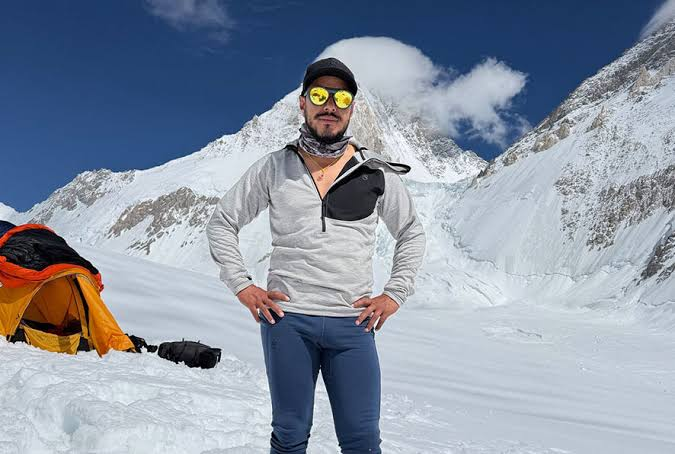
Renowned mountaineer Nirmal Purja, better known as Nims Dai, is among the climbers who died after an avalanche struck Broad Peak in Pakistan’s Karakoram mountain range. The incident has drawn global attention not only for the scale of the rescue operation but also because Purja was widely regarded as one of the greatest high-altitude climbers of his generation.
Rescuers on Sunday recovered the body of celebrated British-Nepali mountaineer Nirmal “Nims” Purja after an avalanche killed him and nine members of his expedition on Pakistan’s Broad Peak, one of the world’s highest mountains, according to the Alpine Club of Pakistan.
The avalanche struck on Thursday, severing communication with the international climbing team led by the 43-year-old mountaineer during their ascent of the 8,051-meter peak in northern Pakistan.
“The ground rescue team has reached Nims Dai (Purja) at approximately 5,700 m on Broad Peak — a mountain he loved and a mountain that has now taken him from us,” the Alpine Club of Pakistan said in a social media post.
Ayaz Shigri, the club’s general secretary, said rescuers were transporting four bodies down the mountain, including those of Purja, two Nepali climbers and a Chinese national.
He added that rescue teams had also located another body at a much higher altitude but warned that the dangerous terrain and adverse conditions made any recovery operation unlikely for now.
Purja’s expedition company confirmed on Saturday that none of the 10 members of the team had survived the avalanche.
The 43-year-old Nepal-born climber earned international fame after summiting the world’s 14 highest mountains in a record 189 days in 2019, an achievement that transformed modern mountaineering and was later documented in the Netflix film 14 Peaks: Nothing Is Impossible.
Here’s a closer look at the climber whose accomplishments changed the sport.
Who Was Nirmal Purja?
Nirmal Purja was a Nepal-born elite mountaineer, expedition leader, former British Special Forces soldier, and motivational speaker.
Born on July 25, 1983, in Nepal’s Myagdi District and raised in Chitwan, Purja did not come from a traditional mountaineering background. Instead, his career began in the military.
Starting in 2003, he spent 16 years serving in the British Armed Forces, including the following:
- Six years with the Brigade of Gurkhas
- Ten years with the elite Special Boat Service (SBS)
According to the Gurkha Museum in the UK, Purja became the first Gurkha ever selected for the SBS, one of Britain’s most demanding special operations units.
How Did Nirmal Purja Become a World-Class Mountaineer?
A Trek That Changed Everything
Purja discovered mountaineering relatively late.
While on military leave in 2012, he trekked to Everest Base Camp, an experience that completely changed the direction of his life.
Within just a few years, he transitioned from a military career to professional high-altitude climbing, an unusually rapid rise in a sport where experience is often measured over decades.
Breaking Every Expectation
His defining moment came in 2019 with Project Possible.
The challenge was simple in concept but unprecedented in execution:
Summit all 14 mountains higher than 8,000 metres, also known as the “death zone” peaks, in a single climbing season.
Purja completed the challenge in 189 days, smashing the previous record of nearly eight years.
The achievement immediately established him as one of the most accomplished climbers in history.
Although the record was surpassed in 2023, Purja’s climb remains one of the sport’s most influential achievements because of the logistics, endurance, and technical difficulty involved.
Why Was Nirmal Purja Famous Beyond Mountaineering?
Netflix’s 14 Peaks
Purja’s story reached a global audience through the Netflix documentary 14 Peaks: Nothing Is Impossible.
The film chronicles the immense physical and logistical challenges involved in climbing all 14 eight-thousanders in just over six months.
It also highlighted his leadership style, willingness to assist fellow climbers, and determination to challenge long-held assumptions about what was physically possible.
Historic Winter Ascent of K2
In January 2021, Purja joined a team of ten Nepali climbers that completed the first successful winter ascent of K2, the world’s second-highest mountain.
Before that expedition, K2 had never been climbed during winter despite decades of attempts.
The climb is considered one of the greatest achievements in modern Himalayan mountaineering.
What Happened on Broad Peak?
Purja was leading an international expedition on Broad Peak (8,051 metres) in Pakistan’s Karakoram range when an avalanche struck on Thursday.
According to Pakistan’s Alpine Club, the expedition included climbers from several countries, including Nepal, Pakistan, Oman, China, and the United States.
Rescue efforts were complicated by:
- Severe weather
- Avalanche danger
- High altitude
- Limited flying conditions for helicopters
Everest Chronicle later reported that Purja’s GPS tracker showed slight movement. However, the publication cautioned that the signal may have been a technical glitch rather than evidence of movement by the climber.
Tracking data reportedly showed a rapid descent of approximately 800 metres shortly after the avalanche, consistent with reports from the mountain.
More Than a Mountaineer
Purja’s influence extended well beyond climbing records.
Entrepreneur
In 2020, he launched Nimsdai, a company focused on high-altitude expeditions and mountaineering education.
The goal was to share professional climbing expertise while improving safety standards for Himalayan expeditions.
Philanthropy
Through the Nimsdai Foundation, Purja supported numerous humanitarian initiatives.
Among them:
- Financial assistance to Sherpa communities during the COVID-19 pandemic.
- Food aid for families whose livelihoods depended on tourism.
- Community development projects in Nepal.
Author
Purja documented his extraordinary journey in the memoir:
Beyond Possible: One Soldier, Fourteen Peaks – My Life in the Death Zone
The book explores both his military career and the mindset behind his record-breaking climbs.
Why Did Nirmal Purja Matter to Mountaineering?
Purja represented a new generation of elite Himalayan climbers.
His achievements have challenged long-standing assumptions about what is possible in high-altitude mountaineering while bringing greater international recognition to Nepali climbers, many of whom have historically received less attention than their Western counterparts despite playing central roles in Himalayan expeditions.
Former Nepal Mountaineering Association president Ang Tshering Sherpa has described Purja as “one of the best climbers” in the world, citing both his technical ability and repeated ascents of the world’s highest peaks.
Beyond records, Purja is widely respected for participating in numerous high-altitude rescue missions, often putting the safety of fellow climbers ahead of summit ambitions.
Why This Story Has Captured Global Attention
The death of Nirmal Purja has resonated far beyond the climbing community.
For many, he embodied perseverance, discipline, and the belief that perceived limits can be challenged through preparation and determination.
His career has inspired countless climbers worldwide and helped reshape perceptions of Nepali mountaineers on the international stage.
TL;DR
- Nirmal Purja, known globally as Nims Dai, is missing after an avalanche on Pakistan’s Broad Peak.
- He gained worldwide recognition by climbing all 14 mountains above 8,000 meters in just 189 days.
- Purja is a former British Army Gurkha and Special Boat Service (SBS) operator.
- He was part of the historic team that completed the first winter ascent of K2 in 2021.
- Beyond climbing, he is an author, entrepreneur, philanthropist, and advocate for Nepal’s mountain communities.