
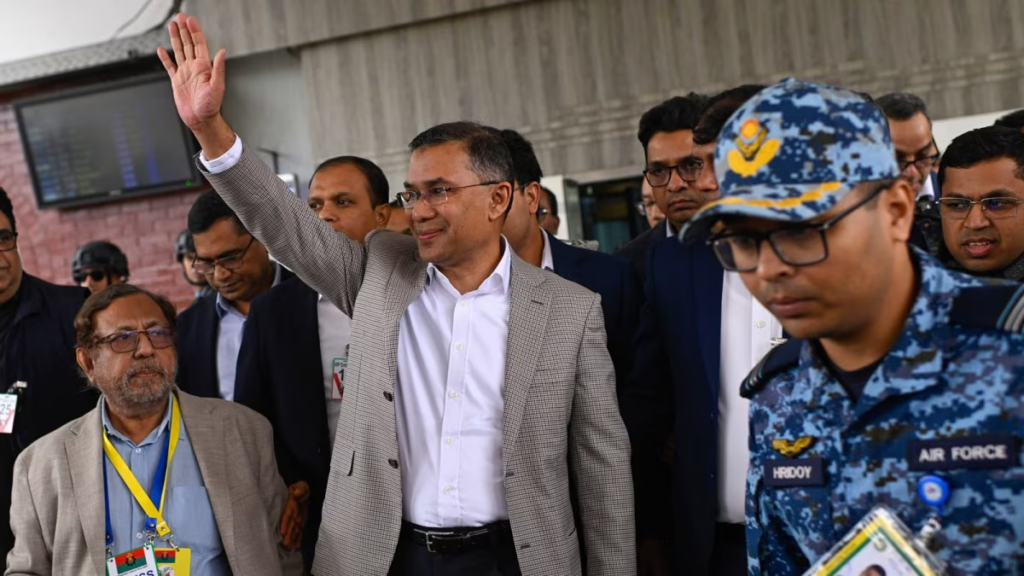
Bangladesh’s latest parliamentary election marks a turning point in the country’s post-Hasina political era. With the Awami League no longer in the race, the spotlight has shifted to the Bangladesh Nationalist Party (BNP) and its chairman, Tarique Rahman.
After 17 years in exile, Rahman returned to Dhaka in December and now stands as the leading contender to become Bangladesh’s next prime minister—if the BNP converts polling momentum into parliamentary seats.
Who Is Tarique Rahman?
Tarique Rahman is the eldest son of former President Ziaur Rahman and three-time Prime Minister Khaleda Zia. During his mother’s tenure, he was widely viewed as one of the most powerful figures within the BNP and was often described by critics as operating from a “shadow” power center.
His return to Bangladesh after nearly two decades abroad is symbolically significant. It signals not just a personal comeback, but the reassertion of dynastic politics in a country long shaped by rival political families.
What Do Pre-Poll Surveys Say About the 2026 Election?
Multiple pre-election surveys indicate that the BNP is the frontrunner in the 13th parliamentary elections.
EASD Survey
A survey conducted by Eminence Associates for Social Development (EASD), as reported by Dhaka Tribune, suggests:
- BNP-led alliance: approximately 208 seats (out of 300)
- Jamaat-e-Islami: approximately 46 seats
The survey claims strong support for the BNP among women voters and suggests that a large share of former Awami League supporters may shift toward the BNP.
NRC Poll
The Nationalist Research Cell (NRC) projects:
- BNP vote share: 77 percent
- Projected seats: 220
- Jamaat-e-Islami: 57 seats
Such a high projected vote share warrants careful verification and contextualization, as polling in transitional political environments can carry significant margins of error.
IILD Survey
A survey by the International Institute of Law and Diplomacy (IILD), as reported by Prothom Alo, presents a tighter race:
- BNP-led alliance: 44.1 percent vote share
- Jamaat-led alliance: 43.9 percent vote share
The Bangladesh Jamaat-e-Islami, once allied with the BNP, is now a principal competitor in this contest.
Why Is the BNP Considered the Front-Runner?
The BNP’s projected advantage stems from several factors:
- The absence of the disbanded Awami League
- Anti-incumbency sentiment after 15 years of rule under Sheikh Hasina
- Rahman’s high-profile return
- Consolidation of opposition voters
In transitional elections, voter behavior often reflects a desire for change rather than strict party loyalty. If the Awami League’s voter base fragments, the BNP stands to benefit most.
However, polling momentum does not guarantee parliamentary outcomes. Bangladesh’s constituency-level dynamics can produce unexpected results.
What Has Tarique Rahman Promised?
Rahman has framed his campaign around a “Bangladesh-first” agenda. His key commitments include:
- Ending entrenched corruption
- Restoring law and order
- Prioritizing national interests
- Strengthening citizen security
After casting his vote at Gulshan Model School and College in Dhaka, Rahman emphasized that improving law and order would be an immediate priority if elected.
What Challenges Could Stand in His Way?
Even with favorable surveys, Rahman faces significant hurdles.
Electoral Competition
Jamaat-e-Islami remains organized and competitive in key constituencies. If anti-BNP voters consolidate behind Jamaat candidates, the race could tighten quickly.
Public Perception
Rahman’s critics associate him with past allegations of corruption during his mother’s tenure. While supporters see him as a natural successor, detractors view him as emblematic of dynastic politics.
Institutional Stability
Bangladesh’s political environment remains volatile following the mass uprising that ended Sheikh Hasina’s long rule. Transitional elections can produce unexpected shifts due to turnout fluctuations, local alliances, or administrative disputes.
How Reliable Are These Pre-Poll Surveys?
Pre-election polling in emerging or transitional democracies carries inherent uncertainty.
Key considerations include:
- Sample size and geographic spread
- Urban versus rural representation
- Transparency in methodology
- Funding sources behind surveys
Without methodological transparency, projections should be treated as indicators rather than outcomes.
What Happens If the BNP Wins?
If the BNP secures a parliamentary majority, Tarique Rahman would likely be nominated as prime minister by his party.
Such a victory would:
- Reestablish BNP dominance after years in opposition
- Signal a major shift in Bangladesh’s domestic and foreign policy direction
- Reshape alliances within South Asia
If the seat count falls short of a clear majority, coalition negotiations could become decisive.
TL;DR
Pre-poll surveys suggest the BNP leads in Bangladesh’s 2026 parliamentary election. Tarique Rahman, recently returned from exile, is the party’s prime ministerial face. Some polls show a dominant BNP lead; others indicate a tight race with Jamaat-e-Islami. Final results will depend on constituency-level outcomes and coalition math.
The Bottom Line
Tarique Rahman appears well-positioned to become Bangladesh’s next prime minister—at least according to current surveys.
But elections are decided by ballots, not projections.
With the Awami League out of the contest and the political landscape reshaped after years of upheaval, this election represents more than a change in leadership. It is a referendum on Bangladesh’s post-Hasina future.