
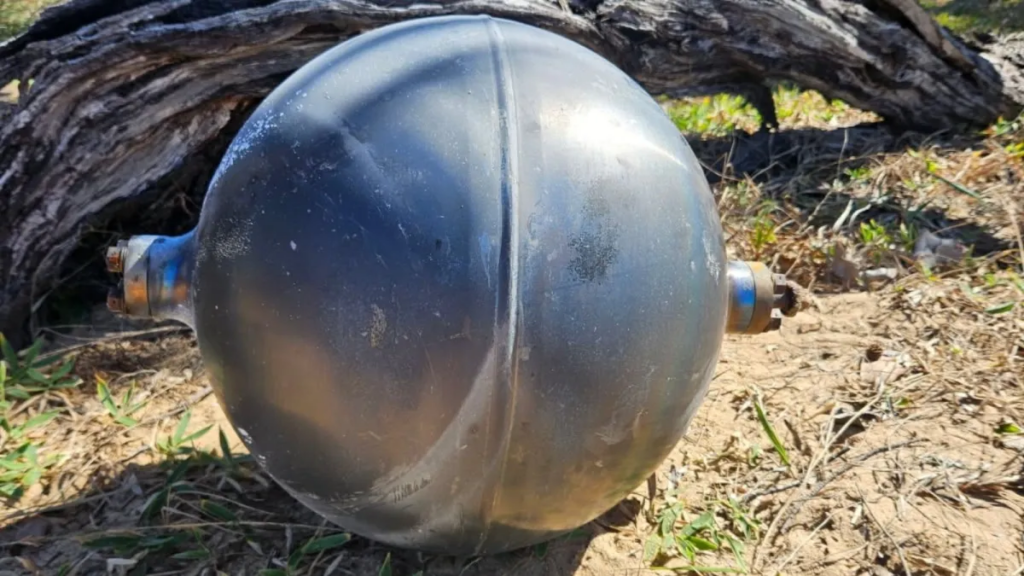
Australian authorities are investigating the discovery of six mysterious silver balls that washed ashore on beaches in Queensland, with early assessments suggesting they could be debris from a rocket launch. Officials have urged the public not to touch the objects, warning they may contain hazardous chemicals while experts work to determine their origin.
The unusual find has drawn attention because similar space debris has reached Australian shores before. In 2023, a large metal object later identified as part of an Indian rocket washed up on a beach in Western Australia, highlighting the growing challenge of tracking objects returning from space.
What was discovered on the Australian beach?
Emergency crews in Queensland responded after several large silver balls were reported on beaches in the state’s north.
According to the Queensland Fire Department, six silver balls have been recovered.
Officials said:
- Five objects have been safely secured inside protective drums.
- A sixth object is still being assessed and rendered safe.
- Scientific specialists continue examining the materials.
Authorities have not confirmed whether all six objects originated from the same source.
Why do experts think they could be space debris?
Early observations suggest the spheres resemble hardware sometimes associated with launch vehicles.
Associate Professor Alice Gorman, a space archaeologist at Flinders University, told The Guardian that the objects do not appear to show significant scorching or burn marks that would normally result from surviving intense atmospheric re-entry.
That could indicate they originated from a lower rocket stage rather than from spacecraft designed to re-enter Earth’s atmosphere.
According to Gorman, the objects may have separated during flight before eventually falling into the ocean and washing ashore.
Could the silver balls contain dangerous chemicals?
Authorities are treating the objects with caution because they may contain hazardous substances.
Police warned the public not to approach or handle any similar objects.
Officials said the spheres could potentially contain hydrazine, a highly toxic rocket propellant used in many spacecraft and satellites.
Hydrazine is hazardous because it:
- Is highly toxic if inhaled or absorbed through the skin.
- Can irritate the eyes and respiratory system.
- Is considered a potential carcinogen.
- Requires specialized handling and disposal.
Authorities emphasized that no confirmed chemical analysis has yet been released, but the precautionary measures remain in place until testing is complete.
What have Australian authorities said?
The Queensland Fire Department said specialist scientific teams have spent the weekend securing the objects and assessing potential risks.
Officials have established a 50-meter exclusion zone around the remaining object while examinations continue.
Police stressed there is currently no immediate danger to nearby residents.
However, they advised anyone who encounters similar debris to:
- Stay away from the object.
- Avoid touching or moving it.
- Contact emergency services immediately by calling Triple Zero (000).
Is this the first time space debris has washed up in Australia?
No.
Australia has experienced several high-profile discoveries of space debris in recent years.
One of the most notable occurrences occurred in 2023 when a large cylindrical object washed ashore on a beach in Western Australia.
Investigators later identified it as debris from the Indian Space Research Organisation’s Polar Satellite Launch Vehicle (PSLV).
As global launch activity continues to increase, experts say discoveries like these may become more common.
Why does rocket debris end up in the ocean?
Most rockets discard empty stages during launch to reduce weight.
Mission planners typically direct these components toward remote ocean areas where they can fall safely without endangering populated regions.
Ocean currents, storms, and tides can later carry floating debris toward shore.
Some rocket components are designed to sink, while others contain sealed tanks that remain buoyant for extended periods.
How is the Australian Space Agency investigating?
The Australian Space Agency is working with emergency services and technical experts to identify:
- The objects’ country of origin.
- Which launch vehicle they may belong to.
- Whether they contain hazardous materials.
- Whether international space agencies should be notified.
Investigators may compare the objects’ construction, serial markings, alloys, and dimensions with known rocket components from recent launches.
If identified as space debris, international agreements generally require the launching nation to retain ownership of the recovered objects.
What happens after the investigation?
Once testing is complete, authorities will determine whether the spheres:
- Pose any environmental risk.
- Require specialized hazardous waste disposal.
- Should be returned to the country that launched them.
- Have scientific or engineering value for further analysis.
The investigation could also help improve future tracking of space debris as the number of global rocket launches continues to rise.
Why this discovery matters
The mysterious silver balls are another reminder that humanity’s growing presence in space has consequences back on Earth.
Thousands of satellites and rockets are launched every year, increasing the amount of hardware orbiting the planet and occasionally returning to the surface.
While controlled re-entries are carefully planned, unexpected debris discoveries highlight the importance of international coordination, public safety, and effective monitoring systems.
The bottom line
Australian authorities are continuing to investigate six mysterious silver balls found on Queensland beaches, with early indications suggesting they could be parts of a rocket stage.
Although experts suspect the objects may be space debris, officials have not confirmed their origin. Until laboratory testing is completed, authorities are urging the public to avoid the objects because they may contain hazardous chemicals.
The discovery joins a growing list of unusual space debris finds as global space activity continues to expand.
TL;DR
- Six metallic silver balls were found on beaches in Queensland, Australia.
- Authorities suspect the objects could be components from a rocket stage.
- Officials warned they may contain hazardous chemicals, including possible rocket propellant residue.
- The Australian Space Agency is investigating their origin.
- A 50-meter exclusion zone remains in place while specialists examine the objects.