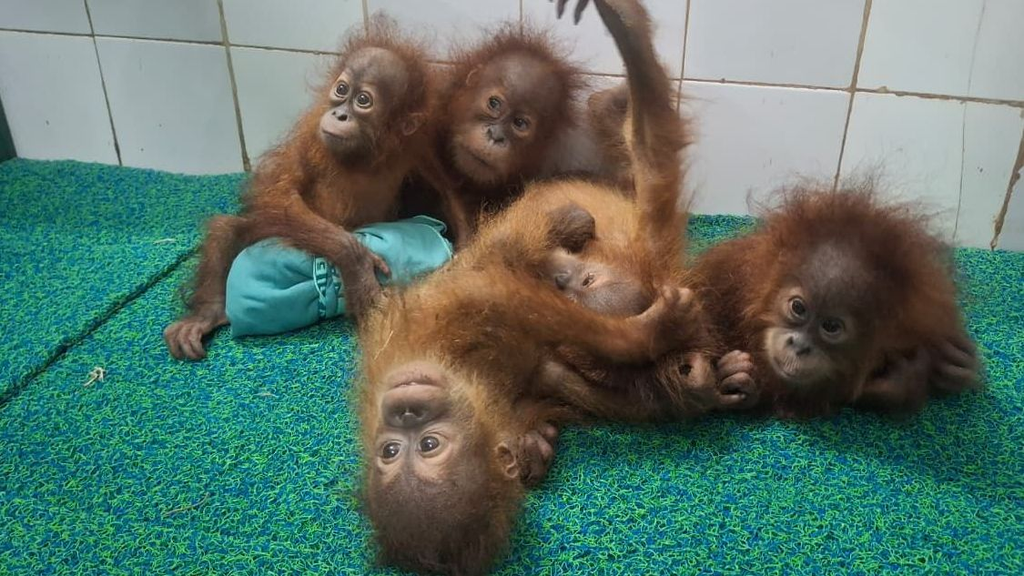
Five baby orangutans discovered abandoned in a forest in Odisha, eastern India, have exposed the devastating human cost of the illegal wildlife trade. The critically endangered great apes, native to the rainforests of Southeast Asia, were found without their mothers and thousands of miles from their natural habitat.
The discovery stunned local residents and forest officials. All five orangutans were reportedly younger than 18 months when villagers found them, prompting an urgent rescue operation and their transfer to Nandankanan Zoo, where they remain under veterinary supervision.
But the unusual sight of five orangutans in an Indian forest raises a much larger question: How did these young animals travel from the rainforests of Indonesia to eastern India?
An investigation by CNN, drawing on interviews with wildlife experts, conservationists, researchers and a former trafficker, examined the likely route behind the animals’ arrival. The evidence points toward the international illegal wildlife trade, an underground industry that profits from capturing, transporting and selling endangered animals.
Although authorities have not publicly established every detail of the five orangutans’ journey, experts say their discovery highlights the cruelty and sophistication of trafficking networks that exploit vulnerable wildlife for profit.
How Were Five Baby Orangutans Found in Odisha?
The orangutans were discovered in a forested area of Odisha’s Balasore district after local villagers noticed the unusual animals among the undergrowth.
With reddish-orange fur, wide eyes and long limbs, the young apes looked unlike any native wildlife in the region. Their appearance drew a crowd of approximately 1,000 bewildered villagers, who alerted nearby forest officials.
Pratik Prakash Indalkar, a forest officer from Balasore, described the discovery as very surprising. Officials were initially uncertain how to handle the animals, which belonged to a species not naturally found in India.
The five infants were subsequently given food and water before being moved to a nearby government facility. They then made a carefully managed journey of nearly 400 kilometers (250 miles) to Nandankanan Zoo.
Rescuers took precautions during transportation to minimize the stress caused by bumps and sudden movements. The animals were eventually placed in quarantine, where veterinarians could assess their health and monitor their recovery.
The discovery quickly attracted national attention. Yet the orangutans’ presence in Odisha was not simply an unusual wildlife story. It raised serious concerns about the movement of endangered animals across international borders and the networks capable of transporting them far beyond their native habitats.
Where Do Orangutans Naturally Live?
Orangutans are great apes native to the tropical rainforests of Southeast Asia. Wild populations survive on the Indonesian islands of Sumatra and Borneo, with Borneo also shared by Malaysia and Brunei.
The animals found in Odisha were believed by Indonesian authorities to have originated in Sumatra, based on the evidence available to them, according to the reporting.
Orangutans are highly adapted to life in the forest canopy. Their long arms, strong hands and feet allow them to move among branches as they search for fruit and other food. They spend much of their lives in trees, making their appearance on the forest floor particularly unusual.
Why are orangutans so vulnerable?
One of the most important factors is their exceptionally long maternal dependency.
Young orangutans remain closely attached to their mothers for years, learning how to find food, move through the forest and recognize potential dangers. Their mothers provide not only protection but also the knowledge needed to survive independently.
This prolonged period of care makes infant orangutans especially vulnerable to trafficking. Unlike animals that can become independent relatively quickly, young orangutans cannot simply be separated from their mothers without serious consequences.
All three orangutan species are classified as critically endangered by the International Union for Conservation of Nature (IUCN). Habitat destruction, human-wildlife conflict, hunting and illegal wildlife trafficking continue to threaten their survival.
Why Does Capturing a Baby Orangutan Often Mean Killing Its Mother?
Wildlife experts interviewed by CNN said the circumstances surrounding the five infants strongly suggested that they had been taken from the wild.
Capturing an infant orangutan is particularly difficult because mothers maintain close physical contact with their young and defend them against threats. Experts say poachers often kill the mother before taking the infant.
Lionel Hachemin, global director of the Wildlife Crime Program at the International Fund for Animal Welfare, told CNN that obtaining five orangutan infants of similar ages through legitimate breeding facilities would be extraordinarily difficult. Such an effort would require a large breeding population and years of coordinated planning.
Binur D. Naibaho, director of sustainable landscape at the Orangutan Information Centre in North Sumatra, described the connection between infant trafficking and the killing of adult females in stark terms.
His assessment was that the discovery of a baby orangutan often indicates that its mother has died.
Femke den Haas, co-founder and director of Jakarta Animal Aid Network in Indonesia, similarly emphasized that an orangutan mother is unlikely to abandon her infant voluntarily.
The implications extend beyond the loss of an individual animal. When a mother is killed, her infant loses its primary source of protection, nourishment and survival skills. The loss also removes a breeding adult from an already threatened wild population.
How much do poachers earn?
According to Naibaho, some villagers in Sumatra may receive as much as 15 million Indonesian rupiah, equivalent to approximately $846 at the conversion cited in the reporting, for capturing a baby orangutan.
The amount illustrates the financial incentives that can encourage people to participate in wildlife trafficking. Local hunters may supply animals to intermediaries, who then move them into broader networks that connect suppliers with potential buyers.
However, the amount paid to a hunter is only one part of the transaction. Animals can pass through several brokers, and their value may increase substantially as they move closer to the international market.
The resulting financial incentives can be powerful enough to sustain a trade that causes lasting damage to wild populations.
How Are Orangutans Smuggled Across Borders?
The precise route taken by the five Odisha orangutans has not been established publicly. However, experts told CNN that the journey from Indonesia to India could have taken between one and three weeks.
Trafficking networks dealing in live animals face a particular challenge: keeping their merchandise alive while avoiding detection. According to Hachemin, syndicates often attempt to minimize transit times for great apes because mortality during transportation can reduce their profits.
The animals may pass through multiple intermediaries and locations before reaching their final destination. Investigators would need additional evidence to determine which routes, brokers or transport methods were involved in this case.
The conditions can be devastating
Testimony and footage shared with CNN by conservationists illustrate the conditions some trafficked orangutans experience.
Animals may be confined in dark, cramped containers, moved repeatedly between locations and given inadequate food or water. The stress of separation from their mothers and unfamiliar surroundings can compound the physical harm.
Wildlife photographer Paul Hilton described witnessing an orangutan being repeatedly struck when it moved inside captivity. He said the animal received very little food before it was eventually rescued and taken to a rehabilitation center.
In another case, footage provided by JAAN Indonesia showed a young orangutan crouching inside a small, dark crate.
Den Haas said that animal was among two young orangutans discovered hidden beneath bananas and luggage on a passenger bus in southern Sumatra. A wildlife detection dog helped uncover the animals.
Such cases demonstrate how traffickers may conceal live wildlife within ordinary passenger or cargo movements. They also show why detecting wildlife crime requires cooperation between local communities, enforcement agencies and specialist conservation organizations.
The five orangutans found in Odisha may have experienced similar conditions, but their exact treatment and route remain unconfirmed.
What Happens to Baby Orangutans After They Are Rescued?
For the five rescued infants, the immediate priority is recovery.
At Nandankanan Zoo, veterinarians are monitoring their health, checking their temperatures and providing regular updates on their condition. The animals have also been given orangutan plush toys as sources of comfort.
According to the zoo’s deputy director, Pradeep Mirase, the infants have begun recognizing their caregivers. The slightly older animals have started climbing and swinging, while the younger ones continue to cling to one another.
These behaviors offer some encouragement, but the animals remain in quarantine and require careful observation.
Can rescued orangutans return to the wild?
Rehabilitation is often a long and complicated process for orangutans rescued from trafficking.
Because young orangutans normally learn essential survival skills from their mothers, orphaned infants may need years of specialized care. Rehabilitation programs must help them develop appropriate feeding, climbing, social and behavioral skills while minimizing their dependence on humans.
The ultimate goal, where circumstances permit, is to prepare suitable animals for release into protected natural habitats. However, release is not guaranteed. It depends on the animals’ health, behavior, ability to survive independently and the availability of a safe habitat.
For infants that have suffered trauma or spent substantial time in captivity, the process may be particularly challenging.
The Odisha five will therefore need more than immediate medical attention. Their longer-term welfare will depend on sustained care, appropriate social development and decisions guided by wildlife specialists.
What Does the Discovery Reveal About the Global Wildlife Trade?
The illegal wildlife trade operates across borders and involves a range of species, from reptiles and birds to primates and other mammals. Animals may be captured for private collectors, the exotic-pet market or other commercial purposes.
Its scale is difficult to measure because transactions are concealed and enforcement data capture only part of the activity. CNN’s reporting described the wider illicit trade as an industry worth approximately $20 billion, although estimates vary according to which markets and activities are included.
The discovery in Odisha demonstrates how wildlife trafficking can connect distant ecosystems. An animal taken from an Indonesian rainforest can end up in a forest in India, far beyond the range where it naturally belongs.
It also highlights several challenges for enforcement:
- Cross-border coordination: Investigators may need cooperation between the countries where animals are captured, transported and discovered.
- Online and intermediary networks: Sellers and brokers can connect suppliers with buyers through concealed transactions.
- Animal welfare: Trafficking can cause injury, dehydration, stress and death long before animals reach a destination.
- Conservation losses: The death of adult females can damage already threatened populations and reduce their ability to reproduce.
- Long-term rehabilitation: Rescued animals may require years of specialist care, creating substantial demands on conservation resources.
Preventing such crimes requires more than rescuing individual animals. Authorities must also investigate the people and networks responsible for capturing, transporting and selling them.
How Can Wildlife Trafficking Be Prevented?
Experts and conservation organizations emphasize a combination of enforcement, public awareness and habitat protection.
Stronger cooperation between wildlife authorities can help identify trafficking routes and investigate cross-border networks. Specialist detection teams, intelligence gathering and inspections can also help identify animals being concealed during transport.
Public awareness matters because demand for exotic pets and privately owned endangered animals can sustain the trade. People who encounter suspicious wildlife sales can report them to the relevant authorities rather than attempting to intervene directly.
Protecting orangutans in their natural habitats is equally important. Forest conservation and support for local communities can help reduce the pressures that make wildlife vulnerable to exploitation.
International frameworks, including the Convention on International Trade in Endangered Species of Wild Fauna and Flora (CITES), regulate international trade in protected species. Effective enforcement, however, remains essential to prevent illegal transactions.
The five orangutans rescued in Odisha are now receiving care, but their story reflects a much larger problem. Their journey from a Southeast Asian rainforest to eastern India may never be fully reconstructed. What is clear is that the illegal trade in endangered animals can separate infants from their mothers, move them across vast distances and leave them facing years of recovery.
Their rescue offers a chance for survival. Preventing the next such case will require authorities to pursue trafficking networks, communities to remain alert and conservation efforts to protect the animals where they belong: in the wild.