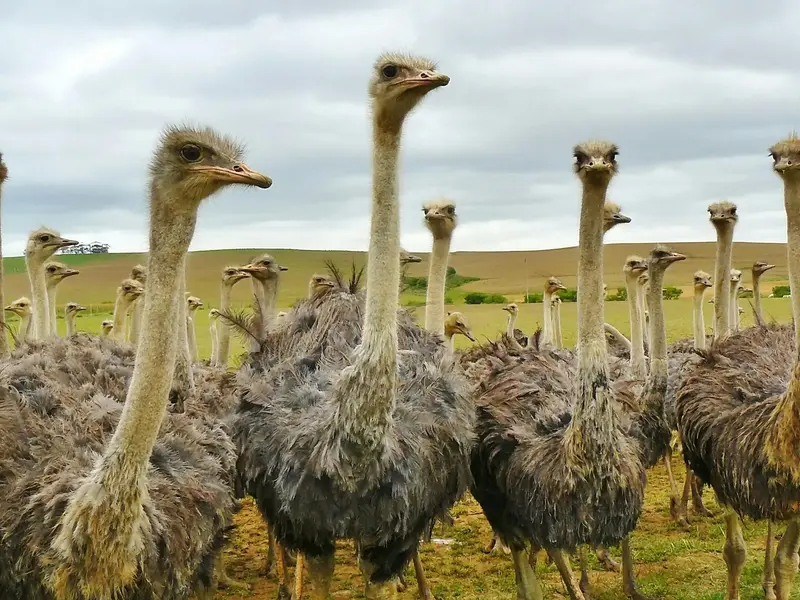
In a shocking incident that has sparked outrage and disbelief, Canadian authorities killed 314 ostriches on a British Columbia farm over fears of a bird flu outbreak. However, the farm’s owner has made a startling counterclaim, alleging that the mass culling was a deliberate act to suppress research that could have led to new treatments for COVID-19 and H1N1 influenza.
What happened at the British Columbia ostrich farm?
The Canadian Food Inspection Agency (CFIA) ordered the extermination after testing confirmed that at least two ostriches on the property carried the highly pathogenic H5N1 avian influenza virus.
The farm, identified as Universal Ostrich Farms, was owned by Katie Pasitney and her mother, Karen Espersen. On November 6, a firing squad reportedly entered the farm and shot hundreds of ostriches in a single day. Photographs and videos circulating online show dozens of large birds lying lifeless, covered with tarps, while others appear decapitated.
Pasitney described the event as a “war zone,” claiming some of the birds were over 35 years old and had been raised as part of the family. “They could have quarantined and monitored them, but they chose execution,” she told The Daily Mail.
According to CFIA, the operation was carried out under standard national protocols for containing avian influenza outbreaks. “Given multiple laboratory-confirmed cases of H5N1 and ongoing serious risks to animal and human health, as well as trade,” CFIA said in a statement, “the response activities at the infected premises were necessary.”
The owner’s explosive claim: “They didn’t want our therapeutic antibodies out”
While authorities insist the cull was a biosecurity measure, Katie Pasitney claims something more sinister was at play.
According to her, Universal Ostrich Farms had been conducting medical research using ostrich egg yolks to develop antibody-based nasal sprays and masks capable of neutralizing viruses like COVID-19 and H1N1.
“Ostriches naturally produce antibodies against major viruses,” Pasitney said. “They are effective and can neutralize 99.9% of coronavirus particles.”
She alleges that the farm had approached the government for research funding, but shortly afterward, an outbreak of bird flu was “suspiciously detected.”
“We went to the government looking for funding, and not long after that, we suddenly had an influenza outbreak,” Pasitney claimed. “They didn’t want our therapeutic bodies out.”
Canadian authorities have not publicly responded to Pasitney’s accusations.
Ostrich immunity and previous medical research efforts
The idea of using ostrich antibodies in medical treatments is not new. Ostriches possess one of the most robust immune systems in the animal kingdom.
In 2021, Espersen told North Shore News that her team had successfully inoculated hens with the deactivated COVID-19 virus, leading to the production of antibodies within weeks.
“The hen produces antibodies in two weeks, and two weeks after that, she puts them into her eggs,” Espersen said at the time.
These antibodies, extracted from egg yolks, were reportedly being tested in nasal sprays aimed at neutralizing respiratory viruses.
While the concept has a scientific basis, studies in Japan and South Korea have explored ostrich-derived antibodies for similar applications — no peer-reviewed research from Universal Ostrich Farms has been publicly released or validated.
Legal battle before the culling
When the CFIA ordered the extermination, the farm appealed to Canada’s Federal Court of Appeal to halt the killing and conduct more tests. The court refused in June 2025, upholding the CFIA’s right to proceed under national biosecurity laws.
Pasitney maintains that the CFIA’s decision was “disproportionate” and “unscientific,” arguing that only a small fraction of the flock tested positive. “They could have isolated and treated the sick birds,” she said.
The farm’s efforts to delay the cull proved unsuccessful. On November 6, all 314 ostriches were shot. Some who survived the night were reportedly beheaded the following day.
What authorities say about the incident
In its public statement, the Canadian Food Inspection Agency emphasized that the culling followed internationally accepted procedures for managing avian influenza outbreaks.
The agency cited:
- Prevention of further spread of the H5N1 strain, which poses risks to both birds and humans.
- Trade protection, as infected flocks can trigger import bans on Canadian poultry products.
CFIA also reaffirmed that compensation programs are available for affected farmers, though it is unclear if Pasitney and Espersen will receive any.
Why ostrich antibodies intrigue scientists
Ostriches, the world’s largest birds, have remarkably strong immune systems and produce high volumes of antibodies that can be extracted from their eggs.
Researchers in Japan’s Kyoto Prefecture have developed ostrich antibody masks that detect and neutralize viral particles, an innovation that gained attention during the COVID-19 pandemic.
Such projects highlight genuine scientific potential. However, claims like those made by Universal Ostrich Farms, suggesting government interference or deliberate infection — remain unverified and speculative.
A tragic end amid unanswered questions
The massacre of 314 ostriches raises both ethical and scientific questions. While authorities argue it was a necessary containment step, the farm’s owners view it as the destruction of years of pioneering work.
Pasitney has vowed to continue advocating for the ostrich antibody project, insisting that “our research can save lives.”
Meanwhile, the CFIA maintains that its focus is on public safety and disease control, not silencing innovation.
As investigations continue, this incident underscores the tension between scientific ambition and biosecurity regulation and how easily the two can clash in times of crisis.
TL;DR
- 314 ostriches were shot dead on a Canadian farm after H5N1 bird flu was detected.
- Farm owner Katie Pasitney claims the cull was retaliation for her team’s COVID-19 antibody research using ostrich eggs.
- Authorities deny wrongdoing, citing avian influenza control protocols.
- The farm had previously sought government funding for nasal spray and mask research.
- The claims of deliberate infection remain unsubstantiated.