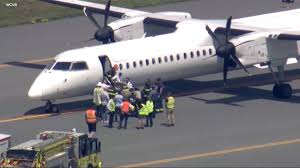
An Air Canada flight travelling from New Jersey to Canada was forced to make an emergency diversion to Boston after the captain suffered a medical emergency while the aircraft was in flight, highlighting the aviation industry’s extensive safeguards for pilot incapacitation.
The incident occurred on Wednesday aboard Flight AC7664, a regional service operated by PAL Airlines on behalf of Air Canada. The flight was en route from Newark, New Jersey, to Halifax, Nova Scotia, carrying 61 passengers, when the captain became unable to continue performing flight duties.
The aircraft landed safely at Boston Logan International Airport after the first officer took control and followed established emergency procedures.
TL;DR
- Air Canada Flight AC7664 diverted to Boston after the captain experienced a medical emergency.
- The flight was travelling from Newark, New Jersey, to Halifax, Nova Scotia.
- The aircraft was carrying 61 passengers.
- The first officer safely flew and landed the plane at Boston Logan International Airport.
- Emergency responders met the aircraft upon arrival.
- No passenger injuries were reported.
- The incident highlights aviation protocols designed to handle pilot incapacitation.
What Happened on Air Canada Flight AC7664?
According to Air Canada, the incident occurred while Flight AC7664 was travelling between Newark Liberty International Airport and Halifax Stanfield International Airport.
The flight was being operated by PAL Airlines using a De Havilland Dash 8-400 (Q400), a twin-engine turboprop aircraft commonly used on regional routes throughout North America.
During the flight, the captain experienced a medical issue that required immediate attention.
Following established airline safety procedures, the captain was removed from active flight duties, and the first officer assumed responsibility for operating the aircraft.
The flight crew then elected to divert to Boston Logan International Airport, one of the nearest major airports capable of accommodating the aircraft and providing rapid medical assistance.
The plane landed safely at approximately 1:37 p.m. local time.
How Airlines Handle a Pilot Medical Emergency
While incidents involving pilot incapacitation are rare, commercial aviation is specifically designed to manage them.
Modern airline operations rely on a two-pilot system in which both pilots are fully qualified to fly the aircraft independently.
If one pilot becomes incapacitated, the other pilot can:
- Assume sole control of the aircraft
- Coordinate with air traffic control
- Declare an emergency if necessary
- Divert to a suitable airport
- Complete the landing safely
Airline crews regularly train for such scenarios in flight simulators.
The procedures are treated as critical safety events, ensuring pilots are prepared to respond quickly even under stressful circumstances.
Why Commercial Aircraft Have Two Pilots
The incident serves as a reminder of one of aviation’s most important safety redundancies.
Commercial airlines employ two pilots not only to manage workload but also to provide immediate backup in emergencies.
Each pilot undergoes extensive certification and recurrent training that includes:
- Medical incapacitation scenarios
- Emergency diversions
- Systems failures
- Adverse weather operations
- Communication procedures with emergency services
This layered approach is one reason commercial aviation remains among the safest forms of transportation.
Passenger Accounts Describe a Tense Situation
Although the flight ultimately landed safely, some passengers described moments of uncertainty before learning what had happened.
Passenger Rodney McDonald, who was travelling with his wife and two sons, told ABC News that the aircraft appeared to move unexpectedly before the crew responded.
According to McDonald, the aircraft made several unusual movements that initially caused concern among passengers.
“The moment the plane swerved, I knew something was wrong because it was not turbulence,” he told the network.
McDonald said passengers became increasingly worried as events unfolded and that some travelers began praying.
He also described seeing a flight attendant quickly enter the cockpit before one of the pilots was later assisted into the cabin.
The airline has not publicly confirmed specific details regarding events inside the cockpit beyond stating that the captain experienced a medical emergency.
Emergency Responders Met the Aircraft in Boston
Following the diversion, emergency personnel were waiting on the ground when the aircraft arrived.
According to Massachusetts authorities:
- Massport Fire Rescue responded to the aircraft.
- Boston Emergency Medical Services provided medical assistance.
- The captain was transported for further treatment.
Massachusetts State Police told local media that authorities had been informed a crew member suffered a medical emergency while the aircraft was being flown by the co-pilot.
Air Canada has not released additional information regarding the captain’s condition, citing privacy considerations.
Why the Diversion Was the Safest Option
When a pilot experiences a medical emergency, airlines typically prioritize reaching the nearest appropriate airport rather than continuing to the original destination.
Several factors influence diversion decisions, including:
Medical Care Availability
Major airports provide immediate access to emergency medical personnel, ambulances, and hospitals.
Flight Safety
Reducing flight time minimises operational risk when one pilot must manage the aircraft alone.
Operational Support
Large airports offer extensive ground resources and maintenance support if additional inspections are required.
Boston Logan International Airport met all of those requirements and was well-positioned relative to the aircraft’s route.
How Common Are Pilot Incapacitation Events?
Pilot medical emergencies are uncommon but not unheard of.
Aviation regulators worldwide require pilots to undergo regular medical examinations designed to identify health conditions that could affect flight safety.
Despite these precautions, sudden medical events can still occur.
Industry experts note that commercial aviation’s safety systems are built around the assumption that unexpected events—including pilot illness—may happen. As a result, airlines maintain detailed procedures to ensure flights can continue safely even when a crew member becomes unable to perform their duties.
In most cases, these incidents end similarly to the Boston diversion: a safe landing, rapid medical response, and minimal disruption to passengers.
What Happened to the Passengers?
Passengers remained on board during the diversion and landing.
Air Canada confirmed that no passenger injuries were reported.
The airline said it was arranging alternative travel plans to help customers continue their journey to Halifax after the unscheduled stop in Boston.
The carrier has also stated that there were no reported mechanical or operational issues with the aircraft itself.
Why This Incident Matters
While the diversion created an unexpected disruption for travelers, it also demonstrated how aviation safety protocols function in real-world emergencies.
The successful landing underscores several key elements of modern airline safety:
- Redundant flight crew systems
- Extensive pilot training
- Well-established emergency procedures
- Coordination between airlines, airports, and emergency responders
For passengers, the event serves as a reminder that commercial aviation is designed with multiple layers of protection to address even highly unusual situations.
In this case, those safeguards worked exactly as intended, allowing the aircraft to land safely and ensuring the affected pilot received prompt medical attention.