
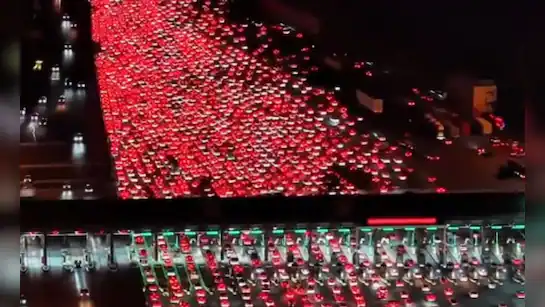
A sea of red tail lights at China’s busiest toll station
In what has become an annual travel spectacle, China’s Wuzhuang toll station in Anhui Province witnessed a massive traffic jam on October 6 as millions of travelers returned home after the country’s eight-day National Day and Mid-Autumn Festival holiday.
Viral drone footage and social media clips showed an endless line of cars stretching for miles, their red taillights illuminating the night sky. The Wuzhuang toll plaza, known as China’s largest, with 36 lanes, became a bottleneck as more than 120,000 vehicles attempted to pass through on the same day.
The congestion, captured by several drone operators, displayed vehicles merging from multiple lanes into narrow exit queues. Online users compared the sight to “a river of red light” or “a festival of cars,” with many calling it symbolic of China’s growing car culture and massive domestic mobility.
How holidays trigger record traffic in China
The National Day and Mid-Autumn Festival coincided this year, extending the break from October 1 to 8. Known as the “Golden Week,” it’s one of the most significant travel periods in China, when millions journey home or to tourist destinations.
According to the Ministry of Culture and Tourism, an estimated 888 million trips were made during this year’s holiday, up from 765 million trips last year. Such scale inevitably strains the country’s extensive but overburdened highway infrastructure.
The Wuzhuang toll jam reminded many of the Chinese New Year rush, another major travel season when highways often come to a standstill as citizens return to their hometowns.
Viral footage captures the chaos
A widely shared post by social media user @TansuYegen on X (formerly Twitter) showed cars crawling through the toll plaza with the caption:
“In China, traffic caused by people returning home after the holiday was captured.”
The footage quickly amassed millions of views, with users comparing it to scenes from dystopian films. Others joked that “you could finish an entire series before clearing the toll.”
Videos circulating on Weibo and Douyin showed drivers stepping out of vehicles, stretching, and even playing games to pass time while waiting to cross the toll gates.
China’s long history of epic traffic jams
While the recent jam was remarkable, it’s far from unprecedented in China. In 2010, the country faced what remains one of the longest traffic jams in recorded history, a 12-day gridlock stretching over 100 kilometers on the Beijing-Tibet Expressway. Thousands of drivers were stranded, some resorting to buying food from roadside vendors who hiked prices during the standstill.
Such episodes have since prompted Chinese authorities to upgrade infrastructure and improve real-time traffic management, but the combination of mass holidays and growing vehicle ownership continues to test the limits of even the world’s largest highway network.
Why this year’s jam matters
This year’s congestion highlights the dual challenge China faces, balancing economic mobility and urban planning with the rising middle class’s appetite for domestic travel. The surge in car ownership has made road travel more affordable and accessible but also more chaotic during peak holidays.
Experts say the trend may continue as domestic tourism becomes a key driver of post-pandemic economic recovery. “People prefer traveling by car now more than ever,” one transport analyst told state media, citing flexibility and safety as primary reasons.
TL;DR
China’s Wuzhuang toll station in Anhui Province saw one of the largest traffic jams in recent years as millions of vehicles returned home after the eight-day National Day and Mid-Autumn Festival holiday. Videos of the 36-lane toll plaza glowing red with tail lights went viral, echoing memories of China’s infamous 2010 gridlock. The incident underscores the growing pressure on infrastructure as domestic tourism booms.