
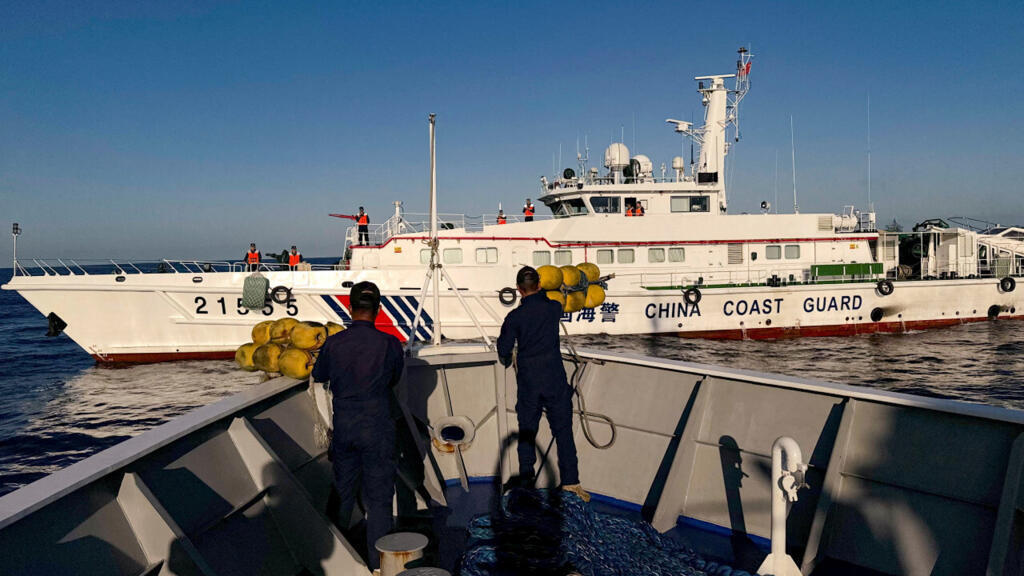
A fresh confrontation between the China Coast Guard and the Philippines has once again raised tensions in the South China Sea. On July 20, the Armed Forces of the Philippines (AFP) said a Philippine Navy sailor suffered a serious head injury after allegedly being struck with a wooden baton by China Coast Guard personnel during a confrontation near Second Thomas Shoal, also known as Ayungin Shoal.
The latest incident adds to a growing list of dangerous encounters between Chinese and Philippine vessels in disputed waters, where competing territorial claims have repeatedly brought the two countries to the brink of a broader regional crisis. While no firearms were used, the reported assault marks one of the most serious physical confrontations in recent months and underscores how quickly maritime disputes can escalate.
TL;DR
- The Philippines says a China Coast Guard officer struck a Philippine Navy sailor with a wooden baton during a mission near Second Thomas Shoal.
- The injured sailor reportedly suffered a serious head wound and was evacuated for medical treatment.
- The incident occurred during a routine Philippine rotation and resupply mission to the BRP Sierra Madre.
- China and the Philippines continue to blame each other for escalating confrontations in the South China Sea.
- The clash comes amid growing military activity, diplomatic protests, and increasing involvement from the United States and regional allies.
What happened at Second Thomas Shoal?
According to the Armed Forces of the Philippines, the confrontation unfolded near the BRP Sierra Madre, a grounded Philippine Navy vessel stationed at Second Thomas Shoal since 1999.
The AFP said a China Coast Guard rigid-hull inflatable boat (RHIB) carrying around eight personnel approached the ship, circled it, and recorded videos and photographs of the Philippine position.
The situation reportedly escalated when Chinese personnel confronted a Philippine boat participating in a routine presence-maintenance mission. During that encounter, AFP officials allege that one China Coast Guard member struck a Philippine sailor on the head with a wooden baton.
Medical personnel stationed nearby treated the sailor before he was evacuated for further care. Philippine authorities described the injury as serious.
No immediate Chinese statement addressing the specific allegation was released at the time of reporting.
Why is Second Thomas Shoal so important?
Second Thomas Shoal has become one of the most volatile flashpoints in the South China Sea.
The BRP Sierra Madre serves as a military outpost
In 1999, the Philippines intentionally grounded the aging BRP Sierra Madre on the reef to reinforce its territorial claim. Since then, a small group of Philippine Marines has continuously occupied the ship.
Keeping those troops supplied requires regular rotation and resupply missions—operations that have increasingly drawn confrontations with Chinese vessels.
For Manila, maintaining the outpost is a demonstration of sovereignty.
For Beijing, those missions represent what it considers illegal activity inside waters it claims.
Why do China and the Philippines both claim these waters?
The dispute centers on overlapping territorial claims in the South China Sea.
The Philippines argues that Second Thomas Shoal lies well within its 200-nautical-mile Exclusive Economic Zone (EEZ) under the United Nations Convention on the Law of the Sea (UNCLOS).
China, however, claims sovereignty over most of the South China Sea through its expansive historical claims, despite international legal challenges.
This disagreement has transformed what was once primarily a diplomatic dispute into a recurring series of dangerous encounters at sea.
How have China-Philippines confrontations intensified this year?
The latest incident is not an isolated event. Instead, it reflects a broader pattern of increasingly aggressive maritime encounters.
Repeated confrontations near Philippine missions
Over the past several months, Philippine officials have accused the China Coast Guard of:
- Blocking Philippine resupply missions
- Ramming or attempting to ram Philippine vessels
- Deploying water cannons
- Boarding or attempting to board Philippine boats
- Conducting close-range maneuvers
- Expanding maritime militia and coast guard patrols
China, meanwhile, has consistently accused Philippine vessels of trespassing in what it considers Chinese waters and provoking dangerous situations.
Both governments have lodged repeated diplomatic protests.
Other South China Sea flashpoints in 2026
Second Thomas Shoal is only one of several disputed areas where tensions have risen this year.
Scarborough Shoal
The Philippines protested Chinese efforts to prevent Filipino fishermen from operating near Scarborough Shoal.
In June, Manila also objected to a Chinese floating structure equipped with personnel and antenna systems, expressing concern it could represent an early stage of artificial island construction.
Although the structure was later removed, military stand-offs continued.
Sabina Shoal
Chinese coast guard deployments around Sabina Shoal have also increased, according to Philippine authorities, further expanding areas of maritime friction.
Environmental accusations
Earlier this year, Philippine officials claimed they found traces of cyanide contamination in marine samples allegedly linked to Chinese fishing activities near Second Thomas Shoal.
China dismissed the allegations, calling them fabricated.
Why the 2016 South China Sea ruling still matters
Much of today’s dispute traces back to a landmark international legal decision.
In 2016, the Permanent Court of Arbitration in The Hague ruled overwhelmingly in favor of the Philippines, concluding that China’s expansive maritime claims had no legal basis under UNCLOS.
The ruling also determined that several disputed maritime features, including areas surrounding Second Thomas Shoal, did not generate the extensive maritime rights claimed by Beijing.
China rejected the ruling immediately and continues to refuse its legal validity.
The Philippines continues to cite the decision as the foundation for its maritime rights.
How regional security is changing
The maritime dispute has become increasingly international.
In response to rising tensions, the Philippines has expanded defense cooperation with:
- The United States
- Japan
- Australia
- ASEAN security partners
Joint military exercises have increased in both frequency and scale, while China has continued conducting naval patrols and live-fire military drills in parts of the South China Sea.
Analysts increasingly describe these encounters as part of China’s broader “grey-zone strategy”—using coast guard vessels, maritime militia, and non-military assets to assert territorial claims without triggering outright armed conflict.
Could incidents like this trigger a larger conflict?
Most experts believe neither Beijing nor Manila wants a direct military confrontation.
However, repeated close encounters significantly increase the risk of miscalculation.
An injury, collision, or accidental exchange involving military personnel could quickly escalate into a diplomatic crisis—or potentially invoke security commitments involving allied countries.
Because the Philippines has a mutual defense treaty with the United States, any serious armed attack on Philippine armed forces in the Pacific carries broader strategic implications.
That makes each confrontation closely watched not only in Asia but also in Washington, Tokyo, Canberra, and other regional capitals.
What happens next?
Philippine officials are expected to continue documenting the incident and may pursue additional diplomatic protests against Beijing.
China is likely to maintain its position that it is enforcing sovereignty within waters it claims.
Absent a broader diplomatic breakthrough, experts expect routine Philippine resupply missions to continue—and with them, the possibility of further confrontations around Second Thomas Shoal.
For now, the reported injury to a Philippine sailor serves as another reminder that one of the world’s busiest waterways remains one of its most dangerous geopolitical flashpoints.